What Does "Sales Pipeline" Actually Mean?
The sales pipeline meaning is straightforward: it's a visual representation of every active deal your sales team is working, organized by stage — from first contact to closed won (and beyond).
Here's the quick version:
A sales pipeline is a structured, stage-by-stage system that tracks where each prospect is in your sales process, so your team knows exactly what action to take next — and so leadership can forecast revenue with confidence.
| Element | What It Means |
|---|---|
| What it tracks | Active deals and the actions reps take to move them forward |
| Who uses it | Sales reps, sales managers, RevOps, and finance teams |
| Main benefit | Visibility into deal status, revenue forecasts, and bottlenecks |
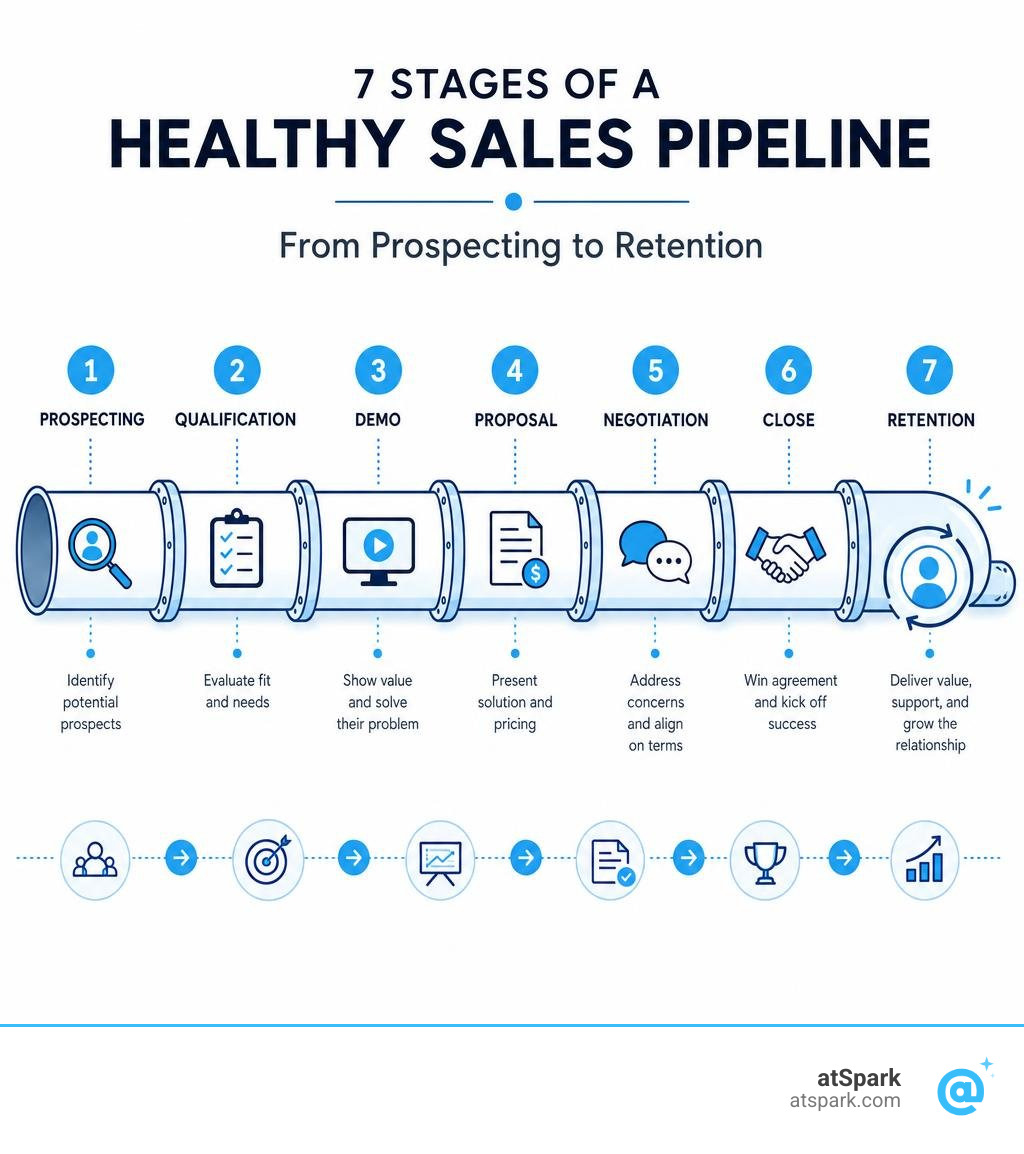
| Common stages | Prospecting to Qualification to Demo to Proposal to Negotiation to Close to Retention |
| Key tool | CRM (e.g., Salesforce, HubSpot, Pipedrive) |
If you're a finance or RevOps lead at a SaaS company, the pipeline isn't just a sales tool — it's your earliest signal on revenue risk, quota gaps, and where deals are stalling.
Think of it this way: focusing only on closed deals is like a marathon runner trying to take a shortcut. You might get ahead briefly, but you won't finish the race. The pipeline is everything that happens between first contact and closed revenue — and managing it well is what separates predictable growth from constant surprises.
This guide breaks down exactly what a sales pipeline is, how it works, how to build and manage one, and which metrics actually matter for SaaS teams who need real answers without waiting on a data pull.
Demystifying the Sales Pipeline Meaning and How It Works
To understand the sales pipeline meaning, it helps to look at the linguistic roots of the word. According to the Definition of 'pipeline', a pipeline is literally a system of pipes used to transport materials (like oil or water) over long distances. Metaphorically, however, it refers to a "route, channel, or process along which something passes or is provided at a steady rate."
In business, we use this metaphor to describe the flow of prospective customers. The PIPELINE | English meaning - Cambridge Dictionary defines something "in the pipeline" as a plan, product, or deal that is currently being discussed or prepared for the future.
When we apply this to sales, a sales pipeline is a visual map plotting the exact waypoints a prospect crosses as they make purchase decisions. It is the operational engine that translates raw interest into predictable revenue.
For For Finance Teams and For RevOps, the pipeline is the foundation of the sales forecast. Without a structured pipeline, projecting future cash flow or Annual Recurring Revenue (ARR) is little more than guesswork. By tracking every deal as it moves through sequential gates, you gain a realistic view of what will close, when it will close, and how much it will be worth.

Sales Pipeline vs. Sales Funnel: The Key Differences
It is incredibly common to hear "sales pipeline" and "sales funnel" used interchangeably. However, confusing the two can lead to massive misalignments between your sales, marketing, and finance teams.
As outlined in What is a Sales Pipeline? | Salesforce, the core distinction lies in perspective:
- A sales pipeline represents the seller's view of active deals. It focuses on the specific, concrete actions sales reps must take to move an opportunity from one stage to the next.
- A sales funnel represents the buyer's journey from awareness to purchase. It focuses on the volume of leads, conversion rates, and the drop-off of prospects as they filter down to become customers.
Think of the pipeline as a horizontal track showing what your reps are doing, and the funnel as a vertical mesh showing how many buyers are converting.
| Metric | Sales Pipeline | Sales Funnel |
|---|---|---|
| Primary Focus | Deals, sales activities, and stage-by-stage progression | Leads, buyer psychology, and conversion volume |
| Visual Shape | Horizontal stages (often balanced or block-based) | Vertical, wide at the top and narrow at the bottom |
| Operational Goal | Move deals forward via structured exit criteria | Maximize conversions and analyze where leads drop off |
| Key Questions | "What action does this deal need to progress?" | "Where are we losing the most prospects in their journey?" |
The 7 Critical Stages of a Modern Sales Pipeline
A healthy sales cycle is built on a standardized set of milestones. While transactional businesses might skip certain steps, high-growth B2B and SaaS companies rely on a structured, multi-stage pipeline to maintain consistency.
According to What is a sales pipeline? | Definition from TechTarget, each deal stage must have explicitly defined "exit criteria." A deal shouldn't move forward just because a sales rep "feels good" about it; it must cross a measurable threshold.
Understanding the Sales Pipeline Meaning in Prospecting and Qualification
Every pipeline begins with prospecting—the systematic search for potential buyers. In 2026, prospecting is highly targeted, leveraging data to identify organizations that match your Ideal Customer Profile (ICP).
Once a prospect is identified, they enter the lead qualification stage. This is where you determine if the lead is worth your team's valuable time. Many teams use automated lead scoring, assigning points based on demographic fit and behavioral signals.
A critical rule of thumb here is the Pareto Principle: approximately 20% of your leads are going to provide 80% of your revenue. This means aggressive qualification is your best friend. If a lead doesn't have the budget, authority, or need, they should be disqualified early to keep your pipeline clean.
The Middle Stages: Meetings, Proposals, and Negotiations
Once qualified, the deal moves to active engagement:
- The Sales Call or Demo: This is where you dig deep into the prospect's pain points. In SaaS, a tailored product demo shows the buyer exactly how your software solves their specific operational headaches.
- The Proposal: After establishing value, the rep delivers a tailored proposal. Rather than a generic template, this should explicitly map your solution to their ROI expectations.
- Negotiation and Commitment: This is where terms, pricing, and integrations are finalized. To keep deals from stalling here, modern sales teams use e-signature integrations to make contract signing as painless and frictionless as possible.
Closing and Retention: The Post-Purchase Sales Pipeline Meaning
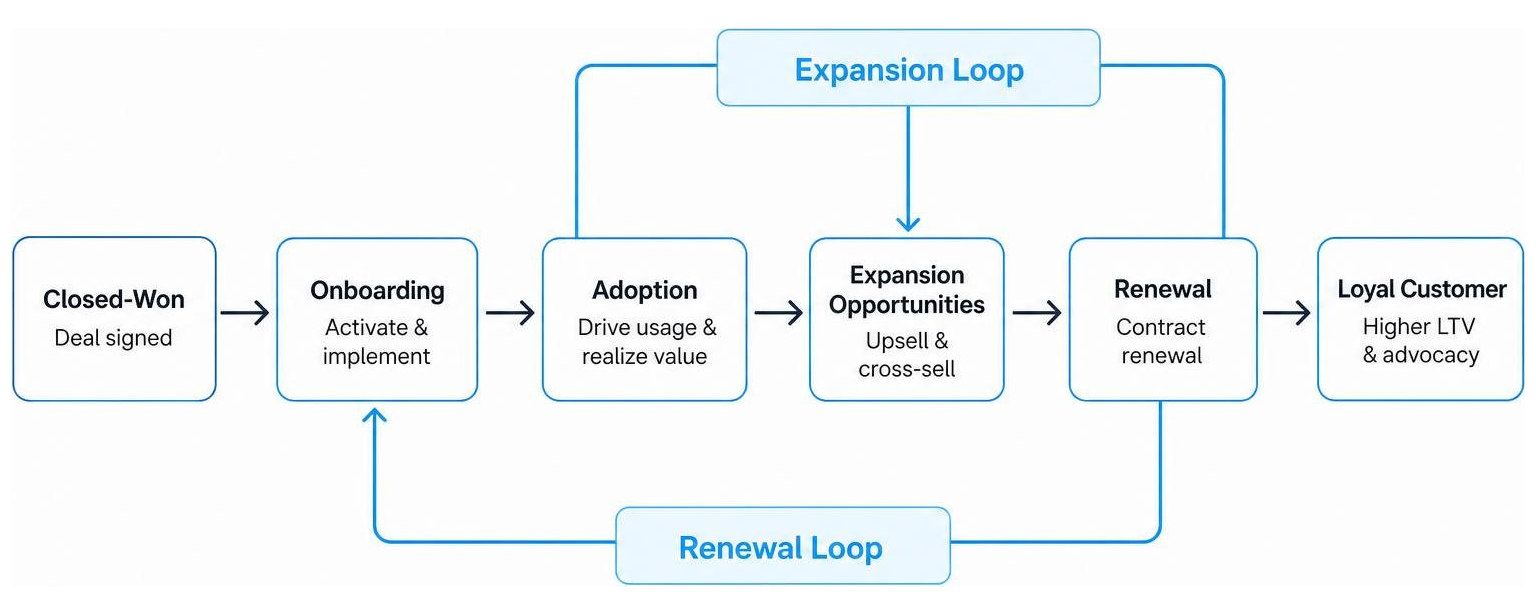
The pipeline does not end when the contract is signed and you pop the bubbly. In SaaS, the post-purchase experience is an active pipeline stage.
Once a deal is marked "Closed-Won," they transition to onboarding and retention. Tracking SaaS Customer Retention Metrics is vital because your initial customer acquisition cost (CAC) is rarely recovered on day one.
A structured post-purchase pipeline identifies opportunities for:
- Upselling: Upgrading the customer to a higher tier as their usage grows.
- Cross-selling: Introducing complementary modules or services.
By treating retention and expansion as formal pipeline stages, you directly boost customer lifetime value (LTV) and create a predictable engine for Net Revenue Retention (NRR).
How to Build, Manage, and Measure a Healthy Sales Pipeline
Building a pipeline requires mapping your internal sales activities to the buyer's milestones. According to Sales Pipeline Management: Best Tools & Complete Guide | Salesforce UK, a pipeline fails when deal stages are vague, data is outdated, or reps do not follow a standardized process.
To manage your pipeline effectively:
- Standardize Data Entry: Every rep must log interactions, update deal values, and adjust close dates uniformly.
- Leverage CRM Automation: Use tools to automatically log emails, set task reminders, and score leads.
- Use Activity Reports: Sales managers should review Weekly Sales Activity Reports Made Simple With Free Templates to ensure reps are consistently performing the inputs (calls, emails, demos) required to produce the outputs (closed deals).
Identifying and Fixing Pipeline Bottlenecks
A healthy pipeline is like a free-flowing river. If there is an issue upstream—such as poor lead qualification—it will inevitably cause a dry spell downstream (fewer closed deals).
To find where your river is blocked, conduct regular pipeline reviews and a thorough win-loss analysis. If you notice that 60% of your deals stall at the proposal stage, it's a clear signal that your pricing is too complex, your proposals aren't conveying ROI, or your reps are pitching to non-decision makers.
Key Metrics to Track for Pipeline Health
To measure the efficacy of your pipeline, you must track more than just total closed revenue. You need real-time visibility into operational health. Ensure your team is monitoring:
- sales velocity: How fast deals move through your pipeline from first contact to close.
- win rate: The percentage of total opportunities that convert to closed-won.
- average deal size: The average contract value of your won deals.
- sales cycle length: The average number of days it takes to close a deal.
- deal age: How long an active deal has lingered in a specific stage compared to your average cycle length.
For a deeper dive into these indicators, check out our guide on SaaS Pipeline Metrics That Actually Matter for Growth.
Frequently Asked Questions About Sales Pipelines
Why do forecasted deals fail to close?
It is a painful reality of sales: approximately 24% of forecasted deals go dark or slip past their estimated close date. This is known as deal slippage.
Deals often fail to close because of poor qualification, champions losing internal budget, or reps failing to address integration hurdles early. To combat this, teams must assign a realistic deal win probability to each stage and over-provision their pipeline to ensure they have enough backup opportunities to hit their targets.
What is pipeline coverage and why does it matter?
pipeline coverage measures the total value of active deals in your pipeline relative to your revenue target. For example, if your quarterly quota is $1M and you have $3M in active pipeline, you have a 3x pipeline coverage ratio.
Maintaining healthy coverage is essential for consistent quota attainment. To learn how to structure your forecasting models around coverage, read The Ultimate Guide to Weighted Pipeline Sales Forecasting and Analytics.
How do you calculate a weighted pipeline?
A weighted pipeline calculates the expected value of your pipeline by multiplying each deal's value by the win probability of its current stage.
For example:
- A $50,000 deal in the Demo stage (30% win probability) is worth $15,000 in weighted pipeline.
- A $100,000 deal in the Negotiation stage (80% win probability) is worth $80,000 in weighted pipeline.
Summing these weighted values across your entire pipeline gives you a highly accurate, probability-based revenue projection. To see how this metric helps protect your business runway, explore our breakdown of the Weighted Pipeline Growth Rate: The Secret to Predictable ARR.
Conclusion
Understanding the sales pipeline meaning is the first step toward building a predictable, scalable business. But tracking it shouldn't require your finance or RevOps teams to spend hours writing complex SQL queries, cleaning messy spreadsheets, or struggling to connect CRM data with billing systems.
That is where atSpark comes in.
atSpark is an AI-powered analytics platform built specifically for SaaS companies. By unifying your billing, CRM, and subscription data into a single source of truth, we allow you to ask plain-English questions—like "What is our weighted pipeline for Q3?" or "Which deals have a deal age over 45 days?"—and get instant charts, tables, and insights.
No SQL, no engineering backlog, just clear, governed analytics when you need them.
Ready to take control of your pipeline metrics? Explore our sales pipeline glossary or learn how atSpark can supercharge your revenue forecasting today.