Why Most Bakeries Fly Blind on Revenue (And How to Fix It)
A solid sales forecast for a bakery business is the difference between running a profitable shop and constantly scrambling to cover costs.
Here's a quick answer if you need it fast:
How to forecast bakery sales — the short version:
- Break products into broad categories (cakes, bread, pastries, cookies, drinks)
- Pull 24 months of historical sales data and plot it on a simple line chart
- Project unit sales and prices in a spreadsheet, then multiply for total revenue
- Build monthly forecasts and extend to a 3-5 year view
- Review and adjust every month based on actual vs. expected variance
That's the core of it. The rest is refinement.
Now, here's why it matters more than most bakery owners realize.
No forecast is ever 100% accurate — that's a given. But bakeries that skip forecasting entirely tend to face the same painful problems: surprise cash shortfalls, over-ordering ingredients, understaffed weekends, and under-staffed holidays.
Consider this: a small retail bakery (800-1,500 sq ft) typically generates $200,000 to $500,000 in its first year. But ingredient costs alone run 25-35% of revenue, labor adds another 30-40%, and waste can eat 5-10% of production. That leaves a net margin of just 5-15% — a razor-thin number that punishes guesswork.
A forecast doesn't eliminate uncertainty. It just stops uncertainty from catching you off guard.
Why a Sales Forecast for a Bakery Business is Your Recipe for Success
When you run a bakery, you are dealing with highly perishable inventory, fluctuating ingredient prices, and intense seasonal demand. A sales forecast for a bakery business serves as your operational command center. It directly impacts four critical areas of your daily operations:
- Cash Flow Management: You cannot pay your flour suppliers or rent with "expected" sales. A reliable forecast tells you when cash will flow into your bank account and when you need to tighten your belt.
- Cost Control: Flour, butter, and sugar prices fluctuate. By forecasting your sales, you can lock in bulk ingredient purchases at the right time, keeping your food costs within the healthy 25-35% range.
- HR and Staffing Planning: There is nothing worse than being understaffed on a Saturday morning when the line is wrapped around the block—except, perhaps, paying three bakers to stand around on a slow Tuesday. Accurate forecasting helps you schedule labor (which consumes 30-40% of your revenue) with precision.
- Pricing Strategy: If you know your seasonal demand is about to dip, you can adjust your retail pricing or introduce high-margin specials to keep revenue steady.
To understand how these pieces fit together financially, it helps to look at established benchmarks. According to the Bakery Economics & Benchmarks — Revenue, Margins & Valuation | BizMetricsHQ, independent bakeries typically generate a median annual revenue of $450,000, with a healthy range spanning from $280,000 to $750,000.
Understanding Bakery Industry Benchmarks and Margins
To build an accurate projection, we must understand standard bakery cost structures. While gross margins on individual baked items look incredibly high on paper—often 65-75%—the actual net profit margins tell a different story.
Let's break down where the money goes in a typical retail bakery:
- Ingredients (COGS): 25% to 32% of total revenue.
- Labor: 28% to 36% of total revenue.
- Rent and Occupancy: 8% to 12% of total revenue.
- Packaging: 3% to 5% of total revenue.
- Waste / Stales: 5% to 10% of production.
After subtracting these operating costs, the median net profit margin for a healthy retail bakery sits around 12%, with top-performing shops reaching 15% to 18%.
According to the State of the Industry: Retail Bakeries in the U.S. (19th Edition), consumer preferences heavily dictate these margins. For instance, specialty items like custom cakes and gluten-free pastries carry gross margins closer to 70-80%, whereas daily artisanal sandwich breads operate on lower margins but drive consistent, high-volume foot traffic.
The Step-by-Step Framework for Bakery Forecasting
You do not need a degree in statistics to build a highly functional sales forecast. In fact, overcomplicating your forecasting models with advanced mathematics often leads to "analysis paralysis." Instead, we advocate for a visual, common-sense approach built on simple spreadsheets and historical visual trends.
Step-by-Step: Building Your First Sales Forecast for a Bakery Business
1. Group Your Products into Broad Categories
Do not try to forecast sales for individual flavors of cupcakes or specific types of sourdough loaves. That is a fast track to burnout. Instead, group your menu into 5 to 7 broad categories:
- Artisanal Breads
- Daily Pastries (Croissants, Muffins, Danishes)
- Custom Cakes & Event Orders
- Cookies & Sweet Treats
- Beverages (Coffee, Tea, Specialty Drinks)
2. Gather Your Historical Sales Data
Pull your last 24 months of sales data from your Point of Sale (POS) system. If you are a brand-new bakery, you will have to rely on local market research and conservative foot traffic estimates.
3. Plot Your Data on a Simple Line Chart
Visual tracking is incredibly powerful. By plotting your past two years of monthly sales on a line chart, you will instantly spot recurring trends. You will see your holiday spikes in November and December, and your summer slumps in July and August. Extend these lines forward visually to map out your baseline expectations for the next 12 to 24 months.
In financial terms, this baseline represents your standard Sales Forecast Glossary, which acts as your primary road map for the coming fiscal year.
Projecting Unit Sales and Pricing with Simple Tools
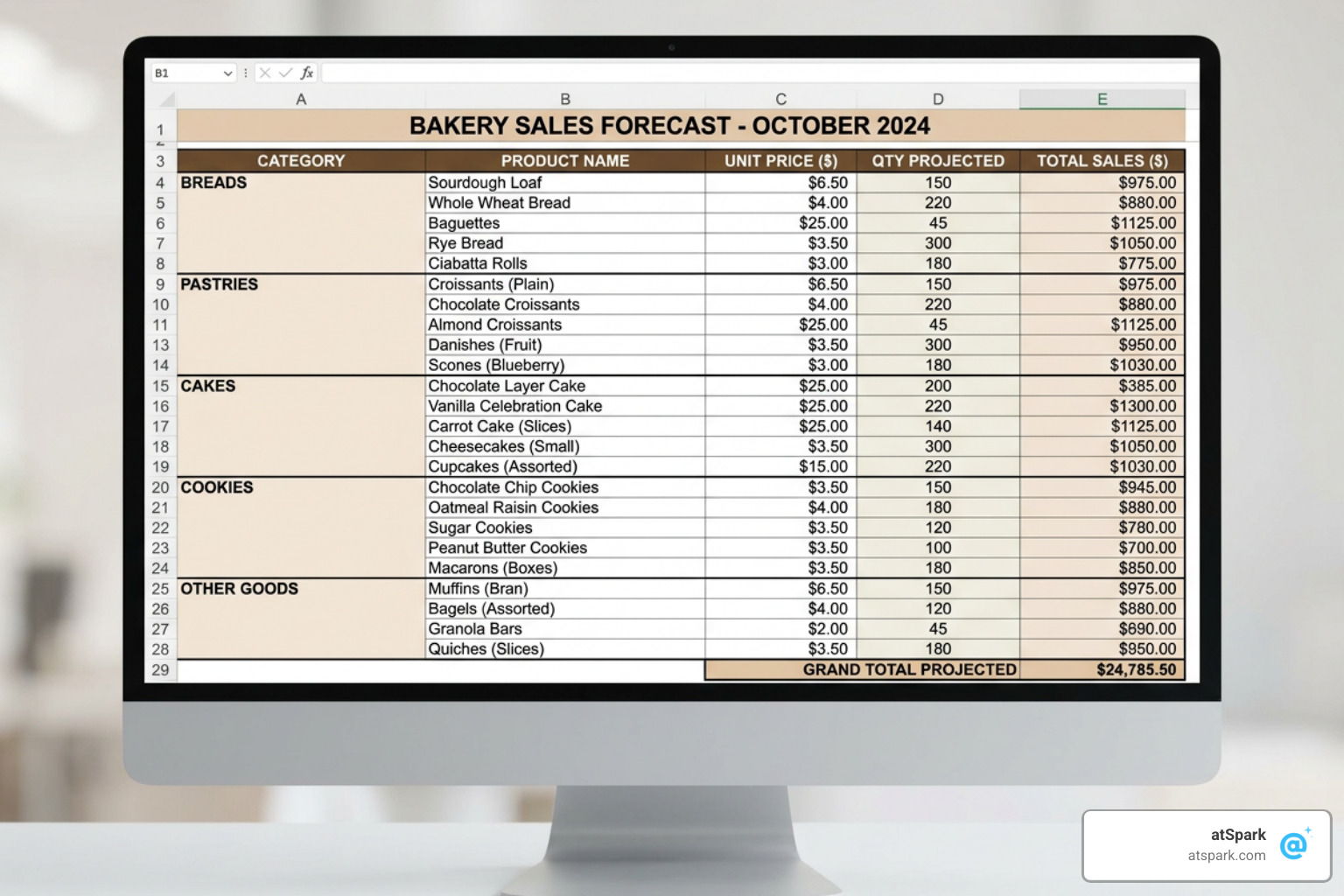
Once you have your broad product categories and historical trends, it is time to build your calculation engine. You can easily do this in Microsoft Excel or Google Sheets.
We recommend setting up your forecasting spreadsheet in three distinct blocks:
- The Unit Volume Block: Estimate how many units you expect to sell per day or week in each category (e.g., 150 croissants per day).
- The Pricing Block: List the average retail price for items in that category (e.g., $4.50 per croissant).
- The Revenue Block: Program your spreadsheet to multiply the units by the price to calculate your total projected sales.
Using a structured tool like the Bakery Financial Projections Generator - PlanArmory - PlanArmory can help automate this math. It ensures your pricing changes dynamically flow through to your total revenue projections, allowing you to run quick "what-if" scenarios when butter prices spike or when you decide to raise your pastry prices by 5%.
Overcoming Common Bakery Forecasting Challenges
Bakery forecasting is unique because your products have an incredibly short shelf life. If a retail clothing store over-forecasts demand for a winter jacket, they can discount it in the spring. If a bakery over-forecasts demand for croissants, those croissants go directly into the trash bin at 6:00 PM.
Common Pitfalls That Can Ruin a Sales Forecast for a Bakery Business
Many bakeries see their financial projections fall flat because they overlook operational realities. Here are the three most common mistakes:
- Ignoring Returns and Stales: If you bake 100 baguettes but only sell 90, your POS system registers 90 sales. If you forecast based purely on those 90 sales without accounting for the 10 wasted baguettes, you are ignoring a vital demand signal. Your forecast must track "Revenue vs. Returns" to calculate your true production needs.
- Disconnecting Price and Volume: Raising your prices by 15% will likely cause a slight dip in unit volume. If your sales forecast assumes you will sell the exact same volume at the higher price point, your revenue projections will be artificially inflated.
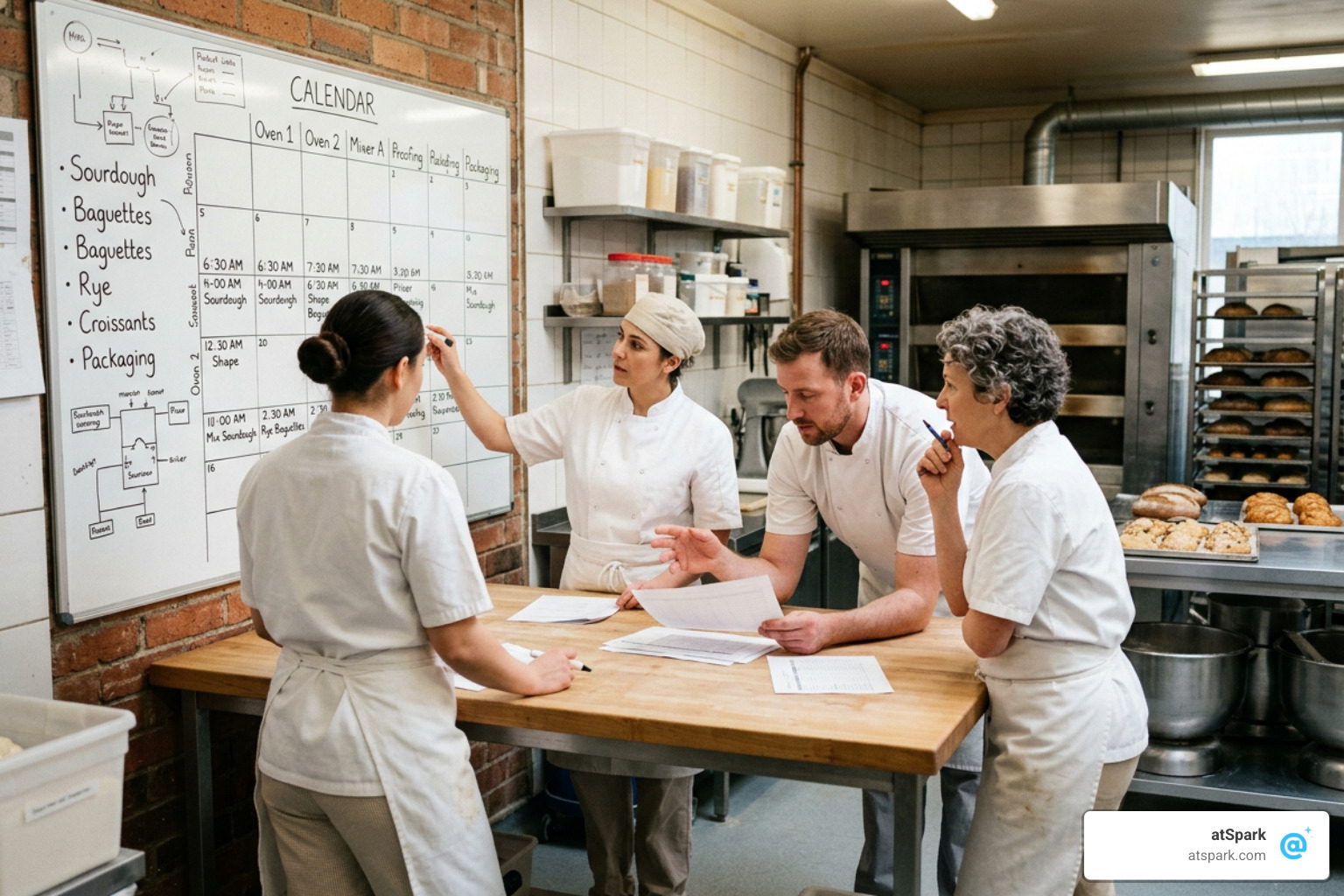
- Operating in a Silo: A sales forecast that lives on an owner's laptop and never reaches the lead baker is useless. Your sales forecast must directly dictate your daily production plan.
In many retail bakeries, the customer journey functions like a classic retail Sales Funnel Glossary. Passersby turn into foot traffic, foot traffic converts into paying customers, and some of those customers become high-value catering or custom cake clients. If you run a wholesale bakery, your sales process behaves more like a commercial Sales Pipeline Glossary, where you track active leads, sample deliveries, and contract negotiations with local cafes.
Fresh vs. Long-Shelf-Life: The Cost of Getting It Wrong
The cost of forecasting errors depends heavily on what you are baking:
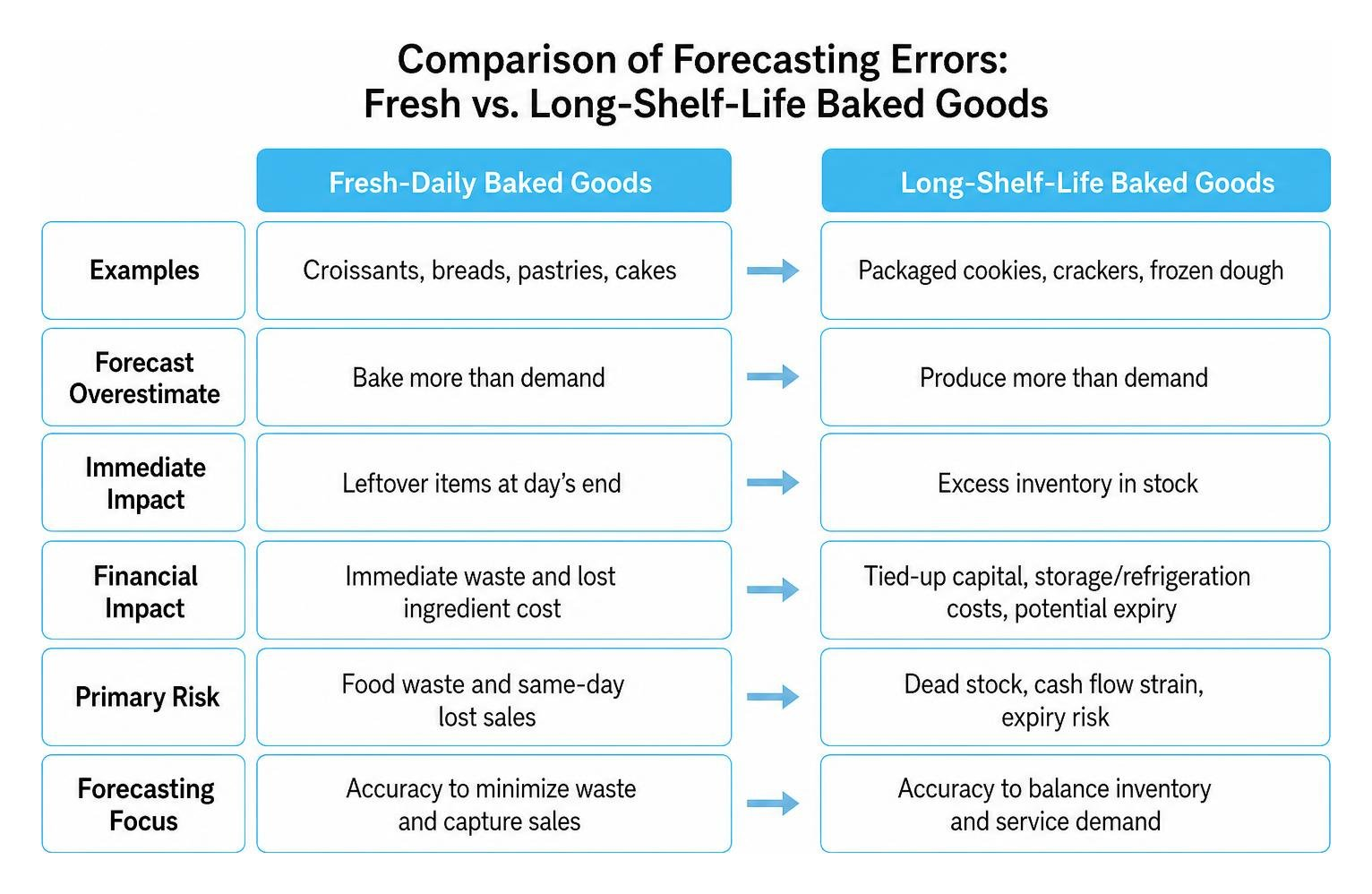
For a fresh-daily bakery, overproducing means immediate waste and lost ingredient capital. For long-shelf-life manufacturers (like packaged cookie brands or frozen dough suppliers), overproducing leads to dead stock that ties up warehouse space, incurs refrigeration costs, and risks expiring before it can be shipped.
Connecting Your Forecast to Production and Technology
To stop losing revenue, you must connect the "sell" side of your bakery to the "make" side. In modern bakery operations, specialized Enterprise Resource Planning (ERP) software like FlexiBake plays a massive role in automating this connection.
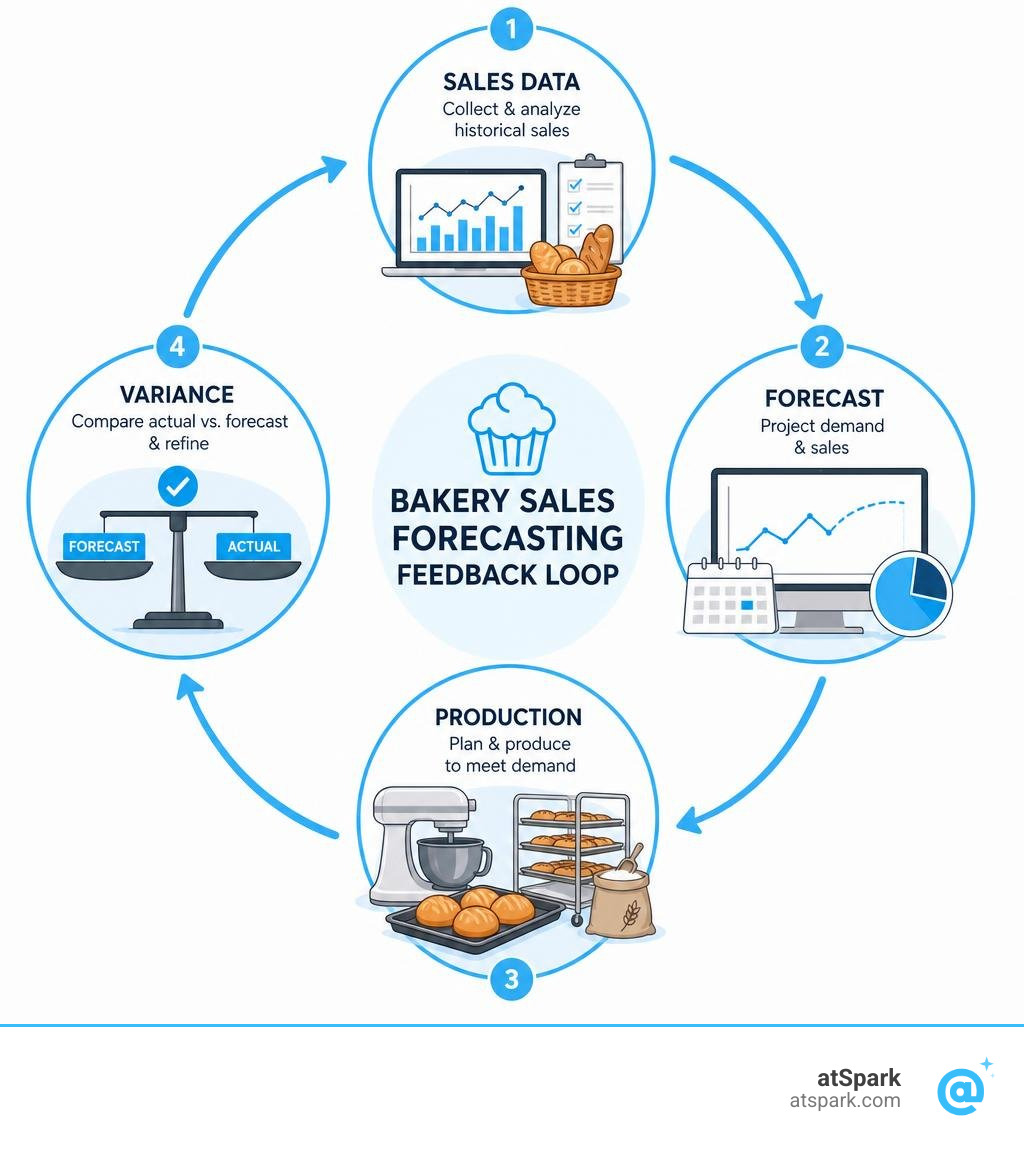
When your sales forecast is integrated with your back-of-house technology, a 5-step loop occurs:
- Capture the Sales Signal: The system pulls historical POS data, standing wholesale orders, and active custom event contracts.
- Validate Against Inventory: The software checks your current physical inventory of flour, sugar, yeast, and packaging.
- Trigger Purchasing: If the forecast requires 500 lbs of butter next week but you only have 200 lbs in house, the system automatically drafts a purchase order for the remaining 300 lbs.
- Translate to Production Plans: The system converts the forecasted sales into a daily bake sheet, detailing exactly how many batches of dough need to be mixed and when.
- Feed Variance Back into the Loop: At the end of the week, the system compares actual sales to the forecast, adjusting the next week's production pars to minimize waste.
Integrating Multiple Data Sets for Maximum Flexibility
For wholesale bakeries, managing future revenue requires tracking recurring business. This is where a Weighted Pipeline Glossary becomes incredibly useful. By assigning a probability percentage to potential new cafe accounts (e.g., a 50% chance of closing a $500/week account), you can project future ingredient and labor needs without over-committing your kitchen resources.
To ensure your bakery has enough upcoming business to cover its fixed overhead, you should also monitor your Pipeline Coverage Glossary. This metric helps you determine if you have enough active leads in your wholesale pipeline to hit your long-term growth targets.
Financial Projections for Your Bakery Business Plan
If you are seeking an SBA loan or looking for outside investors, the financial section of your bakery business plan must be airtight. Lenders want to see that you understand your startup costs, your break-even metrics, and your physical production limits.
Let's look at the financial realities of retail vs. wholesale bakery models:
| Financial Metric | Retail Bakery (800 - 1,500 sq ft) | Wholesale Bakery (Commercial Space) |
|---|---|---|
| Year 1 Target Revenue | $200,000 - $500,000 | $400,000 - $700,000 |
| Year 3 Target Revenue | $350,000 - $600,000 | $600,000 - $1,000,000+ |
| Average Gross Margin | 65% - 75% | 40% - 55% |
| Average Order Value | $12 - $35 | $200 - $800 (per week, per account) |
| Daily Customer Count | 40 - 120 customers | 15 - 50 wholesale accounts |
| Typical Startup Costs | $10,000 (home-based) to $200,000+ | $150,000 - $350,000+ |
Modeling Retail vs. Wholesale Revenue Streams
Many modern bakeries operate on a hybrid model: a retail storefront to capture high-margin walk-in traffic, paired with wholesale accounts to provide steady, predictable weekly volume.
When modeling these streams, you must account for your physical capacity constraints. Your revenue growth is not infinite; it is capped by your equipment.
For example, a standard commercial deck oven can produce roughly 200 to 400 loaves or 600 to 1,200 pastries per day, running 2 to 4 batches daily. If your sales forecast projects selling 2,000 pastries a day by Year 2, your financial model must include the capital expenditure (CapEx) to purchase a second commercial oven (which typically costs between $8,000 and $25,000).
To map out these long-term scenarios, we highly recommend using structured templates like the Specialty Donut Shop Template: 4 Mo Breakeven, 17 Mo Payback or the industry-standard Baked Goods Stores - 2025 U.S. Market Research Report with Updated Tariff & Recession Risk Analysis and Forecasts to ground your assumptions in real-world retail data.
Frequently Asked Questions about Bakery Sales Forecasting
How often should a bakery review and adjust its sales forecast?
We recommend a formal review once a month. Set aside a dedicated two-hour window to compare your actual POS sales against your projected forecast. Look for areas of "divergence" (where actual sales missed or exceeded the forecast by more than 10%). Adjust your ingredients, labor schedules, and pricing strategies for the upcoming month based on these real-world findings.
What are the most profitable items to sell in a bakery?
Custom cakes (especially for weddings and large events) and specialty gourmet cupcakes carry the highest profit margins, often yielding 70% to 80% gross margins because you are charging for artistry and specialized labor rather than just flour and sugar. Specialty espresso beverages and coffee drinks also offer fantastic margins, typically contributing 14% to 20% to a bakery's bottom line.
Do I need complex statistical software to forecast bakery sales?
No. While specialized ERP software is incredibly helpful for larger wholesale operations, a simple spreadsheet combined with human common sense is more than enough for a retail bakery. If you want a structured, investor-ready model without building it from scratch, templates like the Bakery Financial Model Suite – 10-Year Forecast, Valuation & Feasibility - Eloquens provide a great balance of simplicity and depth.
Conclusion
At the end of the day, a sales forecast for a bakery business is not about predicting the future with perfect accuracy. It is about building a flexible, resilient operational framework that keeps your kitchen efficient, your staff happy, and your business profitable.
At atSpark, we believe that business data should be easy to understand and act upon. While we specialize in helping modern companies unify their complex billing, CRM, and subscription data through simple, conversational analytics, the core philosophy remains the same: keep your numbers simple, visual, and connected to your daily operations.
By setting aside time every month to review your Sales Forecast Glossary, you will keep your costs controlled, your waste minimized, and your bakery growing year after year. Now, let's get baking!