Why Measuring Customer Loyalty Program Impact Is Harder Than It Looks
Understanding the customer loyalty program impact on your business sounds straightforward — but most companies are measuring it wrong.
Here's the quick answer if you're short on time:
Customer loyalty programs, when measured correctly, deliver strong returns:
| Metric | What the Data Shows |
|---|---|
| Average program ROI | 5.3x reported return (Antavo, 2026) |
| Annual revenue lift | 12-18% more revenue from members vs. non-members |
| Retention profit boost | 5% retention improvement = 25-95% profit increase |
| CLV impact | Emotionally connected customers deliver up to 306% higher lifetime value |
| Engagement gap | Average consumer joins 17.4 programs but actively uses only 8.8 |
The problem isn't whether loyalty programs work. It's whether yours is actually being measured in a way that shows the truth.
Most loyalty dashboards show you vanity metrics: total members enrolled, points issued, redemption counts. These numbers look good in a slide deck. They rarely tell you whether the program is actually changing customer behavior — or just rewarding customers who would have bought anyway.
There's a deeper issue too. Loyalty program participation is at an all-time high. Yet genuine brand devotion is near historic lows. True loyalty — defined as deep brand preference that holds even when a competitor offers a lower price — fell to just 29% of US consumers in 2025, down five points from the year before.
That's the paradox Finance and RevOps leaders need to understand before investing another dollar in rewards infrastructure.
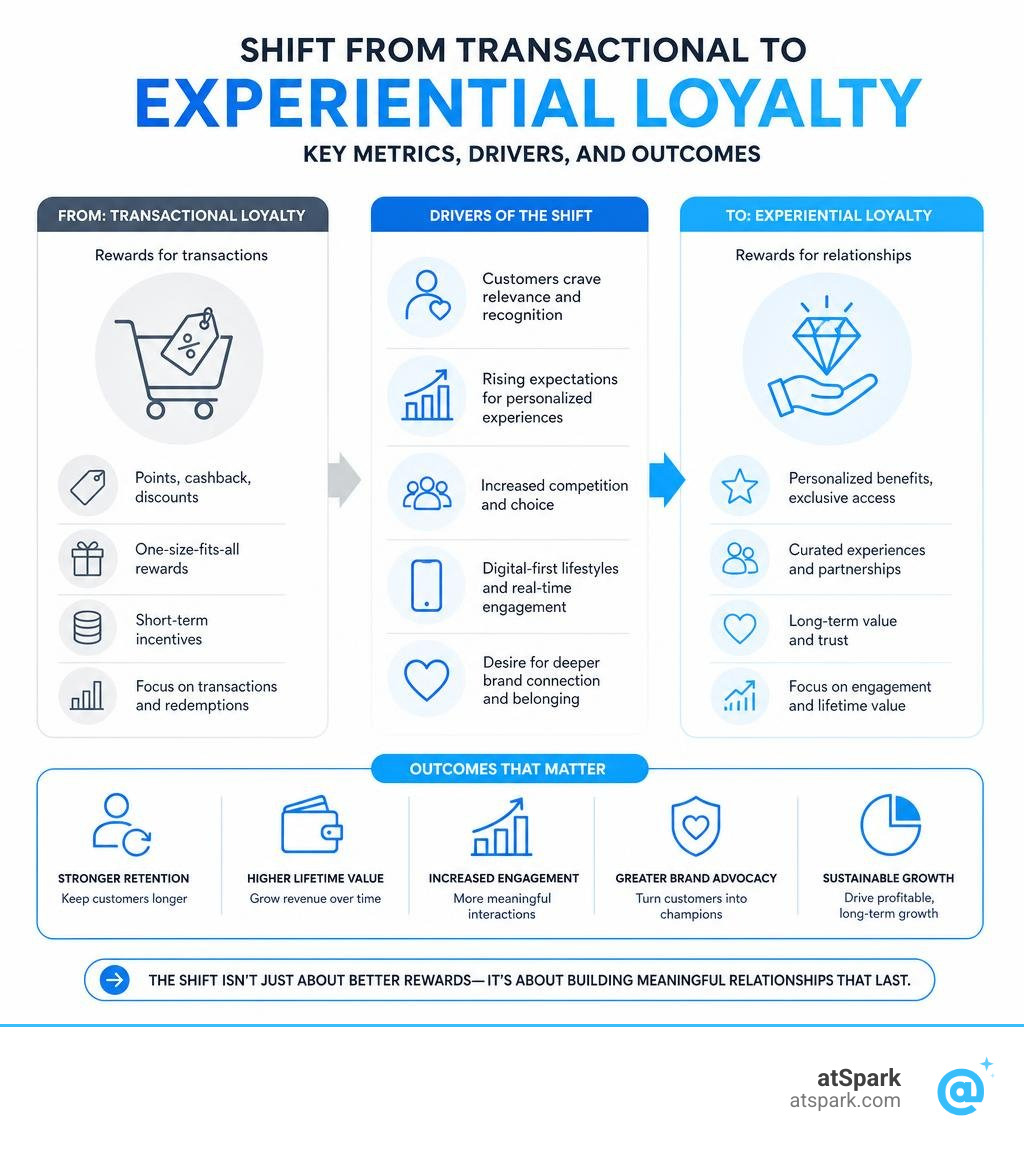
The shift happening right now is from transactional loyalty (points, cashback, discounts) to experiential and identity-driven loyalty (personalized benefits, exclusive access, relevant partnerships). Companies that haven't made that shift are seeing engagement erode even as their membership numbers grow.
This guide walks through how to measure loyalty program impact with rigor — and how to design programs that actually move the metrics that matter to the business.
The Paradox of Saturation: Assessing Customer Loyalty Program Impact in 2026
We live in a world of hyper-saturation. As of July 2026, the average US consumer belongs to more than 15 loyalty programs — representing a 10% increase since 2022. On paper, it looks like a golden age of retention. But the reality under the hood is far more fragile.
While signups are climbing, actual engagement among US consumers has dropped by 10% since 2022, and brand loyalty has plummeted by 20%. More than 35% of consumers plan to cancel several of their current memberships in the coming year. For the younger demographic (ages 18 to 34), that cancellation intent spikes to over 50%.
Furthermore, consumers are 5% to 10% more inclined to switch to a competitor's program within the same industry compared to just two years ago. This widespread "brand promiscuity" means that simply having a program is no longer a defensive moat.

To understand the real customer loyalty program impact, we must look beyond superficial signup rates. Industry leaders are widening the gap: customer engagement for retail loyalty leaders is 4.3 times higher than for laggards.
When evaluating these programs, we must ask if the rewards are genuinely changing consumer behavior. In a landmark study on how incentives affect customer value, researchers at Bain & Company evaluated how rewards build valuable customers. According to the Beyond Sales Lift: How Rewards Build Valuable Customers | Bain & Company report, companies must look past short-term campaign lifts to measure cumulative behavior over time.
Similarly, the Customer Loyalty Statistics 2026: Program ROI Data report highlights that while the average reported program ROI hovers around 5.3x, 91% of program owners struggle with basic data integration and analysis.
The Enrollment-Engagement Gap and Declining Brand Devotion
This disconnect is what we call the enrollment-engagement gap. Consumers sign up for programs at checkout to get an immediate discount, but then the card sits unused in a digital wallet or kitchen drawer.
If your marketing team celebrates a 20% increase in program signups while your overall customer churn rate remains unchanged, you aren't building loyalty — you are simply discounting your margins.
To combat this, we need to understand how to stop your saas customers from slipping away by tracking active usage rather than cumulative signups. Inactive loyalty members represent a hidden liability: they hold unredeemed points (a massive $10 billion problem in the US alone) but have zero emotional connection to your brand.
Mature vs. Emerging Markets: Comparing US and European Customer Loyalty Program Impact
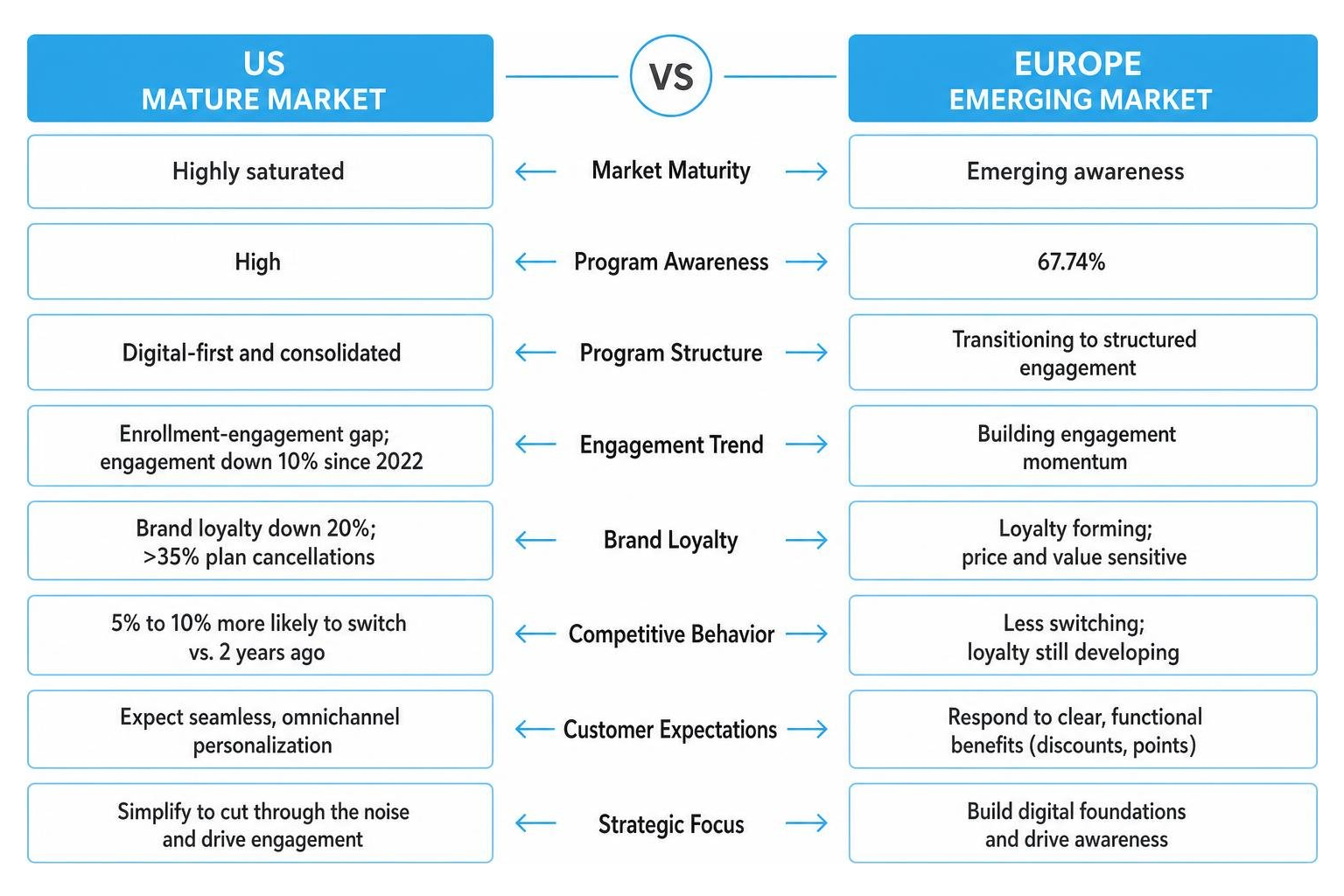
The dynamics of loyalty programs shift dramatically depending on geographic maturity. In highly mature markets like the US, programs are highly consolidated and digital-first. In contrast, emerging markets present a different set of opportunities and challenges.
Take the Albanian retail sector as an example. An empirical study on supermarket loyalty programs in Albania revealed that 67.74% of respondents were aware of loyalty programs. While this awareness is high, the market is still transitioning from basic transactional benefits to structured engagement.
In emerging European markets, consumers respond incredibly well to clear, functional benefits like direct discounts and point accumulation. However, non-monetary or experiential rewards do not yet show the same statistical correlation with brand loyalty as they do in mature markets.
According to The Loyalty Premium study, mature market consumers expect seamless, omnichannel personalization. Emerging market companies can learn to build their digital foundations early, while mature market brands must simplify their programs to cut through the noise.
Designing a Holistic Value Proposition: Integrating Pricing, Personalization, and Partnerships
To drive true customer loyalty program impact, organizations must move away from isolated marketing campaigns and create a unified value proposition. This means integrating your loyalty programs directly with your pricing and personalization engines.
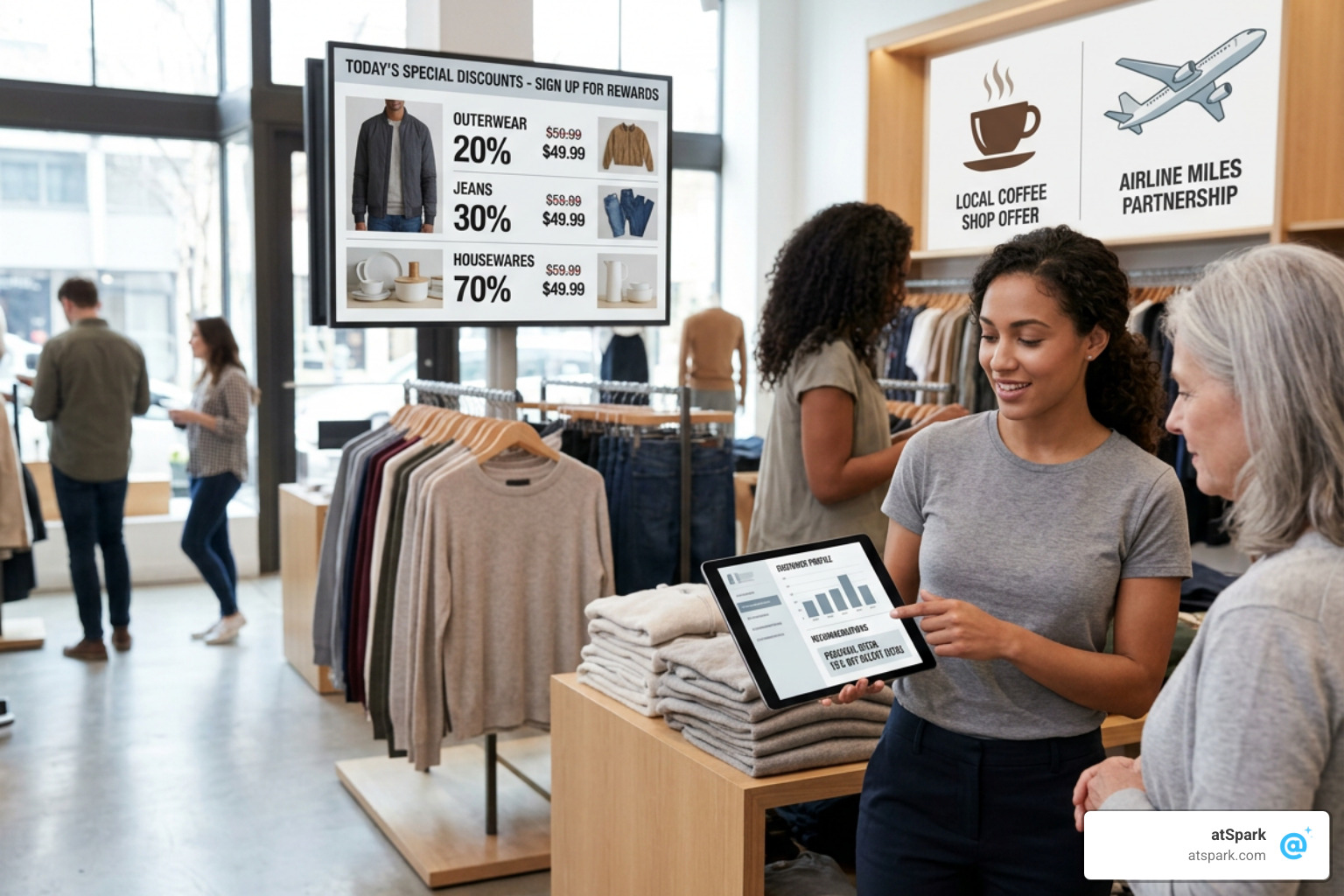
When loyalty and pricing personalization are combined, the business results are undeniable. Companies that integrate these functions see a two to four percentage point margin improvement on gross margin dollars.
Consider the ultimate example of this integration: Amazon Prime. As of 2023, roughly 75% of all US households were Prime members. These members spend more than four times as much as nonmembers over their lifetimes.
Furthermore, mega-events like Amazon Prime Day generated nearly $13 billion in sales in 2023, with an estimated incremental $5 billion in revenue. This is not just a loyalty program; it is an integrated pricing, subscription, and promotional ecosystem that leverages zero-party data to personalize the entire shopping journey.
Overcoming Organizational Silos and Data Capabilities Challenges
The biggest hurdle to achieving this level of integration is organizational. Marketing teams typically own the loyalty program and focus on customer metrics, while merchandising or finance teams own pricing and focus on product margins. They operate in silos, using different software and looking at different databases.
To build a holistic strategy, you need a unified data foundation. This allows you to run advanced customer segmentation and cohort analysis to see how specific loyalty tiers perform over time.
By tracking these groups through a structured mrr cohort analysis complete guide, you can identify if personalized pricing adjustments are driving genuine retention or if they are simply eroding your margins.
Selecting Strategic Partners to Maximize Relevance
No brand is an island. To increase the perceived value of your loyalty program without constantly discounting your own products, you should leverage strategic partnerships.
The key is selecting high-fit partners that align with how your customers naturally live. For example, an airline partnering with a rideshare app makes perfect sense because it streamlines the end-to-end travel experience.
When you evaluate these partner integrations, you should look at saas customer success metrics like partner-referral conversion rates and cross-brand usage frequency to ensure the alliance is mutually beneficial.
The Science of Engagement: Usage Frequency, AI, and Gamification
Why do some loyalty programs feel like a chore, while others feel like a game you want to play every day? The answer lies in behavioral science.
The most successful programs leverage psychological triggers like the Endowed Progress Effect (giving users a head start, such as a pre-stamped loyalty card, which increases completion rates from 63% to 82%) and Loss Aversion (the fear of losing a status tier or expiring points).
To understand the true behavioral impact, researchers analyzed over 40,000 customers across multiple merchants. The Do Loyalty Programs Actually Work? We Analyzed 40,000+ Customers | Oshi study revealed that standard comparison metrics are often highly biased because your best customers naturally sign up for rewards.
By using rigorous matched control groups and excluding the initial enrollment purchase, they proved that every $1 spent on rewards was associated with $10 or more in additional customer spending.
How Usage Frequency Correlates with Customer Loyalty Program Impact
There is a direct, statistical correlation between how often a customer uses their loyalty card and their overall brand devotion. In retail and supermarket studies, customers who reported using their loyalty cards "every time" or "frequently" demonstrated significantly higher retention rates.
But frequency is more than just a retail metric; it is a leading indicator for customer lifetime value forecasting models and heuristics that actually work.
By measuring transaction velocity, you can feed more accurate data into your glossary/ltv calculations, allowing your finance team to project long-term revenue with confidence.
Leveraging Advanced Analytics, AI, and Gamification for Deeper Advocacy
AI adoption in loyalty management has jumped from 37.1% to 51.4% in just one year. Forward-thinking companies are using AI to move away from static, points-based systems toward dynamic, hyper-personalized experiences.
Instead of sending the same 10% coupon to your entire database, AI engines analyze saas product usage metrics and transaction histories to deliver the right incentive at the exact moment a customer is likely to slip.
By combining these predictive models with gamified challenges (like limited-time badges or streak rewards), you can turn passive members into active brand advocates, directly boosting your Net Promoter Score, which you can track using our glossary/nps framework.
Frequently Asked Questions about Loyalty ROI
What is the average ROI of a customer loyalty program in 2026?
According to global industry reports, the average reported ROI for a customer loyalty program is 5.3x. However, this figure is often self-reported by program managers and can be inflated by self-selection bias.
To calculate a clean, audited ROI, companies must subtract the costs of rewards, software licensing, and administrative overhead from the true incremental revenue generated by members (validated against a matched control group of non-members).
For a deeper look at the hard numbers across different business models, read this Do Customer Loyalty Programs Really Work? (Data-Backed Analysis) report.
Why do some loyalty programs fail despite high enrollment?
Programs fail when they suffer from high enrollment friction (like forcing a customer to download a bulky app at checkout instead of using a wallet-native pass) or when the rewards are too distant to feel achievable.
If a customer has to spend $500 just to get a $5 coupon, they will abandon the program. This leads to hidden glossary/revenue-churn and glossary/contraction-mrr as customers quietly drift away to competitors who offer more immediate, tangible value.
How do customer expectations for loyalty programs differ across demographics?
Generational preferences are highly distinct:
- Ages 18 to 34: Prioritize digital convenience, gamified mobile app experiences, exclusive content, and social values alignment. They are highly prone to canceling memberships that fail to deliver continuous engagement.
- Ages 35 and older: Strongly prefer direct monetary rewards, simple point-accumulation structures, and straightforward cashback benefits.
Understanding these differences is critical for driving glossary/expansion-mrr, as it allows you to upsell and cross-sell tailored benefits to the right customer segments.
Conclusion
Measuring the true customer loyalty program impact requires moving past surface-level vanity metrics. If you are only tracking signups and point redemptions, you are missing the bigger picture of customer health, margin changes, and actual behavioral shifts.
To get a clear, accurate view of your retention efforts, you need to break down the walls between your billing, CRM, and subscription databases.
This is where we at atSpark can help. Our AI-powered analytics platform unifies these disparate data streams, allowing SaaS and subscription companies to ask plain-English questions and get instant charts, tables, and insights. You don't need SQL queries or engineering resources to find out if your loyalty strategies are working. You can query your data directly to see how rewards impact your core saas customer retention metrics in real-time.
Stop guessing if your loyalty program is paying off. Let us help you turn your customer data into clear, actionable growth.