You can stare at a busy dashboard all morning and still have no idea whether your SaaS is actually getting healthier. That is why important SaaS metrics matter: they turn noise into signals, so you can see if growth is real, profitable, and likely to last.
SaaS metrics are the numbers that show how your subscription business is behaving across revenue, acquisition, retention, and efficiency. The point is not to track everything. The point is to track the few numbers that help you spot leaks, make better bets, and fix the right problem before it gets expensive.
In this guide, you’ll get a clear map of the metrics that matter most, what each one means in plain English, how to read them together, and what to improve first when a number starts drifting.
What SaaS Metrics Actually Tell You
A good metric does one job: it helps you make a decision. If a number looks impressive but does not change what you do next, it is probably just decoration.
Important SaaS metrics show whether your growth engine is producing durable revenue or just activity. Some numbers tell you if customers are arriving. Some tell you if they stick around. Some tell you if your business is paying too much for growth. Together, they answer a simple question: is your company becoming stronger, or just busier?
That framing matters because SaaS can hide problems for a while. New signups can mask churn. Big annual prepayments can make cash look healthy even when retention is weak. A spike in demos can feel exciting even when close rates are slipping. Metrics give you a way to separate motion from progress.
Early on, even a simple view helps. If you already track a broader set of business health numbers across your company, this guide helps narrow the list down to the ones that most directly shape sustainable SaaS growth.
The difference between vanity metrics and useful metrics
Vanity metrics look good in screenshots. Useful metrics help you fix something.
Pageviews, app downloads, trial starts, and raw signup counts can all rise while the business gets worse. A freemium product can double signups because a landing page got better, but if activated users do not convert or stay, the top line is lying to you. You are seeing more interest, not more value.
Useful metrics tie back to revenue quality, retention, and efficiency. MRR tells you if recurring revenue is expanding. Churn tells you if customers actually want to stay. CAC tells you what growth costs. NRR tells you whether existing customers are growing or shrinking. Those numbers are harder to celebrate blindly, which is exactly why they matter.
Why the “most important” metrics change as you grow
The right dashboard changes with stage, pricing, and sales motion. A seed-stage product-led SaaS should care obsessively about activation, early retention, and conversion from free to paid. A scaling sales-led company usually spends more time on CAC payback, pipeline conversion, and expansion revenue. A mature SaaS business with larger accounts often watches NRR, gross margin, and burn efficiency more closely.
Pricing model changes the picture too. Monthly self-serve products often live and die by churn and activation speed. Enterprise products with annual contracts can look stable on the surface, but customer concentration and renewal quality become bigger risks. There is no universal perfect dashboard. There is only the set of numbers that best reveals your current constraint.

The Core Important SaaS Metrics You Should Know First
Before getting into formulas and nuance, it helps to know the short list. Most SaaS teams return to the same handful of numbers again and again because those numbers connect directly to growth, retention, and cash efficiency.
Here’s the map you should keep in your head:
- MRR
- ARR
- Customer churn
- Revenue churn
- CAC
- LTV
- NRR
- CAC payback
- Gross margin
- Activation rate
- ARPU or ARPA
- Burn multiple
You do not need a giant wall of charts to start making better decisions. You need a clean view of where money comes from, where it leaks, and how expensive it is to keep the engine running.
If you can only track a handful, start here
If your team can only keep a close eye on a few metrics, start with MRR or ARR, customer churn, revenue churn, CAC, LTV, NRR, and CAC payback period. That set gives you a strong operating view without turning your dashboard into a junk drawer.
Those metrics answer the questions that matter most. Are you growing recurring revenue? Are customers sticking? Are bigger accounts expanding or shrinking? Are you paying too much to acquire them? How long until you earn that money back?
For a wider view of the core numbers worth tracking regularly, it helps to think in systems: acquisition, monetization, retention, and efficiency. That structure keeps you from obsessing over one metric while missing the story underneath.
Revenue Metrics That Show If Growth Is Real
Revenue metrics tell you whether growth is steady, predictable, and likely to compound. In SaaS, recurring revenue matters because it is the closest thing to a heartbeat. A healthy beat is not just higher this month than last month. It is also stable, repeatable, and built on customers who keep paying.
The trick is to read movement over time, not worship a single snapshot. A strong month can come from one big deal. A weak month can come from seasonality or delayed renewals. Trends matter more than isolated wins.
Monthly recurring revenue (MRR)
MRR is the monthly value of your recurring subscription revenue. If a customer pays $200 per month, that adds $200 to MRR. If a customer prepays $2,400 annually, that still contributes $200 in MRR terms, not $2,400 all at once.
This is usually the baseline metric for subscription businesses because it shows the recurring engine in monthly terms. It is also useful because you can break it into components: new MRR from new customers, expansion MRR from upsells or seat growth, contraction MRR from downgrades, and churned MRR from lost customers. Once you do that, MRR stops being one number and starts becoming a story.
If total MRR rises because new business is outrunning churn, that can be fine for a while. But if expansion is weak and churned MRR keeps climbing, growth is built on a shaky floor.
Annual recurring revenue (ARR)
ARR is recurring subscription revenue annualized. In simple terms, ARR is MRR multiplied by 12, assuming the revenue is truly recurring.
ARR is often more useful than MRR when your contracts are larger, annual, or enterprise-heavy. It smooths the view and makes long-term planning easier. It also matches how many investors and executives think about business scale. A company at $5 million ARR and a company at $500,000 ARR need very different operating discipline.
Still, ARR can hide short-term movement. If your business is monthly and changes quickly, MRR often gives you a sharper operating signal.
Average revenue per user or account (ARPU/ARPA)
ARPU or ARPA tells you how much revenue, on average, each user or account generates in a given period. This helps you understand monetization across the customer base, not just overall volume.
A rising ARPU can mean your pricing is improving, more customers are choosing higher tiers, or your mix is shifting toward larger accounts. But it can also rise for the wrong reason, such as losing lower-paying customers faster than higher-paying ones. Context matters.
This metric becomes especially helpful when paired with segmentation. Looking at ARPA by customer size, plan type, or acquisition channel can reveal where your best revenue actually comes from.
Annual contract value (ACV)
ACV is the average annual value of a customer contract, usually excluding one-time fees. It is especially useful for annual and enterprise contracts where deal size matters.
ACV is not the same as ARR. ARR is total recurring revenue across the business. ACV is usually the annualized value per contract. If you close ten contracts at $20,000 each, your average ACV is $20,000. Your ARR contribution from those contracts is $200,000.
That distinction matters because ACV helps you understand deal quality and sales efficiency. ARR tells you the scale of the recurring base.
Bookings, billings, and recognized revenue
These three terms get mixed up constantly.
Bookings are contracted revenue. Billings are invoices sent, or cash requested. Recognized revenue is the portion you can record as earned over time under accounting rules. If a customer signs a $12,000 annual contract and pays upfront in January, bookings may be $12,000, billings may be $12,000, but recognized revenue is typically $1,000 per month.
That difference matters because cash collected and revenue earned are not the same thing. If you treat annual prepayments like monthly recurring revenue, your dashboard starts telling fairy tales.

Customer Acquisition Metrics That Keep Growth Efficient
Growth gets expensive fast when you do not know what it costs to win a customer. A lot of SaaS teams find this out after a few months of “good momentum” that somehow never turns into better cash position.
Acquisition metrics show whether sales and marketing spend is paying back in a reasonable way. They also reveal where the funnel is wasting effort.
Customer acquisition cost (CAC)
CAC is what you spend to acquire a new customer. In most cases, that includes ad spend, sales and marketing salaries, commissions, software tools, contractors, and agency costs tied to acquiring customers, divided by the number of new customers won in the period.
The catch is simple: CAC gets misleading when you leave things out. If your paid spend looks efficient only because you excluded sales salaries and tooling, your CAC is dressed up for the meeting.
A clean CAC formula gives you a more honest operating picture. It also makes payback and LTV comparisons far more useful.
Lead-to-customer conversion rate
This metric shows the percentage of leads that become paying customers. It helps you see how efficiently the funnel turns interest into revenue.
Low conversion does not always mean poor lead quality. It could point to slow follow-up, weak qualification, pricing friction, a messy handoff between marketing and sales, or onboarding that fails to close the gap between promise and value. When this number drops, the problem often sits between teams, not inside one team.
CAC payback period
CAC payback period tells you how long it takes to recover what you spent to acquire a customer, usually measured in months based on gross profit contribution.
This is one of the most practical SaaS metrics because it connects growth to cash reality. If payback takes 24 months, your business needs a lot more patience and capital than one with a 9-month payback. Growth can look beautiful on paper and still quietly strain the bank account.
SaaS Magic Number
The SaaS Magic Number is a quick efficiency check that compares new ARR growth to sales and marketing spend. Different teams calculate it slightly differently, but the purpose stays the same: it gives you a directional sense of whether go-to-market spend is producing enough recurring revenue.
Use it as a signal, not a sacred score. A weak Magic Number can mean poor sales productivity, low conversion, weak pricing, or bad-fit leads. A strong one suggests the engine is working, but it still needs to be checked against retention and payback. High output from low-quality customers is still a problem.
Retention Metrics That Usually Matter More Than New Signups
Here’s the thing: retention usually matters more than acquisition. You can outspend a weak product for a while, but you cannot build a durable SaaS business on customers who leave as soon as the trial glow wears off.
Retention is where sustainable growth is won or lost. Strong retention lowers pressure on acquisition, improves payback, raises LTV, and makes revenue more predictable. Weak retention poisons everything around it.
Customer churn rate
Customer churn rate, also called logo churn, is the percentage of customers lost in a period. If you start the month with 100 customers and lose 5, your customer churn is 5%.
Simple, useful, but incomplete. A low customer churn rate can still hide serious revenue problems if larger accounts are downgrading while smaller accounts stay put. Losing one enterprise account may hurt more than losing twenty tiny self-serve customers. That is why churn should never be read alone.
Revenue churn rate
Revenue churn measures lost recurring revenue from cancellations and downgrades. This is often more revealing than customer churn because it shows the financial impact of what you are losing.
Gross revenue churn looks only at revenue lost from churn and contraction. Net revenue churn also accounts for expansion from existing customers. If expansions offset losses, net revenue churn can look far better than gross churn. That tells you your installed base is growing, not just surviving.
For a deeper look at the retention numbers that expose where revenue leaks, revenue churn is one of the best places to start.
Net revenue retention (NRR)
NRR measures how recurring revenue from an existing customer group changes over time after accounting for churn, downgrades, and expansion. This is one of the clearest indicators of SaaS health because it captures all three forces together.
An NRR above 100 percent means your existing customers are worth more now than before, even after losses. That is a powerful sign. It usually points to a product that keeps delivering value, a pricing model that grows with usage, or a customer base with real expansion potential.
Logo retention
Logo retention is the flip side of logo churn. It shows what percentage of customers stayed over a period.
This simpler view is useful when you want a quick pulse on customer stability. It is easy to understand, easy to communicate, and often a good first metric for startup teams that are still tightening reporting. Just remember that customer count and revenue impact are not the same thing.
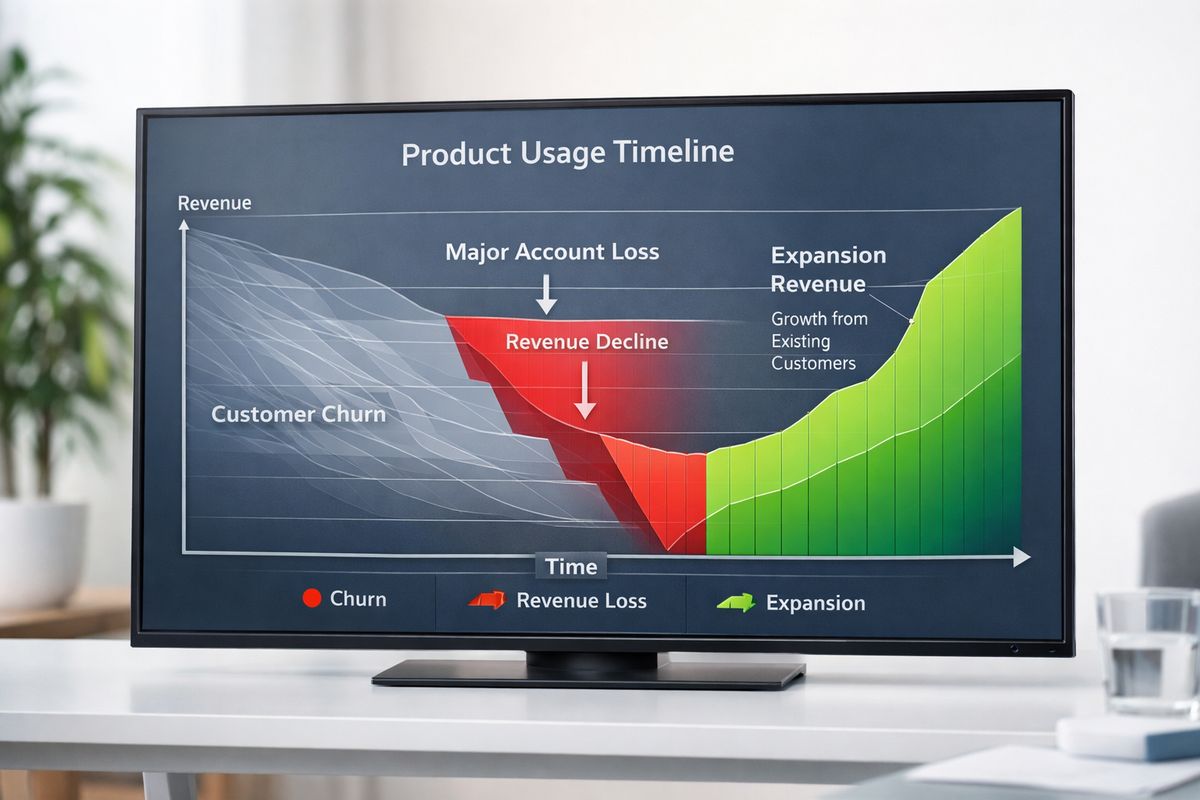
Expansion revenue
Expansion revenue comes from existing customers spending more over time through upsells, add-ons, more seats, or increased usage. In a healthy SaaS business, this is where growth starts getting easier.
Expansion matters because it improves NRR and reduces dependence on new logo acquisition. It also reflects something deeper: customers are getting more value, not just renewing out of habit.
Customer Value Metrics That Tell You What a Customer Is Worth
Acquisition cost means very little until you compare it to customer value. Spending $5,000 to win a customer can be terrible or fantastic, depending on what that customer returns over time.
This is where unit economics become useful rather than theoretical.
Customer lifetime value (LTV or CLV)
LTV estimates how much gross profit a customer generates over the full relationship with your business. A common shortcut is average revenue per account multiplied by gross margin and estimated customer lifespan.
Keep this practical. LTV is only as good as the assumptions underneath it. If churn data is shaky or gross margin is fuzzy, your LTV becomes more wish than metric. That does not make it useless, but it does mean you should treat it as a working estimate, not sacred truth.
LTV-to-CAC ratio
This ratio compares the value a customer generates to the cost of acquiring that customer. A healthy business often aims for around 3:1, though ranges vary by stage and model.
Too low, and growth is overpriced. Too high, and you may actually be underinvesting in growth. If your ratio is 8:1 because you barely spend to acquire customers, that can signal missed opportunity. Efficient growth is good. Timid growth is different.
Gross margin
Gross margin shows how much revenue remains after direct costs to serve customers. In SaaS, those costs often include hosting, customer support, third-party infrastructure, and service-heavy onboarding or implementation.
Software can look cheap to deliver until support tickets pile up, cloud costs swell, or enterprise customers require white-glove setup. Higher gross margin gives you more room to reinvest in product, sales, and retention.
Product and Engagement Metrics That Predict Retention Early
https://www.youtube.com/watch?v=s8_Vax8VUmM
By the time a customer cancels, the warning signs usually showed up weeks earlier. Product and engagement metrics help you catch those signs while you can still do something about them.
This is especially useful for product managers and growth teams because these are leading indicators, not post-mortems.
Daily active users (DAU) and monthly active users (MAU)
DAU and MAU track how many users engage with your product daily or monthly. These metrics matter most for product-led, collaborative, or usage-driven SaaS products where frequent activity reflects real value.
The catch is the word active. Logging in is not always meaningful. Sending a report, inviting a teammate, completing a workflow, or syncing data often matters more. If your activity definition is weak, DAU and MAU become vanity metrics in disguise.
For a more grounded way to think about behavior inside the product that actually predicts account health, start by defining actions tied to customer outcomes, not just clicks.
Activation rate
Activation is the point where a new user reaches first value. That could mean connecting a data source, publishing a first dashboard, inviting the team, or automating one repetitive task.
Poor activation usually becomes poor retention later. If new users never get to the moment where the product starts feeling useful, churn has already started, even if cancellation happens next month.
Customer engagement score
An engagement score combines signals like logins, feature use, teammate activity, and key workflow completion into one simple indicator of account health.
There is no universal formula, and that is fine. What matters is whether your score reflects meaningful behavior. For some products, weekly report exports might be a strong signal. For others, API calls or active seats matter more. The score should help you notice risk early, not impress anyone with mathematical drama.
Net promoter score (NPS) and customer satisfaction signals
NPS is one way to measure customer sentiment by asking how likely someone is to recommend your product. It can be useful, but surveys never tell the full story.
Sentiment metrics work best when paired with behavior. A happy survey score means less if usage is collapsing. On the flip side, a neutral score from a deeply engaged account may be less urgent than it looks. Use NPS, support trends, renewal feedback, and product usage together.
Growth Efficiency Metrics Investors and Executives Watch Closely
Some metrics get more attention in board decks and fundraising conversations, but that does not make them investor-only jargon. They are useful because they summarize durability and efficiency at a higher level.
Rule of 40
The Rule of 40 adds growth rate and profit margin. If the total is 40 or above, your business is often considered balanced between growth and profitability.
This metric is helpful because it forces tradeoff thinking. Fast growth can justify lower margins for a while. Slower growth demands stronger profitability. One number cannot capture every nuance, but this one quickly shows whether the business is leaning too hard in one direction.
Burn multiple
Burn multiple measures how much cash you burn to generate each new dollar of ARR. In plain English, it asks: how expensive is your growth?
This gets more attention when capital is tight because it reveals whether spend is creating durable revenue or just motion. A high burn multiple can be acceptable briefly during a major push. As a pattern, it is usually a warning.
Customer monthly growth rate (CMGR)
CMGR smooths customer growth over time so you can see whether momentum is building or fading. Month-to-month growth can bounce around. CMGR gives you a steadier directional read.
It is especially useful for early-stage SaaS, where one large month can create false confidence. Smoothing helps you see what is really happening.
Customer concentration
Customer concentration measures how much revenue depends on a small number of accounts. If one customer represents 25 percent of ARR, your business has concentration risk no matter how healthy the rest of the dashboard looks.
This matters because concentration can distort retention, growth, and forecasting. One renewal decision can swing the entire quarter. Larger deals are great. Overdependence is not.
How to Calculate Important SaaS Metrics Without Getting Lost
A surprising amount of dashboard confusion comes from inconsistent definitions, mismatched timeframes, and sloppy inputs. The math is usually not the hard part. The setup is.
Use one clear definition for each metric
If finance defines MRR one way, sales defines it another way, and product pulls a third version into a slide, your metrics stop being useful. You need one shared definition for each metric and one owner who protects it.
A simple metric glossary solves a lot of arguments. Write down what counts, what does not, and where the data comes from. Boring? Yes. Worth it? Absolutely.
Pick the right time frame and cohort
Monthly, quarterly, and annual views tell different stories. Monthly data helps you spot movement quickly. Quarterly views smooth noise. Annual views help with strategic planning.
Cohorts matter too. A cohort is just a group of customers who started around the same time. Looking at retention by cohort helps you see if newer customers are sticking better or worse than older ones. That is often more useful than blended averages.
Watch for common calculation mistakes
The most common errors are avoidable: mixing trial users with paying customers, counting booked revenue as MRR, excluding failed payments from churn, or calculating CAC without full acquisition costs.
Another common mistake is using too many versions of the same metric. You do not need five churn formulas floating around Slack. You need one trusted answer.
How to Read SaaS Metrics Together Instead of in Isolation
Tracking numbers is easy. Understanding the business is harder.
The real value comes from reading metrics as a connected system. If one number moves, ask what else should move with it. If MRR rises, is NRR healthy too? If CAC improves, are lead quality and retention still holding up?
When rising MRR hides a retention problem
This happens all the time. Imagine your MRR grows from $80,000 to $95,000 in three months. On paper, that looks great. But if you added $30,000 in new MRR and lost $15,000 to churn and downgrades, the engine is leakier than it looks.
That kind of growth can feel fine until acquisition slows. Then the leak becomes visible all at once. Rising MRR is good. Rising MRR with worsening churn is a warning.
When low churn still doesn’t mean healthy growth
Low churn can hide other issues. Maybe customers stay because contracts are annual, but expansion revenue is flat. Maybe retention is okay, but CAC has climbed so high that growth is no longer efficient. Maybe onboarding gets users through setup, but activation quality is shallow and usage never deepens.
That is why a stronger dashboard pairs retention and growth numbers in one operating view rather than treating each metric as its own universe.
Build a simple metric stack for decision-making
A useful stack does not need to be fancy. Start with four layers: acquisition, activation, retention, and revenue efficiency.
For acquisition, track CAC and lead-to-customer conversion. For activation, track time-to-value and activation rate. For retention, track customer churn, revenue churn, and NRR. For revenue efficiency, track MRR or ARR, gross margin, and CAC payback. That combination gives you a practical decision-making system without turning the company into a spreadsheet hobby.
Benchmarks: What “Good” Looks Like for SaaS Metrics
Everybody wants a benchmark. That makes sense. A number only feels meaningful when you know whether it is weak, average, or strong.
But benchmark envy causes bad decisions. Good numbers depend on stage, pricing, market, average contract size, and sales motion. A self-serve SMB tool and an enterprise platform should not expect the same churn, CAC, or payback profile.
Benchmarks for early-stage SaaS
At an early stage, your data is noisy and sample sizes are small. That means trend lines matter more than hard benchmark worship.
Look closely at activation, early retention, and whether CAC is moving in the wrong direction too fast. If new users reach first value faster this quarter than last quarter, that matters. If retention for recent cohorts is improving, that matters. The job at this stage is finding signal through limited data, not pretending precision exists.
Benchmarks for growth-stage SaaS
As the business scales, the standard changes. You want more repeatable acquisition, better retention discipline, clearer payback, and healthier NRR.
By this stage, you should be able to explain why CAC changed, which segments retain best, and where expansion revenue is coming from. Metrics become operating levers, not just reporting lines.
Why business model changes the benchmark
SMB, mid-market, and enterprise SaaS naturally produce different metric shapes. Product-led businesses often prioritize activation and self-serve conversion. Sales-led businesses often accept higher CAC in exchange for larger ACV and stronger expansion. Usage-based pricing changes how ARPU and expansion behave. Annual contracts change how churn appears.
So yes, use benchmarks. Just use the right neighbors.
Practical Ways to Improve Your Most Important SaaS Metrics
Good metrics should lead to action. If a number drops and nobody knows what to try next, the dashboard is only doing half its job.
Improve MRR and ARR with pricing and expansion moves
You can often improve recurring revenue without doubling lead volume. Pricing and packaging changes, better upgrade paths, annual plan incentives, and usage-based expansion can all lift MRR and ARR.
Sometimes the fix is simple. Customers may be underpaying because plans do not match value delivered. Or expansion prompts may arrive too late, after a team has already hit limits and gotten annoyed. Better monetization usually comes from tighter alignment between value and price.
Lower churn by fixing onboarding and time-to-value
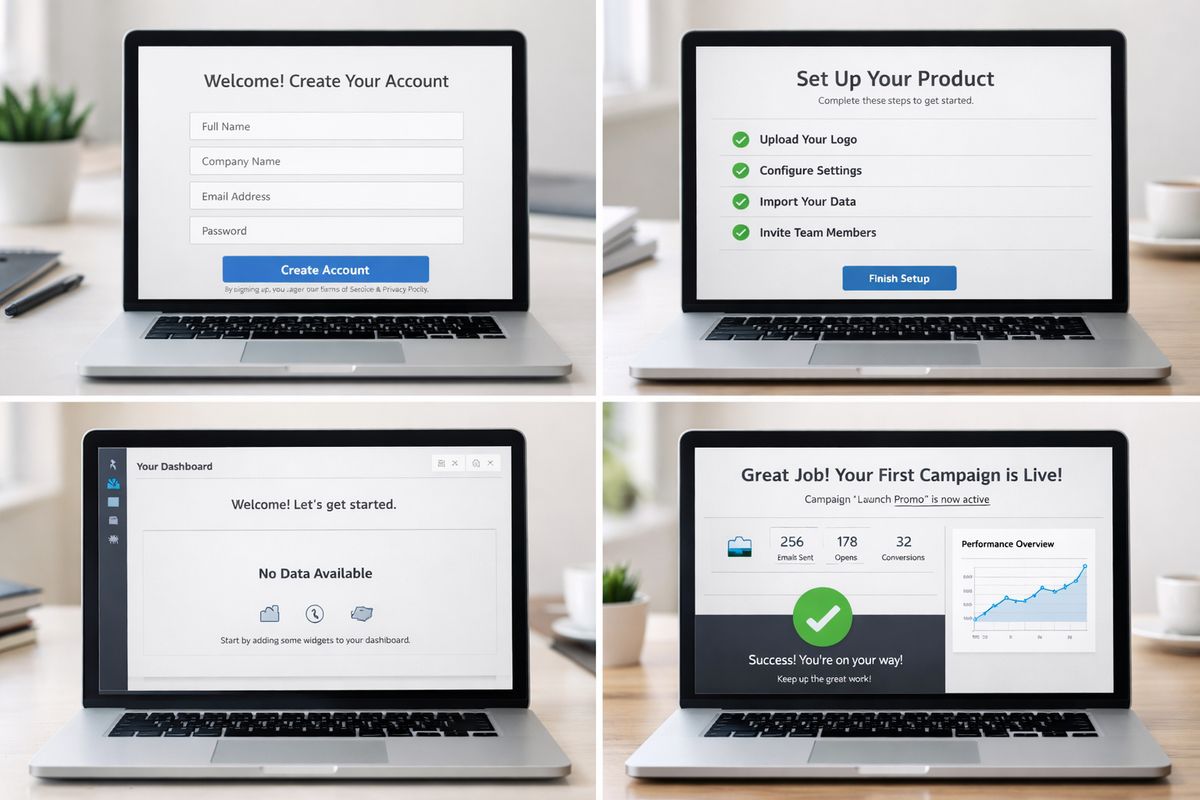
A lot of churn starts during onboarding, not at renewal. If setup is confusing, handoffs are messy, or first value takes too long, customers begin drifting before anyone notices.
Picture a Monday at 9:17 a.m., a new account owner opens your product, sees six setup steps, two unclear labels, and no obvious next move. Then a sales note promised “live in one day,” but implementation needs three approvals and a CSV cleanup. That gap quietly kills activation.
Cleaner onboarding, clearer next steps, and faster first wins reduce early churn more than most teams expect. If customer health is a major focus, it also helps to tighten the signals your success team should watch every week.
Improve CAC by tightening targeting and conversion
Lower CAC does not always come from spending less. Often it comes from wasting less.
Sharper ICP focus, better qualification, cleaner funnel handoffs, and stronger messaging can reduce acquisition cost by improving conversion throughout the journey. If your sales team keeps chasing poor-fit leads, CAC rises even if ad performance looks decent. Better targeting is often the cheapest growth improvement available.
Raise LTV by keeping good customers longer
LTV improves when strong-fit customers stay longer and grow more. That means better education, smarter usage nudges, more proactive customer success outreach, and product experiences that keep proving value over time.
The best retention work usually feels ordinary. A well-timed email, a better in-app prompt, a renewal review done early, a clearer report that helps a customer look smart internally. Small moves compound.
The Best SaaS Metrics Dashboard for Your Team
Your dashboard should help people act, not just admire charts. Different roles need different views, but everyone should work from the same core definitions.
What founders and executives should review
At the top level, focus on MRR or ARR, burn, NRR, churn, CAC payback, and cash efficiency. Those numbers help you judge growth quality, capital efficiency, and business durability.
Keep this view clean. An executive dashboard is not the place for fifty feature charts.
What product and growth teams should review
Product and growth teams usually need activation, engagement, retention cohorts, feature adoption, funnel conversion, and usage depth. These are the leading indicators that explain the lagging business metrics later.
If your team wants a clearer structure for building that view, a practical dashboard setup for the numbers that drive decisions can make reporting much easier.
How often to review your numbers
Some metrics deserve a weekly pulse check, especially pipeline conversion, activation, and cash-sensitive efficiency metrics. Others make more sense monthly, such as churn, NRR, and full-funnel CAC. Quarterly reviews are better for pricing shifts, cohort patterns, and strategic changes.
Consistency matters more than complexity. A simple monthly review that actually happens beats a gorgeous dashboard nobody trusts.
Important SaaS Metrics FAQs
Frequently Asked Questions
What are the most important SaaS metrics?
For most SaaS companies, the shortlist is MRR or ARR, customer churn, revenue churn, CAC, LTV, NRR, and CAC payback period. The exact mix changes with stage, pricing model, and sales motion, but those numbers usually give you the clearest view of business health.
What is the difference between MRR and ARR?
MRR is your monthly recurring subscription revenue. ARR is that recurring revenue expressed on an annual basis. MRR is often more useful for monthly operating decisions, while ARR is useful for long-term planning and larger annual contracts.
Which matters more: churn, CAC, or LTV?
You need all three, but poor retention usually causes the biggest damage. If churn is weak, CAC gets harder to recover and LTV falls fast. In other words, churn tends to undermine the other two.
What metric should you improve first?
Start with the biggest constraint in your growth engine. If retention is weak, fix that before spending more on acquisition. If retention is solid but CAC is bloated, tighten targeting and conversion. The best first metric is the one creating the most drag right now.
How many SaaS metrics should you track?
Track fewer than you think. A focused dashboard with 8 to 12 trusted metrics is usually more useful than a huge reporting layer full of disconnected charts. If a metric does not help you make a decision, it does not belong on the main dashboard.
What changes once you understand your metrics clearly?
You stop reacting to surface-level wins and start seeing the actual business underneath. That changes how you budget, how you prioritize product work, and how confidently you can grow. Try one thing this week: pick your five core numbers, define them in one shared place, and review them the same way every month. If you want a simpler way to turn those numbers into action, try AtSpart.