Why Most SaaS Companies Stall — and What Separates the Ones That Don't
The most effective SaaS revenue growth strategies in 2026 share a common thread: they treat retention, expansion, and distribution as a single compounding system — not separate initiatives.
If you're looking for a quick answer, here are the core strategies that move the needle:
- Build distribution into your product — growth loops, PLG, and engineering as marketing
- Plan for churn from day zero — exit surveys, salvage offers, and proactive retention
- Think global from launch — localized payments, regional preferences, Merchant of Record
- Iterate pricing every quarter — usage-based, outcome-based, and hybrid models outperform flat seats
- Focus on your Serviceable Addressable Market (SAM) — narrow ICP beats broad TAM targeting
- Align RevOps across sales, finance, and CS — clean data drives forecast accuracy and NRR
- Track expansion revenue as a primary growth engine — renewals and expansion account for roughly 40% of SaaS revenue
Here's the uncomfortable truth: 93% of SaaS startups never scale past $1M ARR. Only 3.5% reach $20M ARR within a decade of monetizing. Those aren't product failures — they're largely execution and alignment failures.
The companies that break through don't necessarily start with better metrics. They get relentlessly better at improving them over time — especially retention and revenue per account.
For finance and RevOps leaders, the challenge is acute. You need timely, accurate answers on revenue health, churn risk, and expansion opportunity. But too often, those answers are buried in spreadsheets or waiting on a data team queue.
This guide breaks down exactly what works — with real data — so you can act faster and grow smarter.
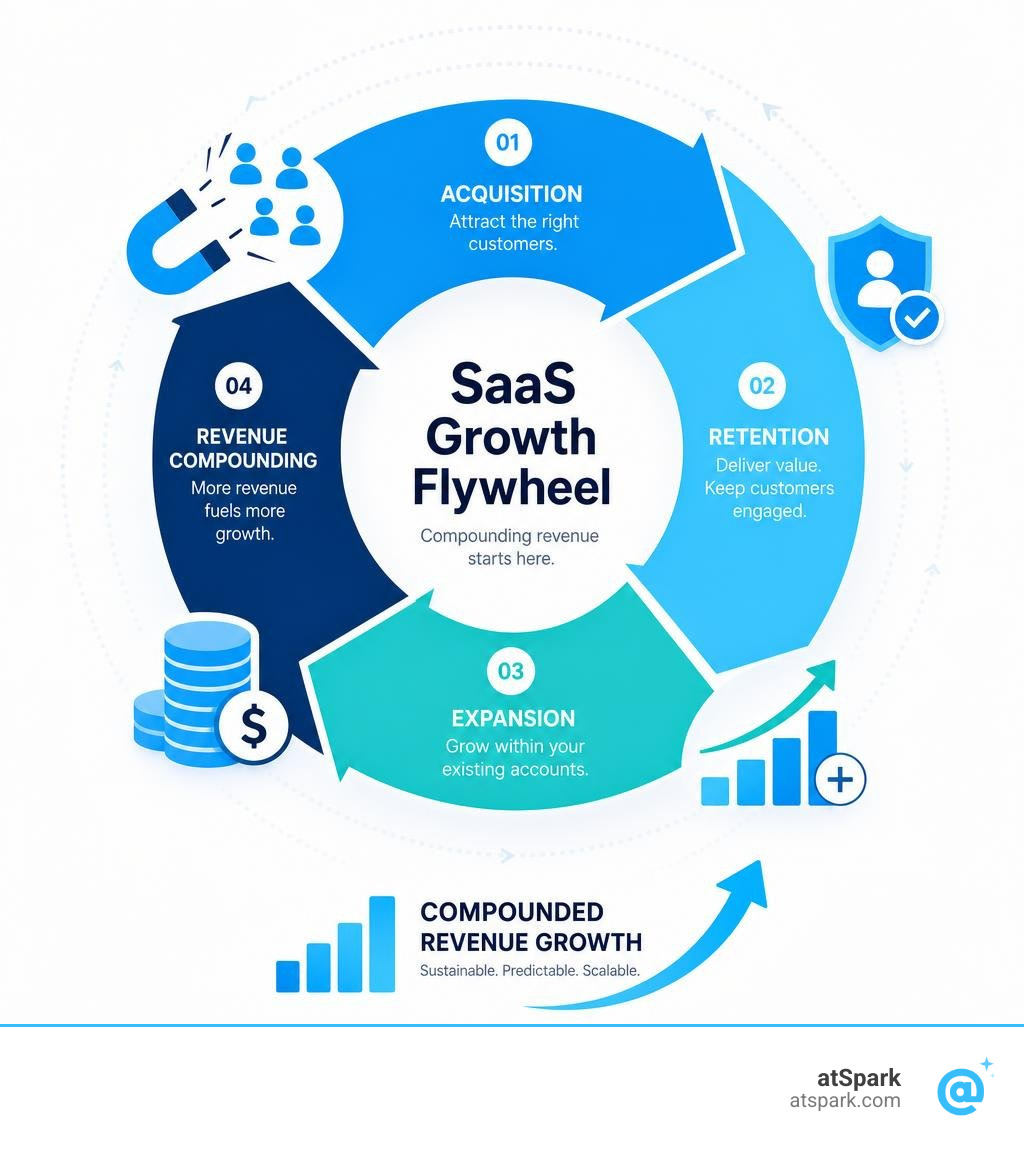
The New Paradigm of SaaS Revenue Growth Strategies in the Age of AI
The traditional playbook of hiring armies of sales representatives and spending heavily on paid ads is no longer viable. In 2026, the SaaS landscape has shifted dramatically. AI-native SaaS companies are achieving unprecedented scale with incredibly lean teams, completely rewriting the rules of operational efficiency.
To thrive, businesses must adopt modern 7 SaaS Growth Strategies That Scale to $100M ARR. This shift is fueled by a staggering trend: AI-native SaaS businesses with less than $1M ARR saw a 93% increase in revenue growth in 2024 compared to the previous year.
However, this rapid growth comes with a catch. Adding AI features without updating your monetization strategy is a fast track to margin erosion.
Why Traditional Seat-Based Pricing is Giving Way to Outcome-Based Models
For years, the "per-seat" subscription model was the gold standard. But in the age of generative AI, seat-based pricing is actively working against your growth. When an AI tool can do the work of five people in a fraction of the time, selling software based on the number of users is a losing battle. Your customers will naturally need fewer seats, which actively caps your expansion potential.
Furthermore, running large language models (LLMs) introduces variable infrastructure costs. If your power users consume massive amounts of API resources under a flat-rate subscription, your gross margins will quickly deteriorate.
The solution? Transitioning toward hybrid pricing models that combine seat-based fees with usage-based or outcome-based components. For example, modern customer service platforms are moving away from charging per agent. Instead, they charge an outcome-based fee for every successful ticket resolved by their AI agents.
To keep your pricing aligned with customer value, you must build a continuous iteration cycle. SaaS companies that roll out a pricing or packaging change every 3 months outperform those that don’t by 103% on average revenue per user (ARPU). Regular iteration helps you avoid pricing "dead zones"—where tier thresholds are set too far apart, preventing growing accounts from triggering natural upgrades.
Leveraging AI-Native Efficiency to Double Your ARR Per Employee
The efficiency benchmarks for high-growth SaaS have been completely redefined. Historically, a healthy pre-AI benchmark for employee productivity sat at $200,000 to $400,000 ARR per employee.
Today, AI-native companies are operating at $500,000 to $1,000,000 ARR per employee. Consider Cursor: the AI-powered coding assistant reached $100M in revenue within 12 months with just 30 employees.
This level of efficiency is achieved by automating non-core workflows and using intelligent systems to drive post-sales revenue. High AI adopters now generate $1.1M in post-sales revenue per head compared to just $600K for companies lagging in AI adoption.
To scale this efficiently, teams rely on advanced data platforms to monitor customer health and predict expansion opportunities. Implementing What is AI Revenue Analytics? allows lean teams to let algorithms identify which accounts are ready for an upsell, completely bypassing manual account reviews.
Building Distribution and Global Localization into Your Product Core
The venture capital funding split has flipped. In the past, capital was split 70% on product development and 30% on go-to-market (GTM). Today, that ratio is reversed: 30% goes to product, and 70% is dedicated to distribution. Because the software market is highly saturated, distribution is the ultimate battleground.

Baking Growth Loops Directly into Product Architecture
The most sustainable way to scale is to build distribution directly into your product's core. Product-led growth (PLG) relies on creating an exceptional user experience that naturally encourages viral sharing, collaboration, or external visibility.
To make your PLG motion work, you must ruthlessly optimize your time-to-value. Your onboarding flow should guide users to their first "Aha!" moment within the first five minutes of signing up. Once a user experiences the core value of your product, they self-qualify as a product-qualified lead (PQL), making the transition to a paid plan incredibly natural.
Another highly effective strategy is "engineering as marketing." By building free, highly useful standalone tools—such as calculators, templates, or graders—you can capture high-intent search traffic. This approach can lead to a 60% to 80% reduction in customer acquisition costs (CAC) while building a steady pipeline of organic signups.
Going Global from Day One with Localized Payments
SaaS businesses are inherently global, yet many restrict their growth by treating international expansion as an afterthought. Restricting your business to a single market limits your growth potential and leaves money on the table.
True global expansion requires deep localized payment processing. Regional payment preferences vary wildly. For example, in South Korea, 70% of buyers prefer local payment methods over standard international credit cards. If you do not offer these local options, your conversion rates will suffer.
However, managing global sales tax, regulatory compliance, and localized currencies is incredibly complex. Rather than building this infrastructure in-house, high-growth SaaS companies leverage a Merchant of Record (MoR) to handle the operational burden.
Consider Nexus Mods: the platform grew its Chinese revenue 9x and successfully re-entered 205 territories (including India) after localizing its payments via a Merchant of Record. By outsourcing compliance and payment routing, they unlocked massive global revenue with zero regulatory friction.
Designing a Bulletproof Retention and Expansion Engine
Acquiring a new customer is 5 to 25 times more expensive than retaining and expanding an existing one. Despite this, many SaaS companies still allocate the majority of their budgets to new logo acquisition.
To build a highly capital-efficient growth engine, you must focus on driving negative net churn, where your expansion revenue from existing customers outpaces the revenue lost from cancellations. For a complete blueprint on this, check out The SaaS Expansion Revenue Playbook: Build Negative Net Churn | SaasFlywheel.
Planning for Churn from Day Zero to Protect Your Bottom Line
Because every subscription will eventually face a renewal decision, you must plan for churn from day zero. Managing churn effectively requires looking past simple price objections to uncover underlying issues with value perception, product onboarding, or support quality.
To catch issues early, you should implement structured exit surveys the moment a customer clicks "cancel." Ask them exactly why they are leaving, but also why they chose your product in the first place. This qualitative data is vital for refining your product roadmap.
Additionally, deploying automated salvage offers can recover a significant portion of departing revenue. For example, HubX retained 63% of customers who initially intended to churn and recovered $106,000 within just three months by using targeted salvage offers and billing recovery tools.
To keep a pulse on these trends, you must regularly monitor your SaaS Metrics to Track. Understanding your customer lifetime value (LTV) and running a detailed MRR Cohort Analysis Complete Guide will show you exactly when and why customers drop off, allowing you to patch the leaks in your bucket before spending more on acquisition.
Scaling Accounts with Signal-Led SaaS Revenue Growth Strategies
To drive meaningful expansion, you cannot rely on calendar-driven outreach, such as emailing a customer only when their annual renewal is 30 days away. Instead, expansion must be a continuous, signal-led motion triggered by real-time user behavior.
To learn how to structure this, read How to Grow SaaS Expansion Revenue: 5 Clear Steps and explore the Expansion revenue playbook: how top SaaS companies grow 40%+ from existing customers | Skene.
We recommend building an "Expansion Signal Stack" that monitors three core telemetry signals:
- Usage Velocity: A sudden spike in consumption (e.g., API calls, storage, or reports generated) approaching 80% to 90% of their current plan limits.
- Seat Saturation: A customer inviting multiple new users in a short window, signaling team-wide adoption.
- Feature-Adoption Breadth: Active usage of adjacent features, which indicates the account is ready for a modular cross-sell.
Instead of sending outbound sales emails, trigger contextual, in-app prompts when a user is close to their limits. These in-product triggers convert at a 60% higher rate than traditional email campaigns because they solve a real-time friction point for the user. To dive deeper into structuring these campaigns, check out SaaS Expansion Revenue: Growing Accounts You Already Won — Gangly Blog.
Strategic Focus: Constraining Your SAM and Refining Your Value Proposition
One of the most common strategic missteps is chasing an overly broad Total Addressable Market (TAM) too early. When you try to build a product for everyone, you end up building a generic solution that resonates with no one.
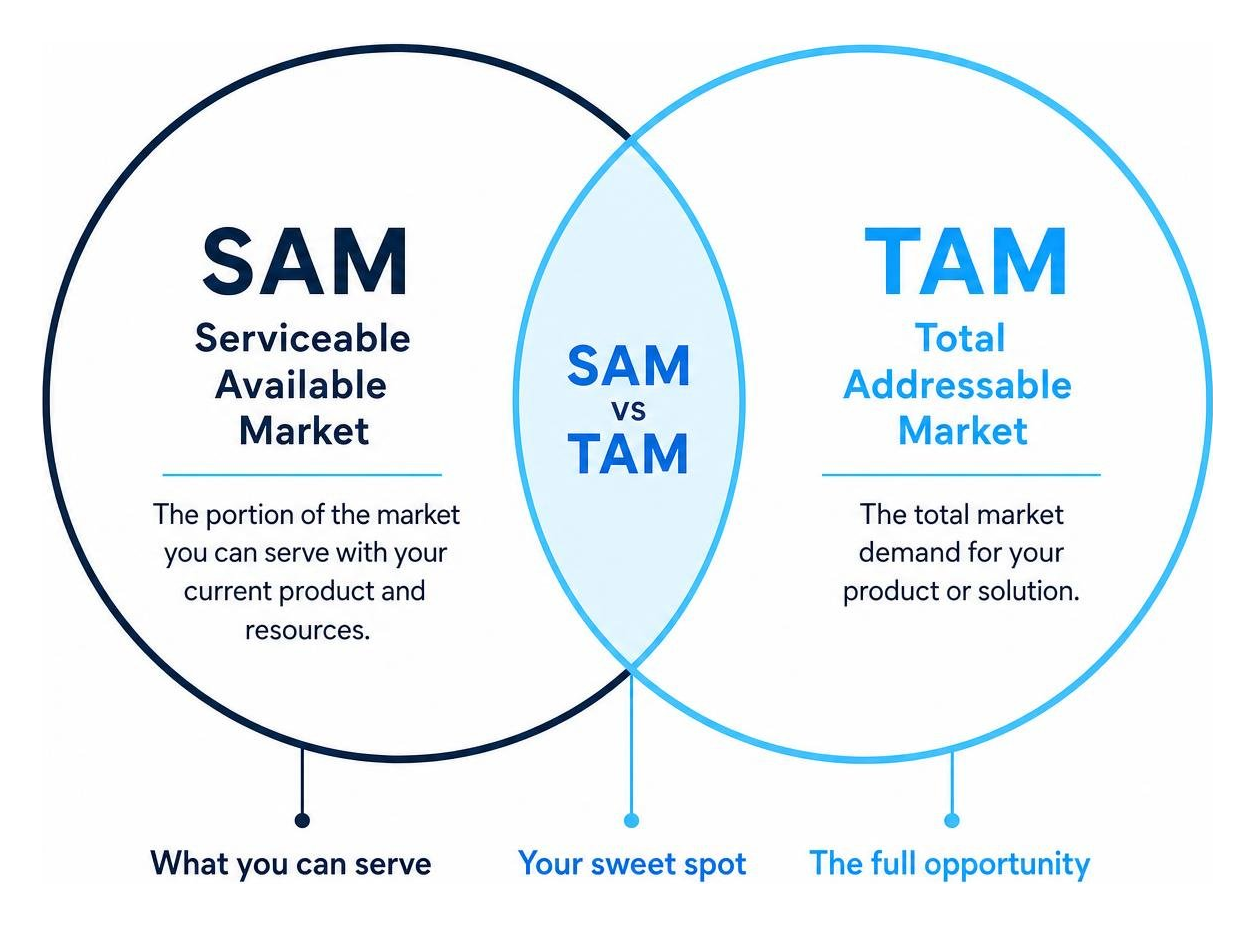
Why Focusing on Your Serviceable Addressable Market Drives Sustainable Scale
To scale efficiently, you must constrain your focus to your Serviceable Addressable Market (SAM)—the portion of the market that you can realistically acquire with your current product and resources.
Maintaining strict Ideal Customer Profile (ICP) discipline before expanding into new channels is critical. SaaS companies that focus ruthlessly on a sharp ICP see 68% higher win rates, a 30% to 40% reduction in CAC, and a 25% to 35% increase in customer lifetime value.
This focused approach is particularly powerful for bootstrapped or early-stage startups. By dominating a clearly defined, narrow niche, you can build a highly loyal customer base and generate predictable cash flow. You can monitor these efficiency gains by tracking your core SaaS Growth Metrics.
Balancing Mission Consistency with Flexible B2B and B2C Business Models
As you scale, you may find opportunities to expand from B2B to B2C, or vice versa. When managing this transition, you must balance your core mission consistency with flexible business models.
Consider these real-world approaches:
- B2C to B2B: A popular digital note-taking app that started as an iOS-only consumer tool can successfully expand into the enterprise market by introducing collaborative team workspaces, single sign-on (SSO), and flexible team billing options.
- B2B to B2C: An enterprise training platform can capture individual self-serve users by offering individual, low-cost training subscriptions alongside their core enterprise contracts.
The key to success here is clear product differentiation. Ensure that your enterprise tiers have distinct, high-value features (like advanced security, audit logs, and custom integrations) gated behind premium pricing, so you do not accidentally cannibalize your high-value B2B contracts with lower-priced consumer plans.
Unifying RevOps and Customer Success as Modern Revenue Engines
In a mature SaaS organization, revenue growth is not just a sales goal—it is an operational discipline. To drive predictable growth, you must unify your Revenue Operations (RevOps), Customer Success (CS), and Finance teams around a single source of truth.
| Metric / Aspect | Sales-Led Expansion | Customer Success-Led Expansion |
|---|---|---|
| Primary Focus | Large account upgrades (>25% TCV uplift) | Seat top-ups, organic usage, feature adoption |
| Ownership | Account Executive (AE) / Account Manager (AM) | Customer Success Manager (CSM) / Self-Serve |
| Core Triggers | Executive alignment, contract renewals | In-app telemetry, usage thresholds, milestones |
| Comp Structure | High commission (8-12% on expansion ARR) | Retention bonuses, soft expansion quotas |
Aligning Sales, Finance, and Operations for Predictable Revenue
Operational friction often occurs during the handoff between sales and finance. For example, a sales team might celebrate marking a complex enterprise deal as "closed-won," only for the finance team to realize they lack the billing details or custom contract terms required to actually invoice the customer.
In an optimized RevOps framework, a deal should never be marked closed-won until all the relevant information required to bill and execute the contract has been fully verified. Establishing this strict gatekeeping process prevents billing bottlenecks and ensures a seamless onboarding experience for your new customer.
To keep all departments aligned, you should build a unified dashboard. By referencing clear SaaS KPI Examples and deploying a centralized SaaS KPI Dashboard, your sales, finance, and operations teams can monitor pipeline health and cash flow predictability in real-time.
Tracking the Essential Metrics for SaaS Revenue Growth Strategies
To scale your SaaS business systematically, you must move away from vanity metrics (like website traffic or signup volume) and focus on the core numbers that directly impact your valuation.
We recommend focusing heavily on these critical SaaS Business Metrics:
- Net Revenue Retention (NRR): This measures the percentage of recurring revenue retained from your existing customer base over a set period, accounting for expansion, contraction, and churn.
- Annual Recurring Revenue (ARR) and Monthly Recurring Revenue (MRR): The foundational baseline of your predictable subscription income.
- Customer Acquisition Cost (CAC) Payback Period: The number of months required to recover the cost of acquiring a customer. Aim for 12 to 18 months.
For a comprehensive breakdown of how these metrics compound, read our analysis on Revenue Growth Strategy: What Actually Works (2026 Benchmarks).
Historically, tracking these metrics required writing complex SQL queries or waiting days for a data analyst to build a report. With atSpark, you can Ask Your Data Anything Without SQL. Our conversational, AI-powered analytics platform unifies your billing, CRM, and subscription data, allowing anyone on your team to type a plain-English question and instantly get the precise charts and insights they need to make strategic decisions.
Frequently Asked Questions about SaaS Revenue Growth Strategies
What is the Rule of 40 in SaaS?
The Rule of 40 is a healthy SaaS metric stating that a company's combined year-over-year revenue growth rate and its profitability margin (typically EBITDA) should exceed 40%.
For example, if your business is growing its MRR at 30% year-over-year, you need a profitability margin of at least 10% to meet the benchmark. Conversely, if you are growing rapidly at 60%, you can afford to run a negative 20% margin as you invest heavily in acquisition.
This metric is a vital indicator of whether your business is balancing growth and capital efficiency effectively.
How does Net Revenue Retention (NRR) impact company valuation?
Net Revenue Retention is one of the most critical metrics for SaaS valuations. A high NRR proves that your product is highly sticky and that your customer base naturally grows over time without requiring expensive new acquisition spend.
Every 1% improvement in Net Revenue Retention (NRR) can lift your SaaS company's valuation by 15% to 20% over a five-year period. Best-in-class enterprise SaaS companies target an NRR above 120%, which means their existing customer base grows by 20% annually even if they add zero new customers.
Why do SaaS startups struggle to scale past $1M ARR?
The primary bottleneck is often the transition away from founder-led sales. In the early stages, founders can close deals through sheer passion, personal networks, and custom product promises. However, this approach does not scale. Around the $500K to $1M ARR mark, founders become a bottleneck, spending too much time on sales execution and not enough on product strategy.
SaaS startups that hire their first professional sales leader or CRO by $500K ARR see 2x revenue growth within 18 months. Transitioning to a repeatable, structured sales playbook is essential to unlock scalable growth.
Conclusion
Supercharging your SaaS revenue growth in 2026 requires moving away from manual, siloed processes and embracing automated, data-driven systems. By building distribution loops directly into your product, localizing global payments, optimizing your pricing models, and aligning your RevOps team, you can build a highly efficient, compounding growth engine.
But you cannot optimize what you do not measure. To make fast, accurate strategic decisions, your team needs instant access to clean, unified data.
This is where atSpark comes in. Our AI-powered analytics platform connects directly to your billing, CRM, and subscription data. Instead of wasting hours writing SQL or wrestling with messy spreadsheets, atSpark lets you ask plain-English questions—like "What is our NRR cohort trend for mid-market accounts over the last six months?"—and receive instant, beautifully visualized charts.
Ready to take control of your revenue data and scale smarter? Explore our comprehensive guide on Important SaaS Metrics to master the numbers that drive your business forward.