The Best Customer Journey Analytics Software in 2026 (Compared)
Customer journey analytics software helps businesses track, analyze, and act on how real customers move across every touchpoint — from a first ad click to a support call to a renewal decision.
If you're evaluating tools right now, here's a quick orientation:
| Category | Best For | Key Capabilities |
|---|---|---|
| Enterprise suites | Unified omnichannel analytics + orchestration | Cross-channel identity stitching, massive data ingestion, and predictive modeling |
| Orchestration + analytics platforms | Automating journeys across 12+ channels | Real-time campaign triggers, multi-channel messaging, and behavioral segmentation |
| Traditional analytics tools | Web and product behavior tracking | Session recording, page-view tracking, and basic funnel analysis |
| Journey mapping platforms | Collaborative CX design and prioritization | Visual journey design, qualitative persona mapping, and team collaboration |
Here's the problem most SaaS and RevOps teams run into: your customers don't move in a straight line. They hit your landing page, ignore three emails, open a chat, talk to sales, churn, and come back six months later. Standard web analytics misses most of that story.
Early web analytics tools were built to track sessions and page views — not complex, multi-channel journeys that span weeks or months. They use a fixed data schema set at the moment of collection, which means you can't go back and ask new questions later.
Customer journey analytics platforms were built to fix that. They stitch together data from web, mobile, email, CRM, call centers, and even offline interactions into a single, time-ordered view of each customer — so you can stop guessing what's driving churn or conversion, and start seeing it.
The stakes are real. A Forrester study found that a combined journey analytics and orchestration stack delivered a 431% ROI. And that's just one data point from the enterprise end of the market.
This guide compares the leading software categories so you can find the right fit — whether you're running a lean SaaS team or managing millions of customer interactions across channels.
What is Customer Journey Analytics?
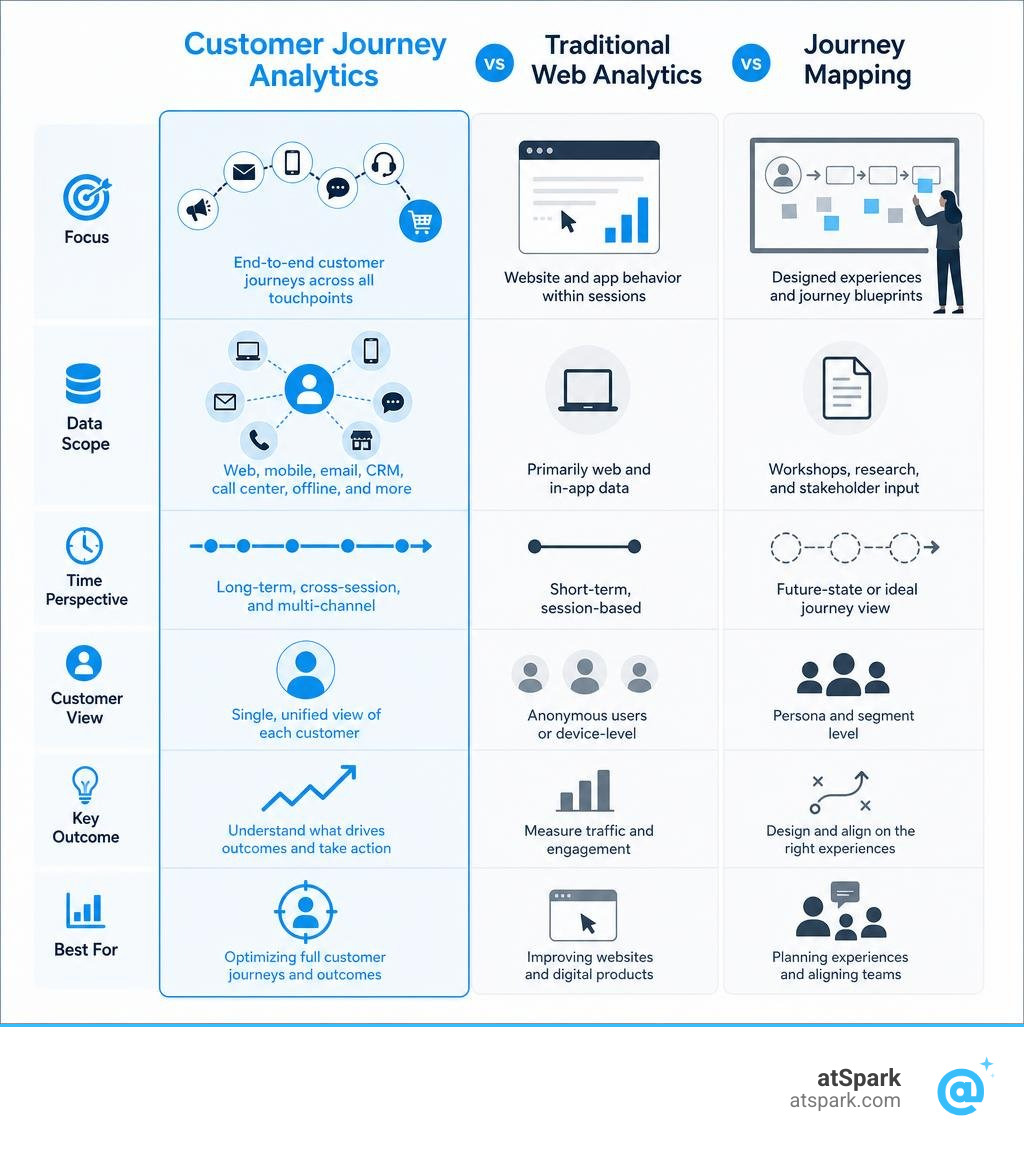
At its core, customer journey analytics is the process of tracking, analyzing, and understanding how customers interact with a brand across all touchpoints and channels throughout their entire relationship. Instead of looking at isolated metrics like "page views on page X" or "open rates on email Y," it focuses on the sequential, time-ordered path a customer takes.
By taking a data-driven, quantitative approach, businesses can transform billions of raw event data points into customer-level insights. This helps us see exactly where users get stuck, why they abandon their carts, or what sequence of actions leads to a long-term subscription renewal.
Customer Journey Analytics vs. Customer Journey Mapping
It is common to confuse customer journey mapping with customer journey analytics, but they serve entirely different purposes:
- Customer Journey Mapping is primarily a qualitative, visual representation of the customer experience. Traditionally, it is based on user interviews, customer personas, and internal assumptions. It is a design-thinking exercise that creates static maps to align teams on what the ideal journey should look like.
- Customer Journey Analytics is a quantitative, data-driven approach that tracks actual, real-time interactions. It does not rely on assumptions; it looks at real user behavior across your systems. This allows you to make data-driven predictions, spot immediate friction points, and measure whether your journey adjustments are actually working.
How It Differs from Traditional Web Analytics
Traditional web analytics platforms measure web and mobile behavior using a fixed report-suite schema that is locked at the time of data collection. They are fundamentally session-based, tracking what happens within a single 30-minute window on a specific browser.
In contrast, modern customer journey analytics software utilizes person-based identity stitching. It takes identifiers from different channels—like a cookie ID from a web visit, a login ID from your SaaS app, an email address from your CRM, and a phone number from a call center log—and merges them into a single, continuous, cross-channel journey. This allows you to analyze integrated performance sequentially rather than in disconnected silos.
The Business Benefits of Customer Journey Analytics Software
Investing in customer journey analytics software is not just about having prettier dashboards; it is about driving tangible business outcomes. When you understand the complete customer experience, you can optimize your marketing spend, streamline your product onboarding, and dramatically improve your return on investment (ROI).
By connecting the dots across touchpoints, teams can also uncover deeper trends, such as how conversational interactions impact the bottom line. To understand how these automated insights tie into your overall financial performance, you can read our guide on what is ai revenue analytics.
Driving Customer Retention and Lifetime Value
For any subscription-based or transactional business, customer retention and lifetime value (LTV) are the ultimate growth metrics. Journey analytics software helps you identify early warning signs of friction—like a sudden drop in product usage or a series of unresolved support tickets—before the customer decides to leave.
By analyzing the pathways of your most successful, highest-value customers, you can build predictive models to guide at-risk accounts toward value. To design a sustainable retention strategy, it helps to pair journey data with proven customer lifetime value forecasting models and heuristics that actually work.
Once you spot these drop-off points, you can deploy targeted interventions. For actionable steps on keeping your subscribers engaged, check out our guide on how to stop your saas customers from slipping away and monitor your progress using key saas customer retention metrics.
How Platforms Unify Online and Offline Touchpoints
One of the biggest hurdles in modern marketing is the divide between digital and physical channels. A customer might research a product on their phone, call a support line with questions, and finally complete the transaction in-store or via a sales representative.
Modern journey analytics platforms break down these data silos by ingesting data from source-system-agnostic channels into a centralized data lake. They use deterministic customer identity matching to stitch these interactions together on a unified timeline.
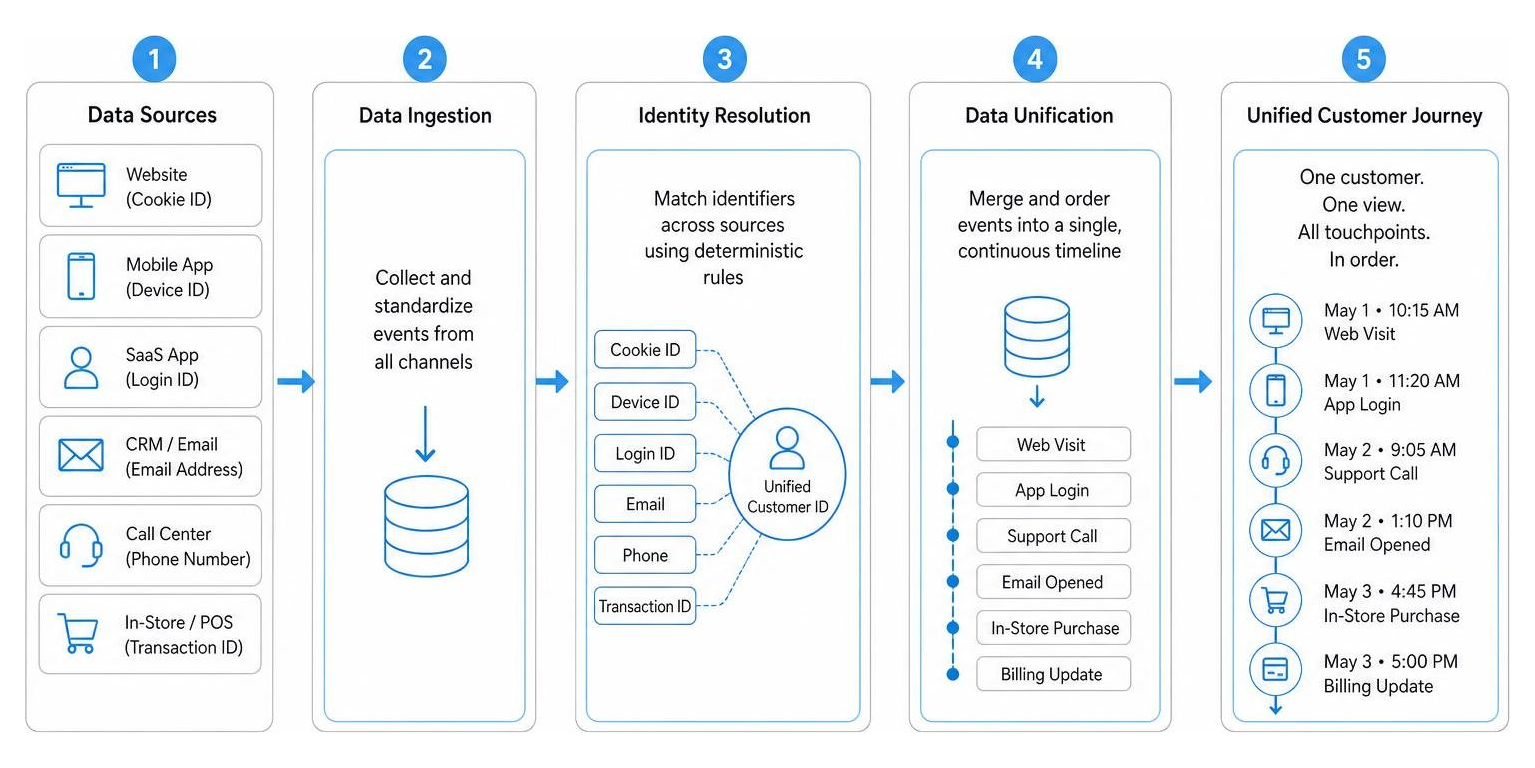
For example, call center logs, CRM updates, billing transactions, and mobile app events are aligned sequentially. This prevents situations where a customer receives an automated "buy now" email for a product they already purchased through a phone representative yesterday.
Key Features and Technology in Modern Platforms
To support real-time data processing and cross-channel stitching, the underlying technology stack of a customer journey platform must be incredibly robust. It must handle massive data ingestion while maintaining strict enterprise governance and data privacy standards. For SaaS organizations, this data foundation is crucial for calculating accurate saas performance metrics.
Key Features to Look For in Customer Journey Analytics Software
When evaluating different platforms, keep an eye out for these essential capabilities:
- Sankey Diagrams and Pathing Visualizations: The industry standard for observing customer flows, allowing you to see where users drop off or take unexpected detours at both macro and individual levels.
- Report-Time Data Flexibility: The ability to retroactively adjust session definitions, change data fields, and modify reporting views non-destructively without needing to reprocess your data pipelines or rewrite code.
- Policy-Based Data Governance: Enforcing sensitivity labels and access controls at the platform level so business users can safely self-serve without violating privacy regulations like GDPR or CCPA.
- Actionable Dashboards: The ability to easily share insights across teams. To see how to structure these insights for your executive team, explore what goes into a modern saas kpi dashboard.
The Role of AI and Machine Learning in Journey Analytics
Artificial intelligence and machine learning have shifted journey analytics from passive reporting to proactive decision intelligence.

Modern tools leverage AI in several ways:
- Agentic and Conversational AI: Allowing business users to query complex journey datasets using plain-English prompts (e.g., "Show me the conversion rate of users who interacted with our chatbot last week").
- LLM Interaction Tracking: Treating generative AI conversational touchpoints (prompts and responses) as structured signals to measure user sentiment and intent directly within the journey map.
- Predictive Audience Segmentation: Automatically grouping users based on their likelihood to churn, convert, or upgrade, allowing for highly targeted campaigns.
Orchestration vs. Analytics-Only Solutions
When shopping for software, you will find a clear divide between analytics-only tools and journey orchestration platforms:
- Analytics-Only Solutions: These focus entirely on data ingestion, identity stitching, and deep behavioral analysis. They help you understand what is happening and why, but you must export those audiences to external marketing tools to take action.
- Journey Orchestration Platforms: These combine analytics with real-time campaign management and delivery engines. They listen to live customer behavior and immediately trigger personalized actions-such as sending a WhatsApp message, a push notification, or an email-directly from a single canvas. For enterprise-grade orchestration, advanced platforms allow teams to build and pressure-test these trigger-based workflows using synthetic user simulations before going live.
Top Customer Journey Analytics Software Platforms for 2026
Choosing the right tool depends heavily on your business size, budget, and engineering resources. To help you navigate the landscape, we have broken down the market categories and their core strengths. Tracking these implementations is key to hitting your overall saas growth metrics.
Comparing Types of Customer Journey Analytics Software Solutions
| Category | Key Strength / Unique Value | Target Audience | Key Evaluation Criteria |
|---|---|---|---|
| Enterprise Suite Solutions | Unmatched data flexibility, deep predictive modeling, and robust data governance. | Large enterprise brands with established data lakes and dedicated data teams. | High return on investment but requires significant integration capabilities. |
| Orchestration & CDP Platforms | Omnichannel reach across 12+ channels; real-time campaign triggers and personalization. | Mid-market to Enterprise B2C and E-commerce brands. | Ease of deployment for marketing teams, though setup can be complex. |
| Point-Solution Journey Mappers | Collaborative visual design, qualitative persona mapping, and ROI tracking for CX fixes. | Enterprise CX teams looking to align internal stakeholders on the ideal journey. | Great for visualization, but lacks real-time data integration capabilities. |
| AI-Driven Conversational Analytics | No-code, plain-English querying; instant charts and insights without SQL or engineering help. | SaaS teams, RevOps, and product managers looking for self-service data access. | Extremely high ease of deployment, low total cost of ownership, and rapid time-to-value. |
Understanding the Different Approaches
- Enterprise Suite Solutions: These platforms are designed for organizations with massive data ecosystems. They decouple the reporting engine from native tracking, allowing you to ingest any offline or online event data. While they offer incredible flexibility and robust data governance, they are highly complex and expensive to set up, often requiring dedicated data engineering teams.
- Orchestration & CDP Platforms: These solutions are powerhouses for multichannel marketing, allowing brands to orchestrate journeys across web, mobile, email, and conversational channels. They help reduce customer acquisition costs and boost conversion rates by delivering personalized messages at the exact right moment.
- Point-Solution Journey Mappers: These tools shift the focus from static mapping to governed decision-making and ROI tracking. They help customer experience (CX) teams prove the financial impact of journey adjustments and prioritize which friction points to fix first.
Overcoming Implementation Challenges
While the benefits of customer journey analytics software are clear, getting these platforms up and running comes with common challenges:
- Data Silos: Your billing data lives in one system, product usage in another, marketing events in a third, and customer support in a fourth. Bringing these together requires robust APIs or a centralized data warehouse.
- Engineering Bottlenecks: Many enterprise solutions require complex SQL queries, custom database schemas, and continuous engineering support just to set up basic tracking or update a report.
- High Total Cost of Ownership (TCO): Enterprise suites often carry hefty annual licensing fees, plus the hidden costs of hiring specialized consultants to manage them.
To justify these investments to your leadership team, it is vital to connect journey improvements directly to important saas metrics and high-level saas business metrics.
Frequently Asked Questions about Customer Journey Analytics
How do you integrate multiple data sources into a journey analytics platform?
Most platforms integrate data using one of three methods: native API connectors, SDKs for real-time web/mobile event tracking, or direct synchronization with cloud data warehouses (like Snowflake or BigQuery). Once the data is ingested, the platform uses a deterministic identifier (like a hashed email or user ID) to stitch the disparate data sources into a single, continuous timeline.
Do I need a dedicated data engineering team to set up journey analytics?
For traditional enterprise suites, the answer is often yes. You will need data architects to configure schemas, manage identity stitching rules, and write SQL queries.
However, the industry is shifting toward no-code, conversational analytics. For SaaS teams that want to bypass the engineering bottleneck entirely, atSpark offers an elegant alternative. By unifying your billing, CRM, and subscription data into an AI-powered platform, atSpark allows your team to ask plain-English questions and get instant charts, tables, and insights—no SQL or engineering resources required.
How does AI-driven decision intelligence differ from standard journey mapping?
Standard journey mapping is a static, qualitative representation of what you think your customers are doing. AI-driven decision intelligence uses real-time behavioral data and machine learning to predict which friction points in your journey are costing you the most revenue. This helps you systematically prioritize which moments to fix, predict the business impact of those fixes, and measure the results dynamically.
Conclusion
The era of relying on basic page-view tracking and gut-feeling journey maps is over. To build a highly defensible, growing SaaS business, you must understand exactly how your users interact with your brand across every single digital and offline touchpoint.
While enterprise-level customer journey analytics software offers incredible power, it often comes with high costs, complex SQL setups, and heavy engineering demands.
At atSpark, we believe that getting deep, actionable customer insights shouldn't require a computer science degree. Our AI-powered analytics platform unifies your SaaS billing, CRM, and subscription data into a single, conversational interface. Your team can ask plain-English questions and immediately receive the charts, tables, and insights they need to optimize saas customer success metrics and drive long-term retention.
Ready to stop guessing and start growing? Explore how you can easily track and optimize your core growth drivers with our comprehensive guide to saas performance metrics.