Why Most Sales Forecasts Fail — and How a Better Process Fixes That
The sales forecasting process is one of the most important — and most broken — routines in any revenue organization. If you're a RevOps or finance lead at a SaaS company, you've probably lived this: the quarter closes, the number doesn't match the forecast, and everyone scrambles to explain why.
You're not alone. Nearly 80% of sales organizations miss their forecasts by at least 10%. And only 45% of sales leaders say they're confident in their own numbers, according to Gartner.
Here's the quick answer on what a solid sales forecasting process looks like:
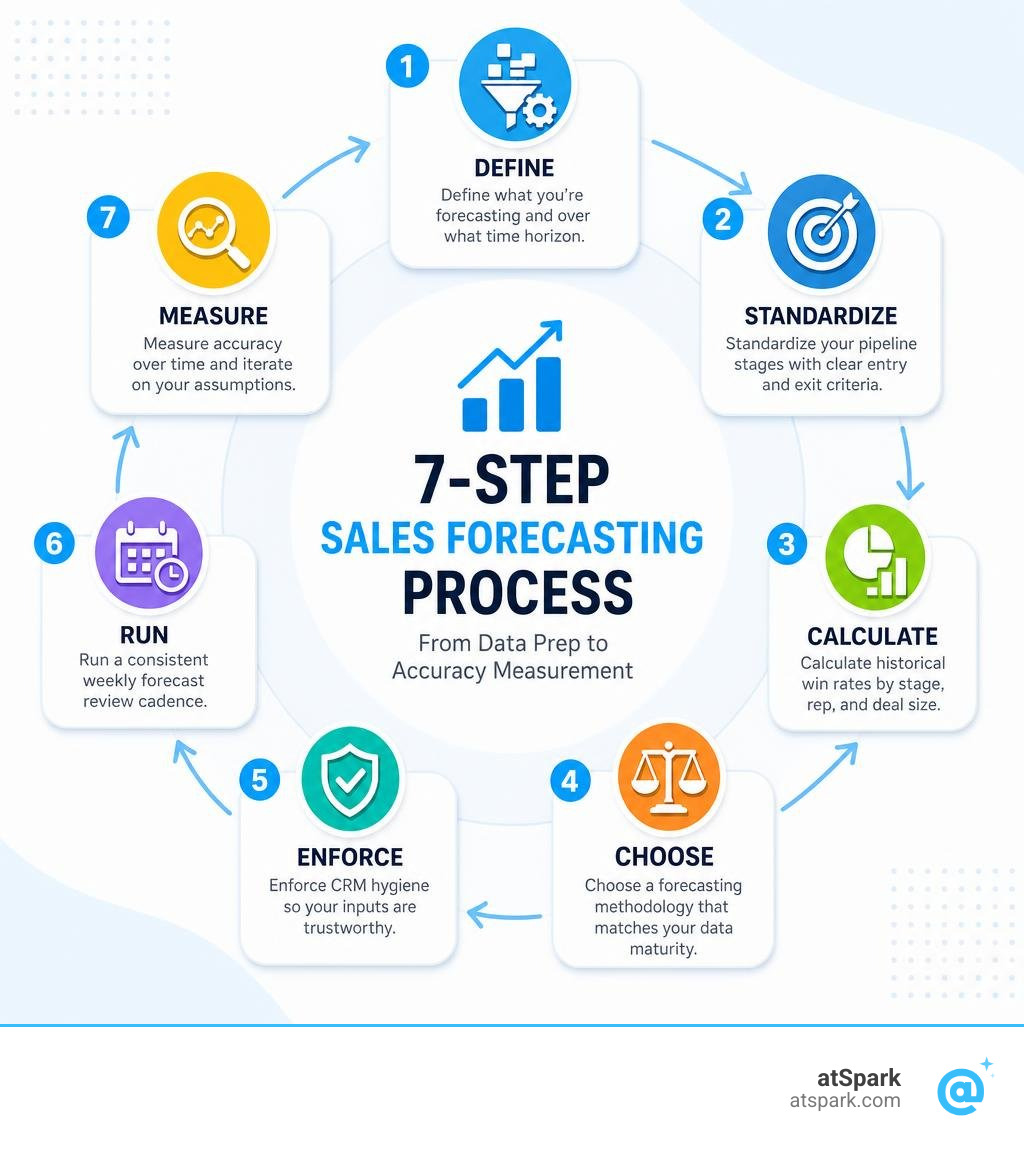
- Define what you're forecasting and over what time horizon
- Standardize your pipeline stages with clear entry and exit criteria
- Calculate historical win rates by stage, rep, and deal size
- Choose a forecasting methodology that matches your data maturity
- Enforce CRM hygiene so your inputs are trustworthy
- Run a consistent weekly forecast review cadence
- Measure accuracy over time and iterate on your assumptions
The problem for most teams isn't the math. It's the foundation underneath it — vague stage definitions, stale CRM data, and a weekly forecast call that's really just a negotiation between a rep's optimism and a manager's fear.
Companies that get this right see real results. Those with precise sales forecasts enjoy 13.4% more year-over-year revenue growth than companies with inaccurate estimates. Getting even marginally better at forecasting creates a compounding advantage.
This guide walks you through every step — from data prep to methodology selection to measuring accuracy — so your forecasts become numbers Finance can actually trust.
What is Sales Forecasting and Why Does It Matter?
At its core, a Sales Forecast is an expression of expected sales revenue within a specific future time frame, such as a month, quarter, or year. It answers two vital business questions: How much revenue are we going to bring in? and When exactly will that revenue land?
It is crucial to distinguish a sales forecast from a sales goal. A sales goal represents where you want to go — it is a motivational target for your sales team. A sales forecast represents where you are actually likely to end up based on active pipeline, historical conversion trends, and current market conditions.
When your forecasting is accurate, it acts as the master lever for strategic decisions across your entire business:
- Resource Allocation: Knowing your future revenue dictates whether you can comfortably hire 20 new engineers or if you need to keep your budget tight.
- Budgeting and Cash Flow: Finance teams rely on the forecast to model runway, manage operating expenses, and execute strategic investments without making critical spending decisions in the dark.
- Operational Planning: For physical product companies, it ensures you do not overproduce inventory or end up with supply chain bottlenecks. For SaaS teams, it helps customer success and onboarding teams staff up ahead of a major customer acquisition wave.

Why Your Business Needs a Structured Sales Forecasting Process
Without a structured, repeatable sales forecasting process, your forecast is nothing more than a collection of finger-in-the-wind guesses. Relying on "gut feel" or unstructured spreadsheets leads to massive revenue blind spots.
A formalized forecasting process provides:
- Predictable Quota Attainment: When you understand your historical conversion metrics, you can set realistic and attainable sales targets. This keeps reps motivated because their targets are grounded in reality, not arbitrary wishful thinking.
- Investor and Board Confidence: For venture-backed or public companies, hitting your forecasted numbers builds immense credibility. Consistently missing your marks by more than a 10% margin, on the other hand, quickly erodes stakeholder trust.
- Proactive Problem Solving: A structured process surfaces pipeline gaps early. If your forecast reveals you are pacing to miss your Q3 numbers, you have time in Q2 to adjust marketing spend, launch promotions, or run targeted outbound campaigns to course-correct before the quarter closes.
Sales Forecasting vs. Demand Planning
While they sound similar and are frequently conflated, sales forecasting and demand planning are distinct processes with different scopes and operational owners.
- Sales Forecasting is primarily a revenue-focused exercise. It looks at the sales pipeline, historical win rates, and rep activity to predict closed deals and incoming cash. It is owned by Sales, RevOps, and Finance.
- Demand Planning is a much broader, cross-departmental operation. It takes the sales forecast as an input and combines it with supply chain data, market capacity, inventory levels, and production capability. Its goal is inventory optimization and production planning to ensure the company can physically deliver what the sales team expects to sell.
| Feature | Sales Forecasting | Demand Planning |
|---|---|---|
| Primary Focus | Revenue prediction and sales pipeline velocity | Inventory optimization and operational capacity |
| Core Question | "How much money will we close next quarter?" | "How much supply do we need to meet customer demand?" |
| Primary Owners | Sales Leadership, RevOps, Finance | Operations, Supply Chain, Product, Procurement |
| Typical Horizon | Monthly, Quarterly, or Annual | Rolling 12 to 18 months |
| Key Inputs | CRM data, rep activities, historical win rates | Sales forecast, market trends, supplier lead times, capacity |
Prerequisites: Preparing Your Data and Pipeline
Before you write a single formula or buy forecasting software, you must prepare your data. Changing your forecasting methodology while your data is dirty is like recalibrating a scale on an uneven floor — you will still get the wrong weight.
To prepare for accurate forecasting, we must first review our sales benchmarks and document our exact sales workflows. This means establishing a shared, clear understanding of how deals move through your pipeline.

Establishing CRM Hygiene and Data Baselines
To build a predictable forecasting engine, your CRM data must be immaculate. You need to establish absolute clarity around five core metrics:
- Sales Pipeline: The total volume of active, qualified opportunities currently being worked by your sales team.
- Sales Funnel: The visual representation of your customer journey, tracking how prospects move from raw marketing leads to closed-won deals.
- Deal Stage: The clearly defined milestones an opportunity must pass through. Every stage must have objective, verifiable buyer actions associated with it (e.g., a signed NDA or a scheduled demo), rather than subjective rep feelings.
- Average Deal Size: The average contract value (ACV) of your closed-won deals. Knowing this helps you spot massive outliers that could artificially inflate your pipeline numbers.
- Sales Cycle Length: The average number of days it takes for a deal to move from creation to closed-won. If your average sales cycle is 90 days, a deal created last week is highly unlikely to close in this month's forecast.
The 7-Step Sales Forecasting Process
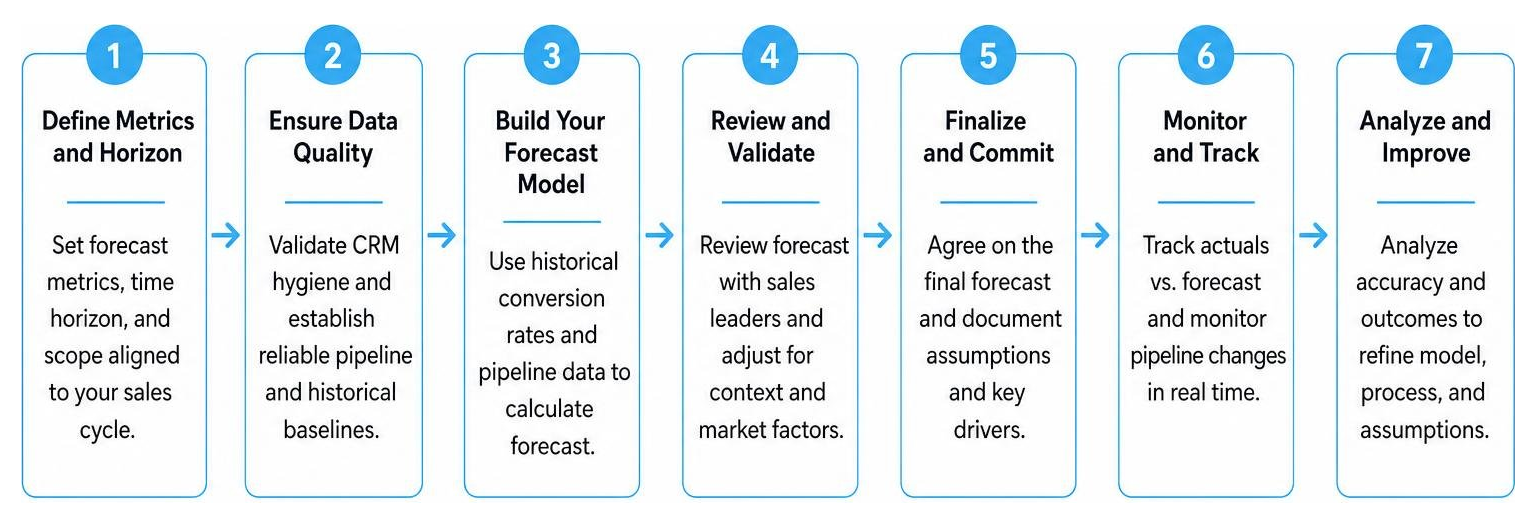
To move away from intuition-based guessing, you must implement a repeatable system. This workflow combines real-time pipeline data, historical conversions, and a structured review cadence.
Let's break down the 7 essential steps to building a robust process.
Step 1: Define Your Forecast Metrics and Horizon
First, determine exactly what you are forecasting and how far out you are looking.
Your forecast horizon should directly match your average sales cycle length. If your typical sales cycle is 30 days, a monthly forecast is highly actionable. If your sales cycle is 180 days, a monthly forecast is mostly a reflection of existing pipeline, and you should focus your efforts on a quarterly or rolling six-month forecast.
Step 2: Standardize Pipeline Stages and Exit Criteria
Next, audit your pipeline stages. The number one killer of forecast accuracy is stage inflation — reps pushing deals into late stages because they had a "great chat" with a prospect.
Every stage must have strict, documented entry and exit criteria based on buyer evidence. For example:
- To enter the "Demo Completed" stage, the buyer must have attended a scheduled demonstration.
- To enter "Proposal Sent," a formal pricing proposal must be delivered to a decision-maker.
Additionally, keep an eye on Deal Age. If a deal has been sitting in the "Negotiation" stage for twice your average sales cycle length, it is not a live opportunity; it is a "zombie deal" that is quietly inflating your pipeline. Every stage should have a maximum time limit before the deal is automatically flagged or moved to closed-lost.
Step 3: Calculate Historical Win Rates
You cannot predict the future without understanding the past. Calculate your baseline Win Rate by analyzing your historical sales data.
For the most accurate results, segment your win rates by:
- Stage: What percentage of deals in "Demo Completed" eventually close-won?
- Rep: Some reps are conservative estimators, while others are eternal optimists.
- Segment and Deal Size: Enterprise deals over $100k close at a different rate than mid-market deals under $20k.
This historical Win-Loss Analysis gives you an objective Deal Win Probability to apply to your active pipeline.
Step 4: Choose a Methodology for Your Sales Forecasting Process
Once your data is clean and your baselines are established, select a forecasting methodology that aligns with your team's data maturity.
For most growing B2B teams, using a Weighted Pipeline is an excellent starting point. This method multiplies the value of each active deal by its stage-specific win probability. For example, if you have a $100,000 deal in a stage with a historical 30% win rate, it contributes $30,000 to your weighted forecast.
At this stage, you must also monitor your Pipeline Coverage. Revenue experts generally suggest maintaining a pipeline coverage ratio of 3x — meaning you have three times your target quota amount in active pipeline to confidently hit your revenue goals.
For a deep dive into structuring these plans, consult The Complete Guide to Building a Sales Forecast | Salesforce UK .
Step 5: Enforce CRM Disciplines and Data Entry
A forecasting model is only as good as the data entered into it. You must build a culture of CRM hygiene where keeping opportunity records updated is viewed as a core sales activity, not an administrative chore.
Enforce strict rules around five critical CRM fields:
- Close Date: Must be updated as soon as a deal timeline shifts.
- Deal Value: Must reflect realistic pricing, not a placeholder.
- Stage: Must match the objective entry/exit criteria.
- Last Activity Date: To quickly identify neglected or stalled deals.
- Next Step and Date: Every active opportunity must have a documented next step.
Step 6: Establish a Weekly Review Cadence
Do not let your forecasting calls turn into "forecast theater," where reps read their deal notes aloud to managers. A forecast review should be a high-signal, structured meeting.
Reps must update all CRM fields before the call. During the review, focus on inspecting at-risk deals and comparing the model-driven numbers against the rep's qualitative commitments. Categorize deals into clear buckets:
- Commit: Deals the rep is highly confident will close this period (≥90% probability).
- Best Case: Deals with a solid path to close, but still carrying open risks (60-80% probability).
- Pipeline: Early-stage deals that are unlikely to close this period but are worth monitoring.
Step 7: Measure Accuracy and Iterate
Finally, you must systematically measure your accuracy. At the end of every period, compare your forecasted numbers against actual closed revenue to evaluate your Quota Attainment and analyze Sales Velocity.
Track your forecast bias to see if your team is systematically over-optimistic or overly conservative. For a masterclass on advanced accuracy metrics like Mean Absolute Percentage Error (MAPE) and Weighted Absolute Percentage Error (WAPE), check out Sales Forecasting: A guide to methods, accuracy & AI (2026) . Use these metrics to continuously tweak your win-rate assumptions and process rules.
Choosing the Right Sales Forecasting Methods
There is no one-size-fits-all forecasting method. The right approach depends on your company's stage, historical data availability, and the complexity of your sales motion.
For a comprehensive breakdown of options, refer to 8 Tested Sales Forecasting Methods for Predicting Revenue | Salesforce .
Quantitative vs. Qualitative Approaches
Forecasting methods generally fall into two buckets: quantitative (data-driven) and qualitative (judgment-driven).
- Historical Forecasting: A quantitative method that uses past performance to predict future results. It assumes your sales run rate will remain constant. While simple, it struggles to account for sudden market shifts or product launches.
- Pipeline Forecasting: A highly quantitative approach that looks at your active pipeline, applying win-rate baselines and deal ages to calculate expected revenue.
- Intuitive Forecasting: A qualitative method relying entirely on the sales rep's subjective evaluation of a deal's likelihood to close. While useful for early-stage startups without historical data, it is notoriously unreliable and impossible to scale.
- Delphi Method: A qualitative approach where a panel of internal and external experts are surveyed anonymously over multiple rounds until they reach a consensus on future market demand. This is highly effective when launching a new product in an entirely emerging market.
- Multi-Variable Forecasting: The gold standard of forecasting, combining active pipeline data, historical sales cycle lengths, rep performance, and external market trends.
Leveraging AI and Predictive Analytics
By 2026, relying solely on manual spreadsheets is a massive competitive disadvantage. Modern sales teams are increasingly building custom machine learning models and leveraging predictive AI to automate the forecasting process, as detailed in AI Sales Forecasting Model: Build | The Skill Shift .
AI-driven forecasting platforms can:
- Identify Hidden Patterns: Machine learning algorithms can analyze thousands of historical deals to find subtle indicators of risk — like an opportunity that has pushed its close date three quarters in a row.
- Analyze Qualitative Signals: Natural Language Processing (NLP) can scan email threads and call transcripts to extract buyer sentiment, tracking how often competitors are mentioned or if a decision-maker has voiced pricing objections.
- Provide Objective Risk Scores: AI can generate an independent deal health score to compare against a rep's subjective "Commit" status, helping managers spot discrepancies before they impact the quarter.
Overcoming Common Challenges in Sales Forecasting
Even with a defined process, external and internal hurdles will arise. The key is building a system that can adapt to changing conditions.
- Market Volatility: Sudden macroeconomic shifts, regulatory changes, or competitor moves can throw off your historical baselines. To manage this, model multiple scenarios (best-case, expected, and worst-case) so your business can pivot quickly.
- Product Lifecycle Changes: Introducing a new product or changing your pricing model will make historical win rates less reliable. In these transition periods, rely more heavily on active pipeline coverage and qualitative buyer feedback.
- Team Alignment: If Sales and Finance are working off different data sets, friction is inevitable. Ensure your forecasting inputs are pulled from a single, unified source of truth.
Managing Human Bias and Dirty Data
The biggest threat to forecast accuracy is the human element. Sales reps are naturally optimistic, which often leads to stage inflation and delayed close dates.
To combat this, apply the GIGO principle: Garbage In, Garbage Out. If your CRM is filled with stale close dates and arbitrary deal values, your forecast will be useless.
Implement automated validation rules in your CRM — such as preventing a rep from moving a deal to "Contract Sent" without attaching a proposal document. Most importantly, tie a small portion of sales managers' variable compensation directly to their forecast accuracy. When managers are incentivized to submit realistic numbers rather than optimistic ones, data hygiene improves overnight.
Frequently Asked Questions about Sales Forecasting
What is a good sales forecast accuracy rate?
For most growing B2B and SaaS companies, landing within 10% of actual closed revenue is considered a healthy and realistic target. Best-in-class revenue organizations consistently achieve an accuracy rate within 5% of actual results.
How often should we update our sales forecast?
You should update deal-level CRM data continuously as events unfold. Formal forecast reviews should happen weekly at the team level, while consolidated roll-ups and snapshots for finance should be produced monthly and quarterly to align with broader business planning.
Can we forecast sales without historical data?
Yes. If you are a new business without historical win rates, prioritize active pipeline coverage. Focus on tracking verifiable buyer engagement (e.g., booked meetings, trials started) and assign conservative, industry-standard close probabilities to your active deals until you build your own baseline data.
Conclusion: Take the Guesswork Out of Your Revenue
Building a reliable sales forecasting process is not about finding a magic mathematical formula. It is about establishing data discipline, standardizing your pipeline, and running a consistent review cadence. When you treat forecasting as a repeatable operational process rather than a guessing game, you gain the predictability needed to scale with confidence.
If you are tired of wrestling with disconnected spreadsheets, stale CRM data, and manual SQL queries just to see where your revenue is pacing, atSpark can help.
As an AI-powered analytics platform built specifically for SaaS companies, atSpark unifies your billing, CRM, and subscription data into a single, trusted source of truth. Instead of spending hours building complex models, your teams can ask plain-English questions and instantly generate beautiful charts, tables, and predictive revenue insights.
Ready to make your forecasting automatic? Explore our resources and learn how to build a reliable Sales Forecast with atSpark today.