What "ARR Meaning" Actually Is (The 30-Second Answer)
The ARR meaning in business is straightforward: ARR stands for Annual Recurring Revenue — the total predictable revenue a subscription-based business expects to collect from its customers over a 12-month period.
ARR = the annualized value of all active, recurring subscription contracts.
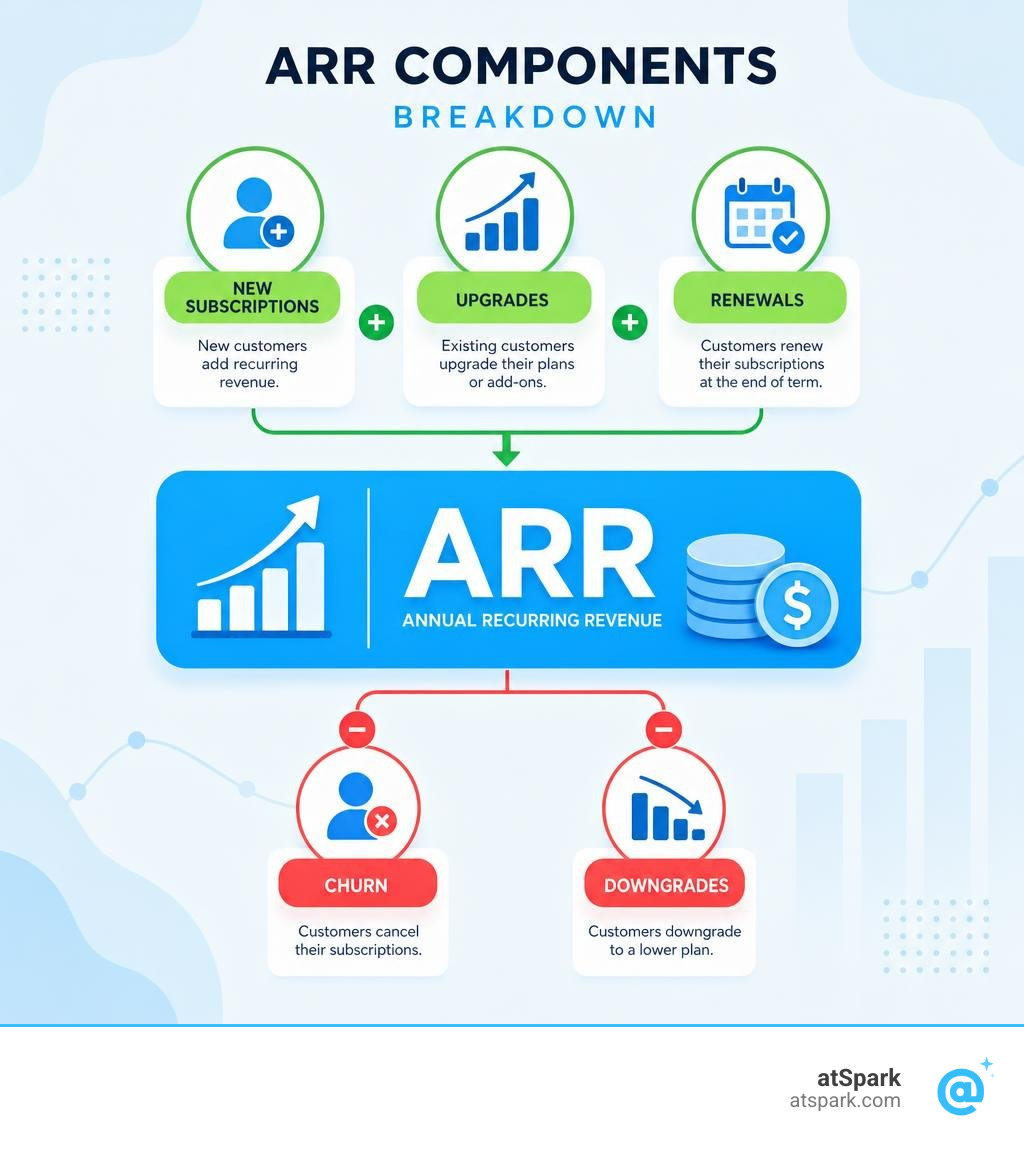
Here's a quick breakdown of what that covers:
| ARR Component | Included? |
|---|---|
| Active subscription fees | Yes |
| Recurring add-ons and upgrades | Yes |
| Renewals | Yes |
| One-time setup or onboarding fees | No |
| Professional services | No |
| Non-recurring charges | No |
If you're a Finance or RevOps lead at a SaaS company, ARR is likely the number your board, investors, and leadership team watch most closely. It strips out the noise of one-time transactions and shows the true, repeatable revenue engine underneath your business.
Now, a quick note on context: "arr" has other meanings depending on where you see it. In travel timetables, arr. means arrival. In sheet music, it means arranged by. In traditional accounting, ARR can even refer to Accounting Rate of Return. But in the SaaS and subscription world — which is almost certainly why you're here — ARR means Annual Recurring Revenue, full stop.
Metrics are only powerful when you understand what they actually measure. ARR is arguably the clearest signal of whether a subscription business is growing, stalling, or quietly bleeding out. And yet, research from a poll of 50 SaaS companies found that 2 out of 5 were calculating it wrong — either including things they shouldn't, or missing things they should count.
That's a costly mistake. This guide covers everything you need to get it right.
What is the True ARR Meaning in Business?
In the subscription economy, ARR is more than just a line item on a spreadsheet; it is the ultimate measure of a company’s momentum. Because subscription businesses operate on recurring contracts, we don't have to start from scratch every single month or year. Instead, we build a compounding engine where each new customer adds to a baseline of predictable, recurring revenue.
The true arr meaning in business lies in this predictability. Unlike traditional retail or consulting models, where sales can wildly fluctuate from one quarter to the next, a healthy SaaS business can look at its ARR and have a highly accurate picture of its financial baseline for the next 12 months. This predictability forms the foundation for strategic hiring, product development, and expansion planning.
However, as we look up the definition of this term, we find that the business definition is often crowded out by everyday language. According to the ARR Definition & Meaning - Merriam-Webster dictionary, the abbreviation has deep roots outside of the corporate boardroom.
Linguistic Origins and the Non-Business ARR Meaning
If you search for the lowercase abbreviation "arr." in a standard dictionary, you won't find mentions of SaaS metrics, churn, or venture capital. Instead, you'll find linguistic definitions used in travel and music.
For instance, the arr. abbreviation - Definition, pictures, pronunciation and usage notes | Oxford Advanced Learner's Dictionary at OxfordLearnersDictionaries.com page notes that "arr." is most commonly used in transportation schedules to denote "arrives" or "arrival" (as in, dep. London 09:00, arr. Edinburgh 13:30).
Similarly, the ARR. | English meaning - Cambridge Dictionary points out its role in travel, alongside its usage in music publishing, where "arr." stands for "arranged by" (e.g., Symphony No. 5, arr. Franz Liszt).
If you dive into Arr. - definition of arr. by The Free Dictionary, you'll find a massive list of homonyms across various industries:
- Medicine: Aldosterone/Renin Ratio (a screening tool for primary aldosteronism).
- Art (UK): Artist's Resale Right (royalties paid to visual artists when their work is resold).
- Dentistry: Apical Root Resorption.
Even the ARR. meaning in English, значение слова. Collins COBUILD Advanced Learner's English Dictionary and the arr - Wiktionary, the free dictionary entries remind us that "arr" can represent the stereotypical pirate interjection (popularized by actor Robert Newton in the 1950 film Treasure Island) or serve as the ISO 639-3 language code for the Arara-Karo language of Brazil.
While these linguistic tidbits are fun at trivia night, they won't help you prepare for your next board meeting. In the business world of July 2026, ARR is the king of metrics.
Why Subscription Businesses Care About the ARR Meaning
Why are subscription companies so obsessed with ARR? Why not just look at standard sales figures?
The answer comes down to three main pillars:
- Predictability as a Crystal Ball: When you know your baseline recurring revenue, you can accurately forecast your cash runway. You can confidently answer questions like: Can we afford to hire five new engineers next quarter? or Do we have the budget to scale up our marketing spend?
- Setting Realistic Goals: Because ARR normalizes your revenue over a year, it prevents you from overreacting to seasonal spikes or temporary dips. It gives you a stable baseline to set targets for your sales, marketing, and customer success teams.
- Attracting Investors and Maximizing Valuation: Investors value subscription businesses at much higher valuation multiples than transactional businesses. Why? Because recurring revenue is highly predictable and significantly reduces investment risk. When valuing a SaaS company, venture capitalists and growth equity firms heavily weigh ARR and its year-over-year growth rate.
To track these dynamics effectively, companies must monitor a suite of SaaS Metrics to Track, ensuring they understand how their recurring engine is performing.
ARR vs. Total Revenue and Annual Profit
One of the most common financial blunders in early-stage startups is confusing ARR with total revenue or GAAP (Generally Accepted Accounting Principles) revenue.
Let's clear this up:
- ARR (Annual Recurring Revenue): This is an analytical metric. It shows the annualized run-rate of your active, recurring subscription contracts. It is not recorded on your official income statement.
- Total Revenue: This is an accounting metric that includes all money coming into the business during a given period. This includes non-recurring streams like setup fees, one-time consulting packages, and hardware sales.
- Annual Profit (Net Income): This is what is left over after you subtract all operating expenses, taxes, interest, and cost of goods sold (COGS) from your total revenue.
Consider a fictional SaaS company in July 2026 with the following annual financial breakdown:
- Active Subscriptions: 100 customers paying $10,000/year = $1,000,000 ARR
- One-time Implementation Fees: $200,000
- Professional Services/Consulting: $300,000
- Total Revenue: $1,500,000
- Operating Expenses: $800,000
- Annual Profit: $700,000
In this scenario, the company's ARR is $1,000,000, but its total revenue is $1,500,000. If the executive team mistakenly used the total revenue figure of $1.5M to calculate their recurring run-rate, they would overhire and overspend, assuming they had $500,000 of highly predictable revenue that was actually just one-time cash.
Understanding how these metrics interact is a core part of tracking SaaS Performance Metrics to keep your business financially stable.
How to Calculate Annual Recurring Revenue
Calculating ARR can be incredibly simple or surprisingly complex, depending on your pricing model.
In its simplest form, if all of your customers are on annual contracts, you simply sum the annual contract value of all active subscribers.
If you sell monthly subscriptions, you must first calculate your Monthly Recurring Revenue and annualize it.
The baseline formula is:
$$ARR = MRR \times 12$$
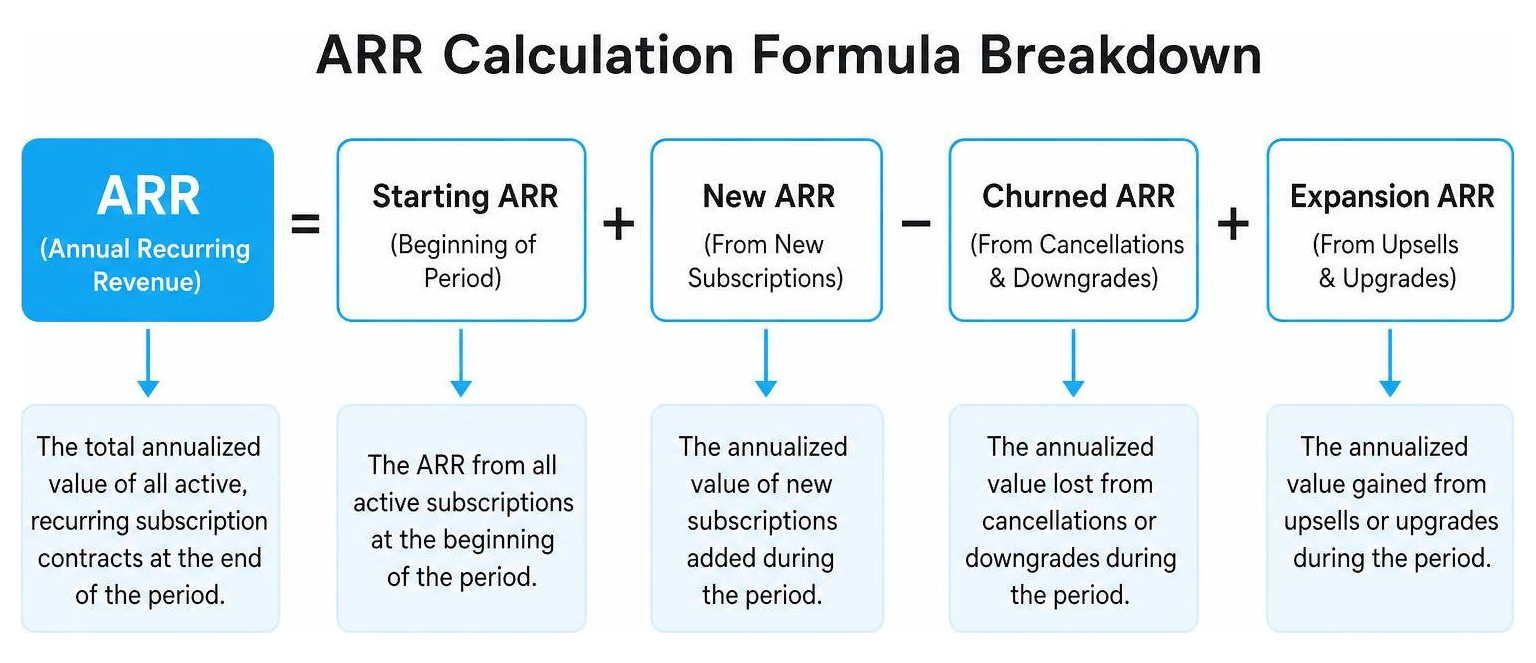
Alternatively, if you want to calculate your Net New ARR (which accounts for the ongoing expansion and contraction of your customer base), you use this formula:
$$Net\ New\ ARR = Starting\ ARR + New\ ARR + Expansion\ ARR - Contraction\ ARR - Churned\ ARR$$
Where:
- Starting ARR: Your recurring revenue at the beginning of the period.
- New ARR: Revenue added from entirely new customers acquired during the period.
- Expansion ARR: Additional revenue from existing customers who upgraded their plans or purchased recurring add-ons.
- Contraction ARR: Lost revenue from existing customers who downgraded to cheaper plans but did not cancel entirely.
- Churned ARR: Lost revenue from customers who canceled their subscriptions completely.
To make these calculations easier, we've built a free MRR Calculator to help you keep your monthly inputs clean before annualizing them.
What to Include in Your ARR Calculations
To keep your metrics accurate, you must be disciplined about what goes into the equation. Only include revenue streams that are contracted, predictable, and recurring.
- Subscription Fees: The core recurring fee paid by your customers to access your software (whether billed monthly, quarterly, or annually).
- Recurring Upgrades and Add-ons: If a customer pays an extra $50/month for a recurring premium support package or an extra seat license, this is Expansion MRR and should be annualized into your ARR.
- Contracted Price Increases: Scheduled, recurring price increases written into multi-year contracts.
What to Exclude from Your ARR Calculations
Including non-recurring revenue in your ARR is the fastest way to lose the trust of your board and investors.
- One-Time Setup/Onboarding Fees: While these fees are great for cash flow, they do not recur next year.
- Professional Services or Custom Development: One-off consulting projects or custom feature builds are transactional, not recurring.
- Discounts and Credits: If you give a customer a temporary $100/month discount for six months, your ARR calculations must reflect that reduced contract value during those six months.
- Variable Usage Fees: Overage charges that fluctuate wildly from month to month should generally be excluded unless there is a guaranteed contractual minimum.
Confusing these elements is incredibly common. For a deeper dive into how to avoid these traps, read our guide on Why You Are Probably Confusing Annual Recurring Revenue with Run Rate.
Limitations and Restrictions of ARR
While ARR is a fantastic metric for measuring growth and valuation, it does have distinct limitations:
- It is Not Cash Flow: ARR represents the contractual value of your subscriptions, not the physical cash in your bank account. If you sign a $12,000 annual contract but bill the customer monthly, your ARR immediately increases by $12,000, but you only collect $1,000 this month. If your customers are slow to pay, you could run out of cash despite having a stellar ARR.
- It Hides Retentive Health: A company could have $10M in ARR and be growing at 50% year-over-year, but if they are achieving that growth by spending massive amounts of cash to acquire new customers while losing existing ones at a rapid clip, the business is fundamentally broken. To see the full picture, ARR must always be paired with your Churn Rate and Net Revenue Retention (NRR).
ARR vs. MRR: Understanding the Key Differences
The debate between tracking ARR versus MRR usually comes down to your contract structures and sales cycles. While they are mathematically related, they serve different operational purposes.
| Feature | ARR (Annual Recurring Revenue) | MRR (Monthly Recurring Revenue) |
|---|---|---|
| Timeframe | 12 Months (Macro view) | 1 Month (Micro view) |
| Primary Use Case | Board reporting, fundraising, long-term planning | Operational tracking, weekly sales velocity, marketing performance |
| Best For | B2B SaaS with annual/multi-year contracts | B2C or B2B SaaS with monthly, self-serve contracts |
| Key Metric Focus | Year-over-Year (YoY) growth | Month-over-Month (MoM) growth, MRR Growth Rate |
MRR is excellent for capturing short-term operational fluctuations. If a marketing campaign in June goes viral, you will see a massive spike in your Net New MRR in July. ARR, on the other hand, smooths out these monthly fluctuations to give you a high-level view of the company’s long-term trajectory.
When to Use ARR vs. MRR
Choosing which metric to emphasize depends on your business model:
- Emphasize ARR if: Your average contract length is one year or longer. If your sales reps are closing annual enterprise deals, monthly tracking is too noisy. ARR aligns perfectly with your annual budget cycles and enterprise sales cycles.
- Emphasize MRR if: Your customers sign up online via credit card and can cancel at any time. For self-serve SaaS models, MRR is your operational lifeblood, helping you spot churn issues before they compound into annual disasters.
Regardless of your contract lengths, both metrics are core pillars of your overall SaaS Business Metrics framework.
What is a Good ARR Growth Rate for SaaS Companies?
Once you have calculated your ARR, the next logical question is: How fast should we be growing?
What constitutes a "good" growth rate depends heavily on your company's stage and funding. A mature, publicly traded company growing at 25% year-over-year might be celebrated by Wall Street, while an early-stage venture-backed startup growing at that same rate would struggle to raise its next round.

Across the SaaS landscape, the median ARR growth rate for private subscription companies typically hovers between 40% and 60%. However, to stay in the top 25% of growth companies worldwide, businesses must achieve and sustain an ARR growth rate above 100%.
To see how your specific growth numbers compare to the broader market, check out our analysis on How Does Your SaaS ARR Growth Rate Stack Up Against the Best?.
Early-Stage Startup Growth Benchmarks
For early-stage startups (typically defined as those with $1M to $3M in ARR), growth expectations are incredibly high. These companies are looking to prove product-market fit and scale rapidly.
Ambitious, venture-backed startups often target the T2D3 growth model (Triple, Triple, Double, Double, Double). This model suggests that a startup should strive to triple its ARR for two consecutive years, and then double it for the next three years.
At this stage, a healthy year-over-year ARR growth rate is 100% to 300%. To sustain this level of momentum, teams must monitor their SaaS Growth Metrics daily to optimize customer acquisition and retention.
Mid-Stage and Mature Company Growth Benchmarks
As a company scales into a mid-stage business ($5M to $15M+ ARR), maintaining triple-digit growth becomes mathematically challenging.
- Mid-Stage Companies: A healthy growth target ranges between 40% and 100% year-over-year.
- Mature Businesses ($15M+ ARR): Growth typically slows to less than 40%, with a sustainable, long-term target of 10% to 30% year-over-year.
At this mature stage, investors look closely at the Rule of 40. This rule states that a SaaS company's growth rate plus its profit margin should equal or exceed 40%. If your ARR growth has slowed to 25%, but your profit margin is a healthy 20%, your combined score is 45% — signaling a highly efficient, valuable business.
Optimizing and Increasing Your ARR
Calculating your ARR is only half the battle; the real work lies in growing it. To increase your ARR efficiently, you have to look beyond simply closing new deals.
Consider this: research shows that sales reps spend just 28% of their time actually selling. The rest of their day is swallowed by manual data entry, updating CRMs, and hunting down billing information. By automating administrative tasks, you can free up your sales team to focus on closing high-value accounts.
Additionally, don't overlook your existing customer base. It is far cheaper to expand an existing account than to acquire a new one. To drive expansion revenue, focus on building tailored customer experiences; 56% of consumers say they will become repeat buyers after receiving a personalized experience. Aligning your product tiers with customer needs makes upselling and cross-selling a natural part of their journey.
Conclusion
Understanding the true arr meaning in business is the first step toward building a predictable, scalable, and highly valued subscription engine. But as your company grows, tracking ARR in manual, disconnected spreadsheets quickly becomes a nightmare. Data gets trapped in your billing system, your CRM, and your customer support logs, leading to costly calculation mistakes.
That is why we built atSpark.

atSpark is an AI-powered subscription analytics platform designed specifically for SaaS companies. We unify your billing, CRM, and subscription data into a single, governed source of truth.
Instead of waiting for an analyst to write complex SQL queries or build fragile Excel models, atSpark lets your team ask plain-English questions—like "What is our net new ARR growth rate this quarter?" or "Show me our expansion ARR by product tier"—and get instant, beautiful charts, tables, and insights. It is conversational, governed business intelligence without the engineering overhead.
Ready to stop guessing and start growing? Explore our comprehensive glossary definition of ARR and see how atSpark can transform your subscription data into your company's unfair advantage.