Why SaaS Billing Cycle Optimization Directly Impacts Your Revenue and Cash Flow
SaaS billing cycle optimization is the process of designing, automating, and refining how and when you charge customers — so you collect revenue faster, lose less to errors, and keep more customers around longer.
If you're looking for a quick answer on how to optimize your billing cycle, here's where to start:
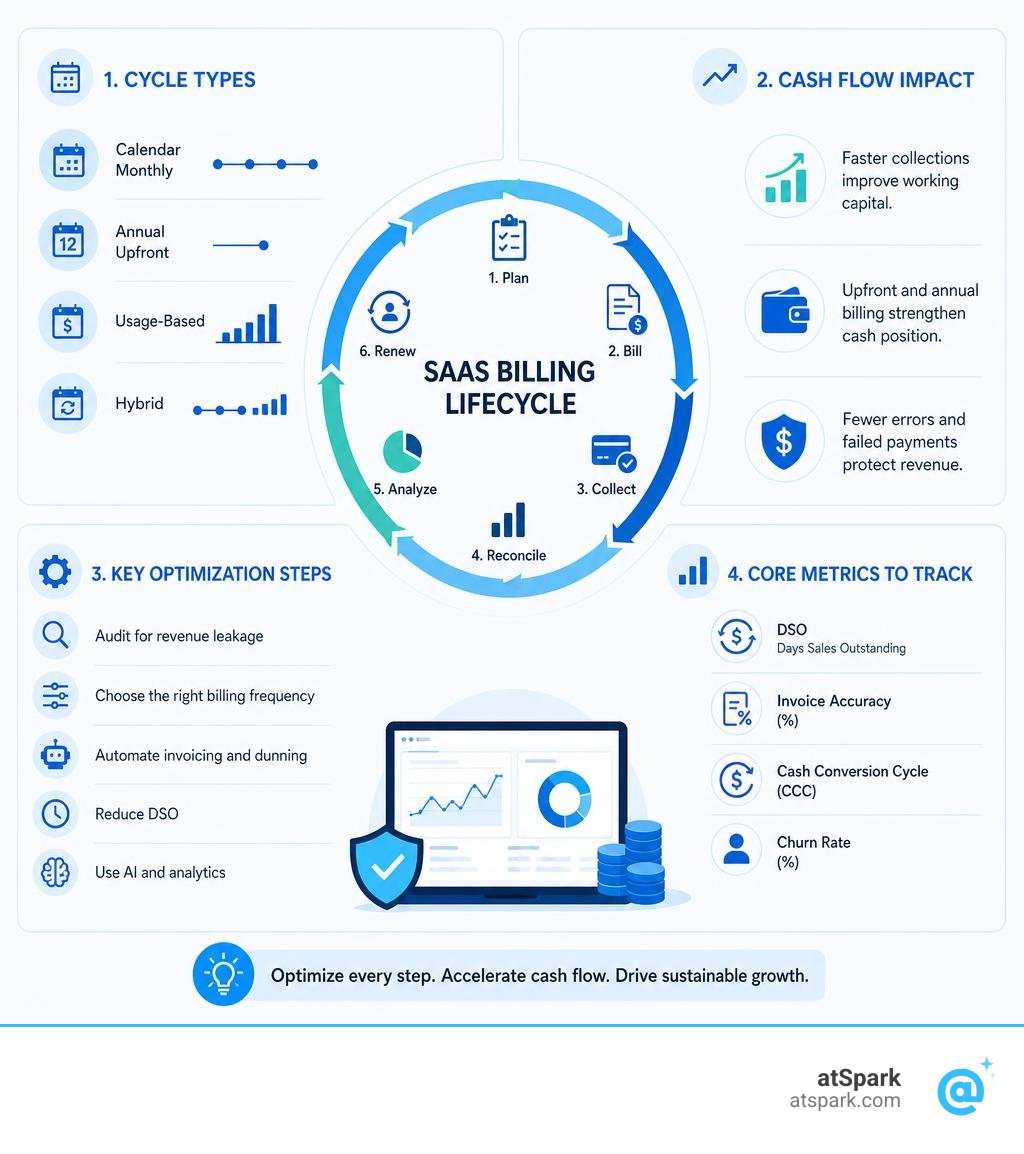
- Audit for revenue leakage — misaligned contracts, missed usage charges, and manual errors cost most SaaS companies 3–5% of ARR every year.
- Choose the right billing frequency — annual billing improves cash flow and reduces churn; monthly billing demands stronger retention.
- Automate invoicing and dunning — manual processes carry a 12.5% error rate and 61% of late payments trace back to billing errors.
- Reduce your DSO — at $24M ARR, cutting your days sales outstanding by just 15 days frees roughly $986,000 in working capital.
- Use AI and analytics — to catch anomalies before invoices go out and predict which customers are at risk of churning or failing to pay.
For Finance and RevOps leaders, billing cycles aren't just an ops detail. They directly shape your MRR predictability, CAC payback, and your ability to forecast with confidence. Yet 57% of invoices are still paid late — and a third take more than 90 days to settle. That's not a collections problem. That's a system problem.
This guide walks through every layer of the issue: how SaaS billing differs from traditional invoicing, which billing models fit which customers, how to eliminate the most common failure points, and when it's time to move beyond spreadsheets to a platform built for scale.
Understanding SaaS Billing Cycles vs. Traditional Invoicing
To understand why SaaS billing cycle optimization requires a distinct approach, we must first look at how subscription billing differs from traditional, one-off invoicing.
In a traditional sales model, billing is transactional. A customer purchases a perpetual software license or physical asset, we send a single invoice, they pay it, and the transaction is complete. The relationship may continue through support contracts, but the core financial exchange is linear.
SaaS, however, operates on a continuous loop of recurring revenue. Instead of a single transactional event, we establish an ongoing subscription billing relationship. This introduces several layers of operational complexity:
- Proration and Mid-Cycle Changes: Customers frequently upgrade, downgrade, add seats, or cancel mid-cycle. Calculating these adjustments manually leads to massive operational debt and a high margin of error.
- Customer Lifetime Value (LTV): In SaaS, the initial sale is only the beginning. Maximizing LTV depends on our ability to seamlessly manage renewals, upsells, and cross-sells over years, not days.
- Complex Pricing Architectures: Modern software pricing is rarely flat. It often includes tiered seats, usage-based credits, one-time setup fees, and custom enterprise contracts.
Managing these continuous loops requires a deep understanding of standard industry terms. If you are looking to brush up on subscription terminology, our comprehensive Glossary is a great place to start.
Why SaaS Billing Cycle Optimization Matters for Cash Flow
At its core, optimizing your billing cycle is about accelerating cash collection and maximizing working capital. When billing processes are unoptimized, companies experience a wide gap between delivering value and receiving cash.
This delay is measured through Days Sales Outstanding (DSO)—the average number of days it takes to collect payment after an invoice is issued. High DSO traps valuable working capital that could otherwise be deployed for product development, sales expansion, or customer acquisition.
Consider the financial impact: at $24M ARR, a 15-day DSO reduction frees approximately $986,000 in working capital.
Furthermore, unoptimized billing cycles lead to silent revenue leakage. Many companies lose 3–5% of their Annual Recurring Revenue (ARR) to leakage caused by misaligned contracts, manual data entry errors, missed usage charges, or delayed invoicing. If we are delivering our services at machine speed but collecting cash at a human pace, we are leaving significant revenue on the table.
To keep a close eye on these dynamics, teams must monitor their broader SaaS Business Metrics to ensure billing friction is not quietly eroding the company's financial health.
Common Billing Cycle Types and Choosing the Right Frequency
SaaS companies have several options when structuring their billing cycles. Each frequency carries distinct trade-offs for cash flow, customer retention, and administrative complexity.
- Monthly Billing: Customers are invoiced every month. This lowers the barrier to entry for cash-conscious buyers but requires continuous value demonstration to prevent high churn.
- Annual Billing: Customers pay for a full year upfront. This drastically improves short-term liquidity, provides immediate working capital, and secures a 12-month commitment.
- Quarterly Billing: A middle ground often used in enterprise deals to balance customer budget cycles with our cash flow needs.
- Usage-Based Billing: Invoices are calculated dynamically based on consumption (e.g., API calls, data stored, active users). While highly aligned with customer value, it makes revenue forecasting more complex.
- Hybrid Billing: A model combining a flat recurring subscription with usage-based overages or add-ons. Interestingly, 68% of AI products still include a subscription component, even when teams layer usage metrics or credits on top to capture additional value.
| Billing Frequency | Cash Flow Impact | Retention/Churn Profile | Admin Complexity | Best Suited For |
|---|---|---|---|---|
| Monthly | Consistent, predictable monthly cash flow; no major upfront spikes. | Higher risk of monthly churn; requires constant retention efforts. | Low to Moderate (automated recurring charges). | SMBs, B2C SaaS, self-serve products. |
| Annual | Excellent; provides immediate upfront working capital. | High retention; gives us 12 months to prove value and secure renewal. | Low (one invoice per year per customer). | Mid-market, Enterprise, high-CAC products. |
| Usage-Based | Variable; cash flow fluctuates based on customer adoption. | Highly aligned with value; churn is lower if usage remains active. | High (requires real-time usage tracking and rating). | Infrastructure, developer tools, API platforms. |
| Hybrid | Balanced; combines predictable base cash with variable expansion. | Strong; scales naturally with the customer's growth. | Very High (must sync subscription states with usage data). | B2B Enterprise SaaS, AI applications. |
Choosing the Right Billing Frequency for Your Customer Segments
There is no one-size-fits-all billing frequency. The right choice depends on your specific customer type, pricing model, sales cycle length, and overarching revenue goals.
- SMB vs. Enterprise: Small and medium-sized businesses (SMBs) usually prefer monthly billing via credit card to maintain cash flexibility. Enterprise buyers, on the other hand, expect annual or multi-year contracts paid via ACH or wire transfer, managed through formal purchase orders (POs).
- Impact on CAC Payback: Billing frequency directly influences your CAC Payback Period. If it costs $6,000 to acquire a customer, a monthly contract of $500 means it takes 12 months to break even. If that same customer pays $6,000 upfront on an annual prepaid plan, we achieve immediate CAC payback on day one, drastically reducing our cash burn.
- Pricing Metrics and Growth: Choosing the right pricing metric is critical. Companies that use a pricing metric grow 30% faster than those who don’t. Aligning your billing cycle with how your customers naturally consume and budget for your software is a proven growth lever.
Strategic SaaS Billing Cycle Optimization: Best Practices for 2026
Optimizing your billing workflow requires moving away from fragmented, manual processes toward a unified, automated system.
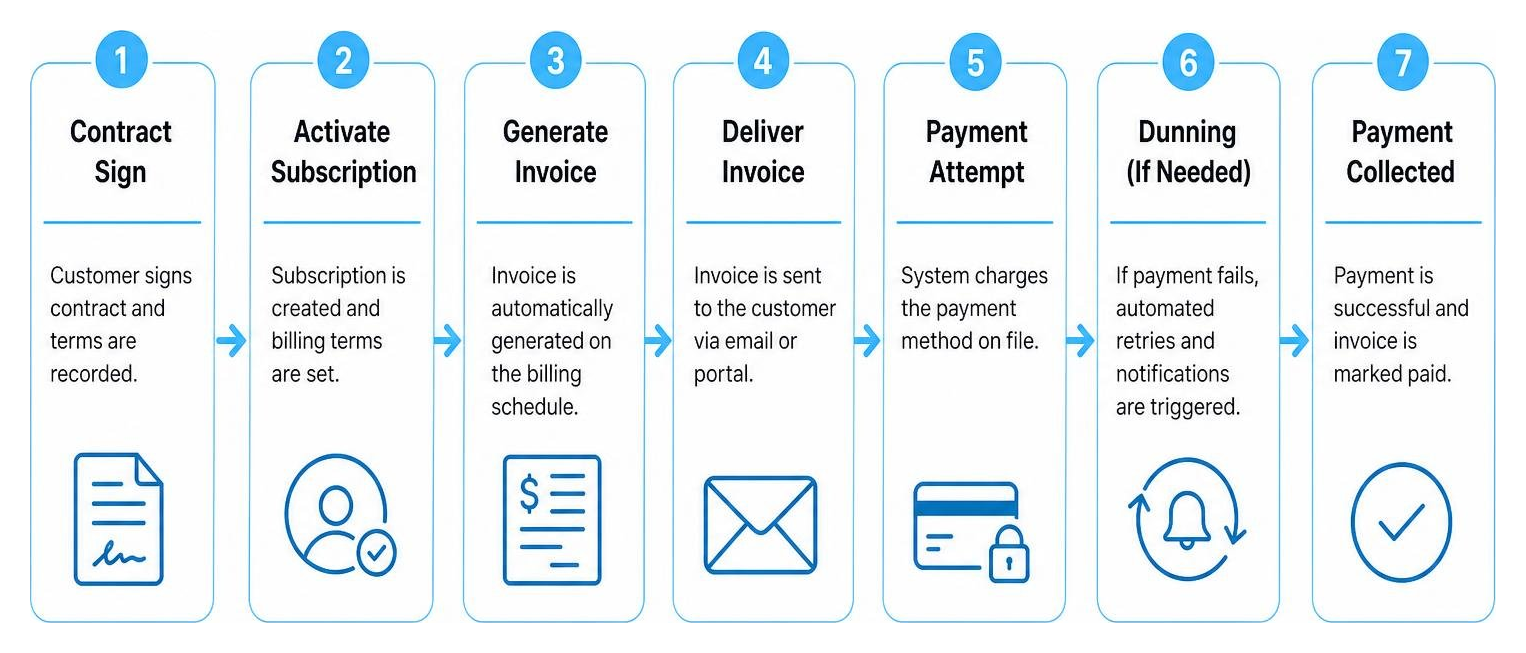
To build a modern, frictionless billing engine, we recommend implementing the following best practices:
- Automate Invoicing and Dunning: Manual invoicing results in an average 12.5% error rate, and 61% of late payments stem directly from billing errors. Automating your invoice generation and dunning (failed payment recovery) workflows ensures invoices are accurate and sent on time.
- Design a Robust Dunning Process: Set up automated card retries, grace periods, and clear, non-intrusive email notifications when a payment fails. This prevents passive churn caused by expired credit cards or temporary bank declines.
- Provide Customer Self-Service Portals: Allow customers to update payment methods, view historical invoices, and upgrade or downgrade their plans without needing to contact support. This reduces administrative overhead and improves the user experience.
- Maintain Transparency: Be open and honest about renewal dates, pricing terms, and cancellation policies. Confusing billing communication damages trust and drives up dispute rates.
If you want to see how your current churn rates compare to industry benchmarks, you can use our interactive Churn Rate Calculator to measure the impact of passive billing churn on your bottom line.
Solving Complex Billing Challenges and Mid-Cycle Changes
As SaaS companies scale, they inevitably face complex billing scenarios that spreadsheets simply cannot handle. Two of the most common challenges are proration and staggered start dates.
When a customer upgrades mid-cycle, we must calculate the exact prorated amount for the remaining days of the current period while instantly granting access to the new features. If this isn't automated, finance teams spend hours on manual calculations, delaying invoice delivery and risking data mismatches between the CRM and the billing system.
Furthermore, enterprise contracts often involve multiple products or add-ons with staggered start dates. For instance, a customer might purchase core licenses starting in January, but add-on modules that don't activate until March. Managing these staggered schedules without creating a disjointed customer experience requires advanced billing capabilities.
To handle these scenarios gracefully, companies often turn to specialized subscription engines. For example, you can learn about aligning billing dates during contract amendments via the Billing Day Alignment During an ABO | Conga Documentation Portal . Additionally, for managing complex multi-year agreements, teams can refer to the guide on how to Group and bill charges with staggered start dates | Zuora Product Documentation .
AI, Compliance, and Transitioning to Dedicated Billing Platforms
For early-stage startups, tracking subscriptions in Google Sheets or basic accounting software is a common starting point. However, as transaction volumes grow, this manual approach creates significant operational debt.
When you reach a point where pricing changes require custom engineering work, or when your sales and finance teams are reporting different ARR figures because contract data is siloed, it is time to transition to a dedicated subscription management platform.
A dedicated platform acts as a central orchestration engine, connecting your CRM, product usage data, and ERP. This integration is crucial for maintaining compliance with revenue recognition standards like ASC 606 and IFRS 15. Under ASC 606, SaaS companies cannot recognize revenue simply when cash is collected; instead, it must be recognized over time as the service is delivered. Automated billing systems ensure that deferred revenue is tracked accurately, keeping your books audit-ready and preventing costly financial restatements.
To measure the overall health of your billing engine, finance and RevOps teams should regularly track these essential metrics:
- DSO (Days Sales Outstanding): The average time it takes to collect payments.
- Billing Error Rate: The percentage of invoices requiring manual adjustment after generation.
- ARR (Annual Recurring Revenue): The normalized yearly value of your recurring revenue.
- MRR (Monthly Recurring Revenue): Your predictable monthly subscription revenue.
- Invoicing Disputes: The volume of customer disputes related to billing errors.
For a deeper dive into the exact formulas and tracking strategies for these metrics, read our guide on SaaS Metrics to Track.
Leveraging AI for SaaS Billing Cycle Optimization
Artificial Intelligence is shifting billing from a reactive, historical process to a proactive growth engine. Rather than looking backward at last month's metrics, modern finance teams use AI to anticipate issues and optimize billing workflows in real time.
- Predictive Anomaly Detection: AI algorithms analyze thousands of billing runs to flag unusual invoices—such as a sudden 10x spike in a customer's usage charge—before they are sent. This allows teams to correct errors silently, preserving customer trust.
- Smart Collections and Payment Prediction: Machine learning models analyze historical customer payment behaviors, card types, and bank response codes to predict which payments are likely to fail. AI can then dynamically adjust retry schedules (e.g., retrying a card on a specific day of the week when bank funds are typically higher) to maximize recovery rates.
- Usage-Based Upsell Signals: By unifying usage and contract data, AI can flag when a customer is approaching 95% of their plan limits. This alerts account managers to proactively reach out with expansion offers, directly boosting your Net Revenue Retention.
Frequently Asked Questions about SaaS Billing Cycles
What is the difference between a billing cycle and an accounting cycle?
A billing cycle focuses entirely on the customer-facing schedule of invoicing and collecting payments (typically running on 28-to-31-day intervals based on subscription start dates). An accounting cycle is an internal financial process focused on recording, reconciling, and closing the company's financial books for a specific period (usually calendar months, quarters, or fiscal years).
How does annual billing affect customer churn?
Annual billing acts as a powerful retention buffer. By securing a 12-month commitment upfront, we eliminate the eleven monthly "purchase decisions" where a customer might consider canceling. This gives our customer success teams a full year to drive product adoption, demonstrate value, and resolve issues before the next renewal window. To understand how this impacts your overall retention, check your Customer Churn Rate metrics regularly.
When should a SaaS startup move away from spreadsheets for billing?
A SaaS startup should move away from spreadsheets when manual billing processes begin to slow down the monthly close, or when custom contracts and mid-cycle proration calculations lead to frequent invoicing errors. Generally, once a company surpasses $1M to $2M in ARR, the operational debt, manual error rates, and risk of revenue leakage make spreadsheets highly inefficient and financially risky.
Conclusion: Turn Billing Data into Strategic Insights with atSpark
SaaS billing cycle optimization is more than just a cost-saving exercise—it is a critical lever for driving capital efficiency, reducing churn, and accelerating growth. By automating complex workflows, aligning billing frequencies with customer segments, and leveraging modern analytical tools, we can transform our billing department from a back-office utility into a strategic growth engine.
However, optimizing your billing cycle is only half the battle. To make truly informed decisions, you need to understand how your billing data interacts with customer behavior and sales pipelines.
This is where atSpark comes in.
atSpark is an AI-powered analytics platform for SaaS companies that unifies your billing, CRM, and subscription data into a single, cohesive source of truth. Instead of writing complex SQL queries or waiting days for engineering to build custom dashboards, atSpark lets your team ask plain-English questions—like "What is our average DSO by customer segment?" or "Show me MRR growth compared to payment failures"—and receive instant, accurate charts, tables, and insights.
By delivering conversational, governed analytics without the technical overhead, we help RevOps and Finance teams uncover hidden revenue leakage, optimize pricing models, and make data-driven decisions in real time.
Ready to gain complete visibility into your billing performance and subscription health? Explore our guide on Important SaaS Metrics to see how you can start measuring and mastering your recurring revenue today.