The Number Every Sales Leader Is Losing Sleep Over
What is quota attainment in sales? Here is the short answer:
Quota attainment is the percentage of their assigned sales target that a rep or team actually achieved in a given period. It is calculated as: (Actual Sales ÷ Assigned Quota) × 100 = Quota Attainment %
For example, if a rep has a $100,000 quarterly quota and closes $75,000, their quota attainment is 75%.
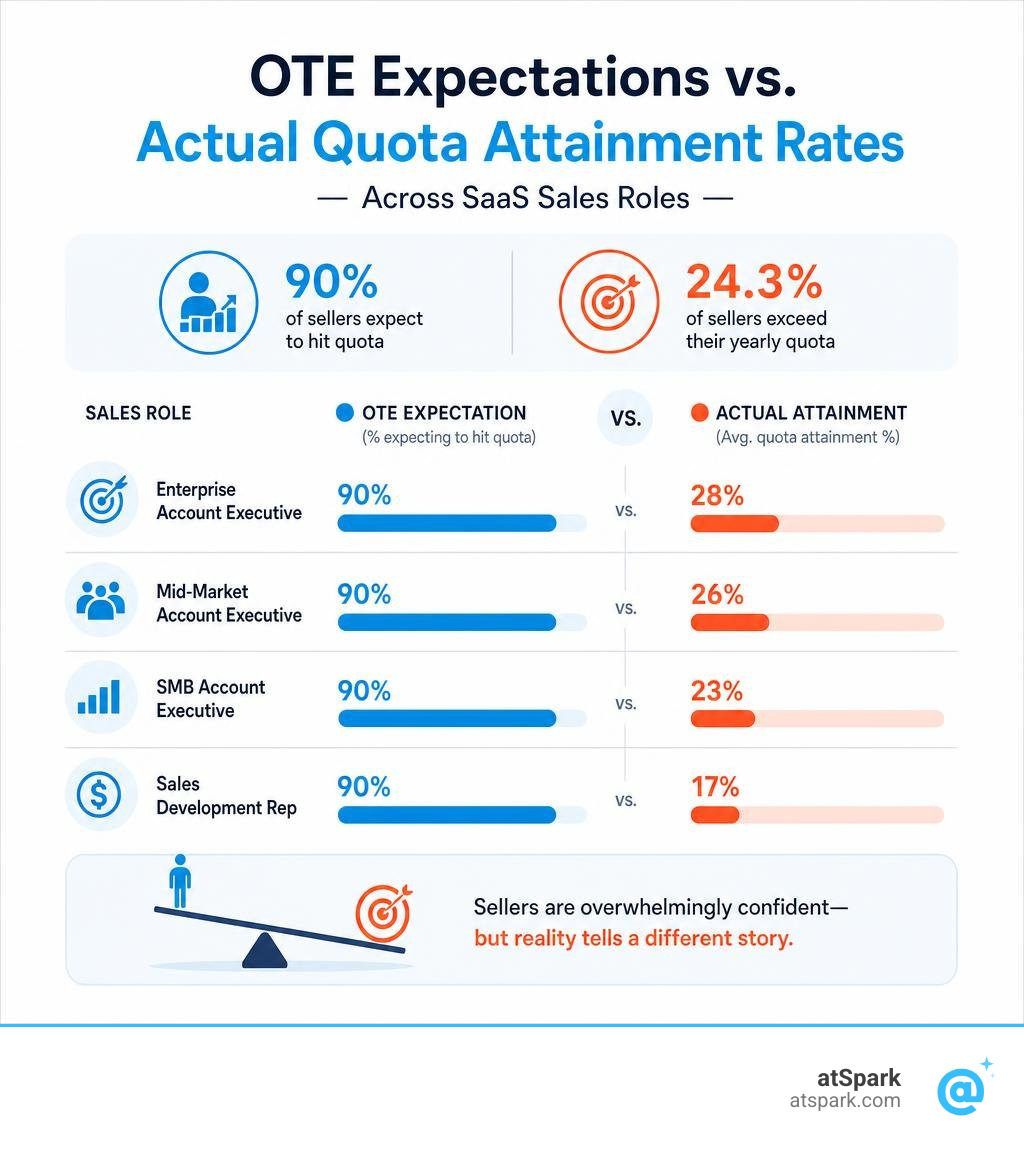
That is the clean, textbook version. The messier reality? Two-thirds of sales reps did not hit their quota by the end of 2025. Only 24.3% of salespeople exceed their yearly quota. And yet 90% of sellers say they expect to hit it.
That gap — between expectation and reality — is exactly what fills threads on r/sales every week. Reps argue their quotas are impossible. Leaders insist the targets are fair. RevOps sits in the middle trying to reconcile three different attainment numbers from three different spreadsheets.
Here is the thing: most of those arguments are actually about something deeper than quota attainment itself. They are about how quotas get set in the first place, and whether the math behind them was ever grounded in reality.
This guide breaks all of it down — the formula, the benchmarks, the debates, and what it means for your capacity plan.
What is quota attainment in sales terminology:
What Is Quota Attainment in Sales and How Is It Calculated?
At its core, quota attainment is a diagnostic tool. While it is heavily tied to sales compensation and commission structures, it is also the ultimate health indicator for your overall go-to-market (GTM) strategy.
When you track What is Quota Attainment?, you are measuring the direct alignment between your sales targets and the reality of the market. If your team's attainment is healthy, it validates your pricing, your product-market fit, and your sales enablement efforts. If it is low, it serves as an early warning system that something in your sales process is broken.
To truly understand this metric, we must look at it from two distinct levels:
- Individual Quota Attainment: The percentage of an individual salesperson's target that they personally closed.
- Team-Level Quota Attainment: Instead of just averaging everyone's numbers, team-level attainment is best measured by the percentage of individual reps who hit or exceed 100% of their target.
For a deep dive into how these dynamics unfold, check out Quota Attainment: Definition, Formula & What It Reveals | Outsales .
The Mathematical Formula for What Is Quota Attainment in Sales
The basic mathematical formula for individual quota attainment is straightforward:
$$\text{Quota Attainment (\%)} = \left( \frac{\text{Actual Sales}}{\text{Assigned Quota}} \right) \times 100$$
Let's look at how this applies across different sales roles:
- Account Executive (AE): An AE has a quarterly revenue quota of $300,000. By the end of the quarter, they close $240,000 in new Annual Recurring Revenue (ARR). $$\left( \frac{\$240,000}{\$300,000} \right) \times 100 = 80\% \text{ attainment}$$
- Sales Development Representative (SDR): An SDR is measured on an activity-based volume quota of 50 sales-qualified leads (SQLs) per quarter. They successfully book 42 SQLs. $$\left( \frac{42}{50} \right) \times 100 = 84\% \text{ attainment}$$
- Customer Success Manager (CSM): A CSM has an annual expansion and upsell quota of $200,000. They close $220,000 in account expansions. $$\left( \frac{\$220,000}{\$200,000} \right) \times 100 = 110\% \text{ attainment}$$
When calculating these numbers, it is critical to use the exact same crediting rules that drive your commission payouts. Additionally, you must prorate quotas for ramping reps. Expecting a newly onboarded rep in their first quarter to hit a full quota will artificially drag down your team's metrics and destroy the rep's motivation.
If you are tracking these metrics in a CRM, check out The Ultimate Guide to Tracking Quota Attainment Per Rep in Salesforce for step-by-step guidance on setting up custom roll-up summaries and formulas.
Understanding the Different Types of Sales Quotas
To measure attainment accurately, managers must first understand the different types of quotas they can set. Depending on your business model, different roles should be aligned with different targets:
- Revenue Quotas: The most common type of quota. Reps are expected to close a specific dollar amount of new business, ARR, or Contract Value (ACV) within a set period.
- Activity Quotas: Tied to leading indicators of sales success rather than closed revenue. These measure the volume of outreach, such as discovery calls, emails, or product demos. You can read more about these operational metrics in our Sales Activity Glossary.
- Volume Quotas: Based on the absolute number of units sold or new-user signups rather than deal value. For example, a Product-Led Growth (PLG) team might set a volume quota of 100 new-user activations per month.
- Profit Quotas: These hold reps accountable for the gross margins or profit of the deals they close. While they protect company margins, they are generally unpopular among sales representatives because they hold them accountable for pricing structures and costs that are often outside their direct control.
- Combination Quotas: A hybrid approach that balances both leading activity indicators and lagging revenue results. This is highly effective for complex, long-cycle enterprise sales where a rep might go months without closing a deal but must maintain high pipeline generation activities.
The Reddit Debate: What Is a Realistic Quota Attainment Rate?
If you spend any time on r/sales, you will notice a recurring theme: reps complaining about "quota inflation." Many believe that leadership sets quotas based on wishful thinking rather than historical data.
So, what does a healthy, realistic quota distribution actually look like?
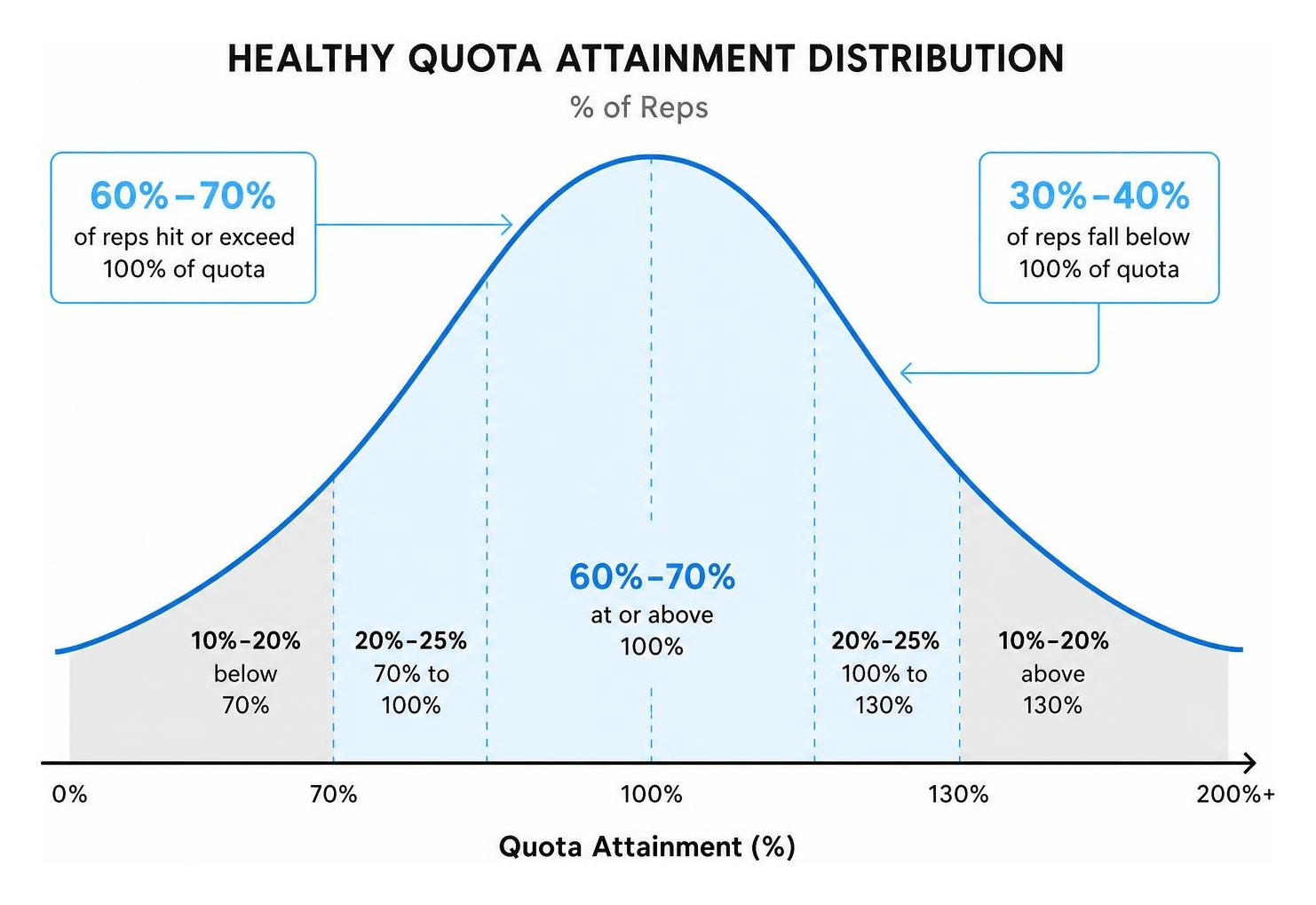
In a structurally healthy sales organization, quota attainment should follow a normal bell-curve distribution:
- 60% to 70% of reps should hit or exceed 100% of their individual quota.
- The remaining 30% to 40% will fall below their goal, with ramping reps and bottom performers making up this group.
This is the standard benchmark referenced in Sales Quota Attainment: Formula & Benchmarks .
If more than 80% of your sales team is hitting quota, your targets are likely set too low. You are leaving revenue on the table and overpaying on commissions relative to your market potential.
Conversely, if fewer than 50% of your reps are hitting their targets, you do not have a "lazy sales team" problem — you have a quota-setting or pipeline-coverage problem. When a majority of the team fails, it fosters a toxic culture where reps expect to lose, leading to high turnover and disengagement.
Why Blended Averages Lie and Distribution Curves Matter
One of the biggest mistakes Revenue Operations (RevOps) and finance teams make is reporting a single, blended average for team quota attainment.
Imagine a team of 10 reps with a collective quota of $1,000,000 ($100,000 each).
- Rep A (a superstar) closes a massive, outlier enterprise deal worth $600,000 (600% attainment).
- Reps B through J each close only $40,000 (40% attainment).
If you look at the blended team average, the team closed $960,000 in total revenue — a seemingly healthy 96% average attainment.
But in reality, 90% of your sales team failed.
This is a fragile, high-risk sales organization. If that single superstar rep decides to leave the company, your revenue engine collapses. This is why you must analyze the distribution curve of your attainment. Look at cohort-level attainment by tenure bands and geography to isolate where the gaps are. For more on how to project these distributions into future performance, see our Sales Forecast Glossary.
The Reality of What Is Quota Attainment in Sales Across Industries
Let's look at the hard data. How many reps are actually hitting their targets in the real world?
According to industry research from Salesforce and RepVue:
- Only 28% of sales reps across all industries hit their annual quota.
- In B2B SaaS, the average individual rep attainment sits between 43% and 47%.
- Fully ramped SaaS sales representatives typically achieve quota attainment rates between 50% and 60%.
- The average yearly quota for an inside sales pro is $985,000, with a healthy attainment rate of 55%.
- The average yearly quota for an outside sales rep is $2.7 million, with a higher average attainment rate of 65% (though enterprise deals run much lumpier with wider spreads).
These benchmarks, detailed in the Sales Quota Attainment Guide (2026) + Free Calculator , show that the classic "60-70% of reps hitting quota" is an ideal planning target, but many companies fall far short.
Why Tracking and Analyzing Quota Attainment Is Critical for GTM Teams
Why does this metric matter so much to your entire go-to-market organization? Because quota attainment is the connective tissue between finance, sales, and operations.
When different departments look at quota attainment, they see different things:
- For Sales Reps, it means commission, accelerators, and job security.
- For Sales Managers, it is a measure of team productivity and coaching effectiveness.
- For RevOps, it is the foundation of capacity planning and forecasting accuracy.
- For Finance, it validates hiring budgets and investor growth targets.
To explore this from a leadership perspective, read Everything You Need to Know About Quota Attainment | Salesforce .
The Strategic Link to Sales Capacity and Forecasting
Quota attainment is the output that validates or invalidates your sales capacity model. When your team falls short of its revenue goals, you can look at the "4 Knobs" of sales capacity planning to find out why:
- Volume: Did we generate enough pipeline?
- Conversion Rate: Did our lead-to-opportunity win rates drop?
- Velocity: Did our sales cycles lengthen? (For a deeper look, check out our Sales Velocity Glossary).
- Average Selling Price (ASP): Did reps have to discount heavily to close deals?
If you plan your future revenue targets against a theoretical 100% quota capacity without adjusting for your historical realized attainment, you will systematically under-staff your team, over-promise to your board, and miss your revenue projections.
The Psychological Impact on Rep Motivation and Retention
Setting unrealistic quotas has a devastating psychological toll on a sales force. If reps look at their targets and realize they would have to pull off a miracle to hit 100%, they will simply check out.
Furthermore, the design of your compensation plan heavily influences rep behavior:
- Accelerators: High-performing reps are driven by uncapped commission accelerators that kick in after they cross 100% of their quota.
- Decelerators: If a comp plan penalizes reps too heavily for falling slightly short (e.g., zero payout if they achieve less than 70% attainment), it encourages sandbagging — holding back closed deals until the next performance period to guarantee a payout.
How Sales Leaders Can Set Realistic, Data-Driven Quotas
How do you break the cycle of arbitrary quota setting? You must move away from top-down mandates and embrace bottom-up planning.
A standard industry rule of thumb is the 5x OTE Rule. This means a representative's annual quota should be set at roughly five times their On-Target Earnings (OTE).
- If a rep has an OTE of $120,000 (e.g., $60,000 base + $60,000 variable), their annual quota should be set at $600,000.
This ensures that the revenue generated by the rep comfortably covers their salary, benefits, and the overhead costs of keeping them on the team. Depending on your company stage and sales cycle length, this multiple can range from 3x to 8x.
For more strategies on aligning quotas with earnings, read How to Improve Quota Attainment by Rep.
Moving Away from Top-Down Board Mandates
Top-down quota setting usually involves taking a board-mandated growth goal (e.g., "We must grow 50% next year") and spreading that growth expectation evenly across all territories and reps. This "peanut butter" approach fails because it ignores historical performance, market changes, and territory maturity.
Instead, sales leaders should set quotas by looking at:
- Historical Attainment: What have fully ramped reps actually delivered over the last 3 years?
- Territory Potential: Does an established enterprise territory in New York have the same pipeline potential as a newly launched territory in the Midwest? (Hint: No).
- Ramp Curves: New hires should have a prorated quota that gradually increases as they complete their onboarding.
Proven Strategies and Tools to Help Reps Consistently Hit Quota
To help your reps consistently clear their targets, focus on these operational levers:
- Implement Strict Pipeline Hygiene: Run weekly or bi-weekly pipeline reviews. If a deal has sat in the same stage with no activity for more than 30 days, move it to "Closed-Lost" or "Nurture." Keep your team's "Stagnant Deal Percentage" below 15% to ensure your forecasts are based on real interest.
- Coach at Stage Transitions: Provide targeted coaching when deals are moving from discovery to demo, or from proposal to negotiation. If a rep receives more than 3 hours of coaching a month, they beat their quota by 7% on average.
- Enable Mobile CRM Access: When reps have mobile access to their CRM, 24% more of them meet their annual quotas because they can update deal information and respond to buyers in real-time.
- Provide Real-Time Commission Visibility: Nothing motivates a seller more than seeing exactly how much money they will make if they close a specific deal. Giving reps a live dashboard that displays their current attainment and estimated payout turns an abstract quarterly goal into a daily, actionable motivator.
Frequently Asked Questions about Quota Attainment
What percentage of sales reps actually hit quota?
Across all industries, only about 28% of sales reps hit their annual quota. In the B2B SaaS space, that number rises to roughly 43% to 47%. In a healthy, well-calibrated sales organization, you should aim to have 60% to 70% of your fully ramped reps hitting or exceeding 100% of their target.
What is the difference between inside and outside sales quotas?
Inside sales representatives (who sell remotely from an office or home) carry an average yearly quota of $985,000. Outside sales representatives (field reps who travel to meet clients in person) carry a much higher average yearly quota of $2.7 million due to larger enterprise deal sizes and higher travel overhead costs.
How does coaching impact quota attainment?
Coaching has a massive, measurable ROI. According to a study by the Corporate Executive Board (CEB), sales reps who receive more than three hours of coaching per month beat their quota by 7% on average. Conversely, reps who receive less than two hours of coaching per month miss their targets by an average of 10%.
Conclusion
The endless debates on Reddit about quota attainment aren't going away anytime soon. But as a sales leader, you can step out of the argument by grounding your quota-setting process in real, unified data.
When you stop guessing and start building bottom-up capacity models based on historical sales velocity, conversion rates, and territory potential, you set your team up for predictable success.
That is where we come in. atSpark is an AI-powered analytics platform designed specifically for SaaS companies. By unifying your billing, CRM, and subscription data, atSpark lets your team ask plain-English questions and get instant charts, tables, and insights. No SQL, no engineering wait times — just governed, conversational analytics that show you exactly who is on track to hit their numbers and why.
Ready to see how real-time data can transform your sales planning? Learn more about tracking What is Quota Attainment? with atSpark today.