Why Quota Attainment Improvement by Rep Is the Hardest Problem in Revenue Leadership
Quota attainment improvement by rep is one of the most urgent challenges facing SaaS revenue teams right now — and the numbers back that up.
Here are the fastest ways to improve quota attainment at the rep level:
- Recalibrate quotas using bottom-up capacity data, not growth-era targets
- Build 3x+ pipeline coverage before each quarter starts
- Give reps real-time visibility into their attainment and commission position
- Invest in structured manager coaching — not just deal inspection
- Cut admin time by automating CRM updates and post-call notes
- Redesign territories to distribute opportunity fairly across the team
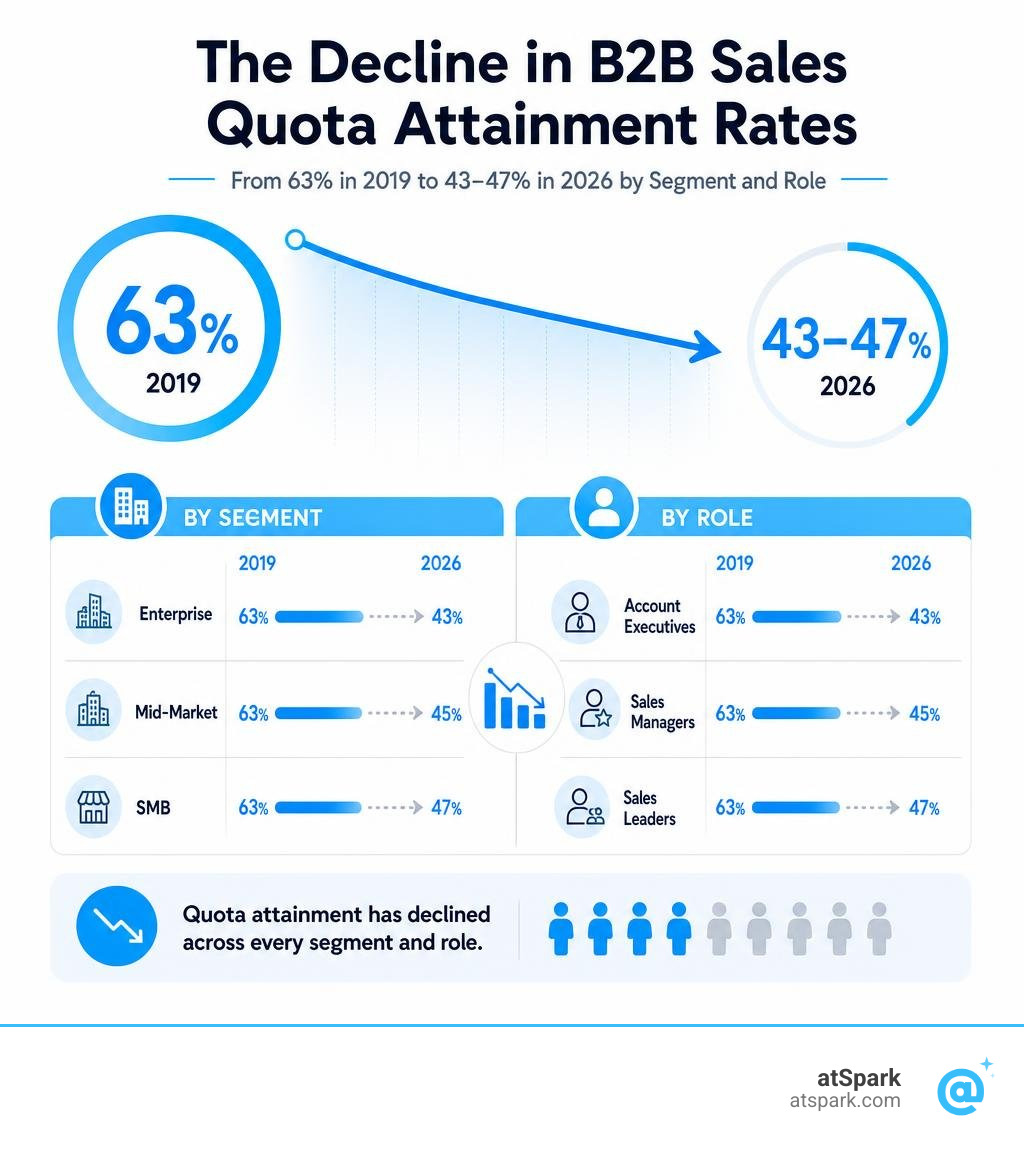
The situation across B2B sales is stark. In 2019, roughly 63% of reps hit quota. By 2026, that number has dropped to somewhere between 43% and 47%, depending on the segment. In SaaS specifically, RepVue's Cloud Sales Index puts the figure near 43% — and only 28% of sales professionals across all industries expected to hit their annual number as recently as 2023, according to Salesforce.
That's not a motivation problem. It's a systems problem.
The quotas many reps are carrying today were often set during a growth era that no longer exists. Buying committees have grown. Sales cycles have lengthened. And reps are spending less than 30% of their week on actual selling — the rest goes to admin, CRM entry, and internal meetings.
For a Finance or RevOps leader trying to forecast revenue accurately, this creates a painful dynamic: you can't trust the pipeline number, the attainment data is blended in ways that hide real issues, and by the time a problem surfaces in a QBR, it's already too late to fix it that quarter.
This guide breaks down exactly what drives rep-level attainment — and what you can actually do about it.
Understanding Sales Quota Attainment and Why It Matters
At its core, a sales quota is the target set for an individual seller or team to achieve within a specific timeframe (usually a month, quarter, or year). It is often tied directly to closed-won revenue, but can also be based on activities, net profit, or contract volume.
Why does tracking this matter so deeply? For individual reps, hitting quota is the difference between thriving (triggering lucrative commission accelerators) and entering a performance improvement plan (PIP). For the broader organization, team-wide quota performance directly impacts:
- Revenue Predictability: If only a tiny fraction of your team hits their numbers, your financial forecasting becomes a guessing game.
- Sales Team Morale: Constant misses breed a culture of defeat. When quotas feel mathematically impossible, your best A-players start looking for the exit.
- Resource Allocation: High-performing teams justify further investments in enablement, marketing, and tooling. Low-performing teams trigger cost-cutting.
To dive deeper into the core definitions of performance tracking, explore our comprehensive Quota Attainment Glossary.
How to Calculate Quota Attainment: Formula and Worked Examples
Calculating quota attainment seems simple on the surface, but minor tracking errors can completely distort your revenue data. The core formula is:
$$\text{Quota Attainment (\%)} = \left( \frac{\text{Actual Sales}}{\text{Assigned Quota}} \right) \times 100$$
To ensure your calculations are clean, follow these best practices:
- Count only recognized, closed-won revenue: Do not count soft verbal agreements or deals stuck in the legal review phase.
- Align timeframes: Ensure both the numerator (actual sales) and denominator (assigned quota) cover the exact same date ranges.
- Establish clear attribution rules: If two reps co-sell a deal, have transparent split-crediting rules to prevent double-counting.
Worked Examples
Let's look at how this plays out across different roles:
- Account Executive (AE): Sarah has a quarterly new ARR quota of $200,000. She closes $160,000 in new ARR. Her attainment is:
($160,000 / $200,000) x 100 = 80% - Sales Development Representative (SDR): Marcus has a monthly quota of 15 qualified meetings. He books 12 that successfully occur. His attainment is:
(12 / 15) x 100 = 80% - Customer Success Manager (CSM): Elena manages a renewal book of $1,000,000 this quarter and retains $900,000. Her gross retention attainment is:
($900,000 / $1,000,000) x 100 = 90%
Individual vs. Team Attainment Calculations
One of the biggest mistakes sales leaders make is relying solely on team-wide averages. A single superstar doubling their quota can mask a failing team.
| Metric | Calculation Method | Example Scenario | Pitfall |
|---|---|---|---|
| Individual Attainment | (Rep's Closed Revenue / Rep's Quota) x 100 | Rep A closes $120k on a $100k quota = 120% | Can create siloed behaviors if not balanced with team goals. |
| Blended Team Average | (Total Team Revenue / Total Combined Quota) x 100 | Team closes $300k on a $400k quota = 75% | Hides uneven performance distribution across reps. |
| Percentage of Reps Hitting Quota | (Count of Reps >= 100% / Total Reps) x 100 | 2 out of 8 reps hit 100% of quota = 25% | Does not show how close the missing reps were to their targets. |
For a broader perspective on how these metrics are defined and tracked, check out the Sales Quota Attainment: Formula & Benchmarks guide.
2026 Benchmarks: What Does "Good" Look Like?
In the current sales landscape of July 2026, the definition of "good" has shifted. The days of expecting 80% of your team to hit 100% of their quota are gone. Today, a widely accepted planning benchmark for a healthy sales organization is that 60% to 70% of fully ramped reps should be able to clear their quota in a balanced plan.
If fewer than 40% of your reps are hitting their numbers, you are no longer dealing with an execution problem—you have a structural quota-setting problem. Conversely, if 95% of your reps are exceeding their quotas, your targets are likely set too low, leaving significant revenue on the table.
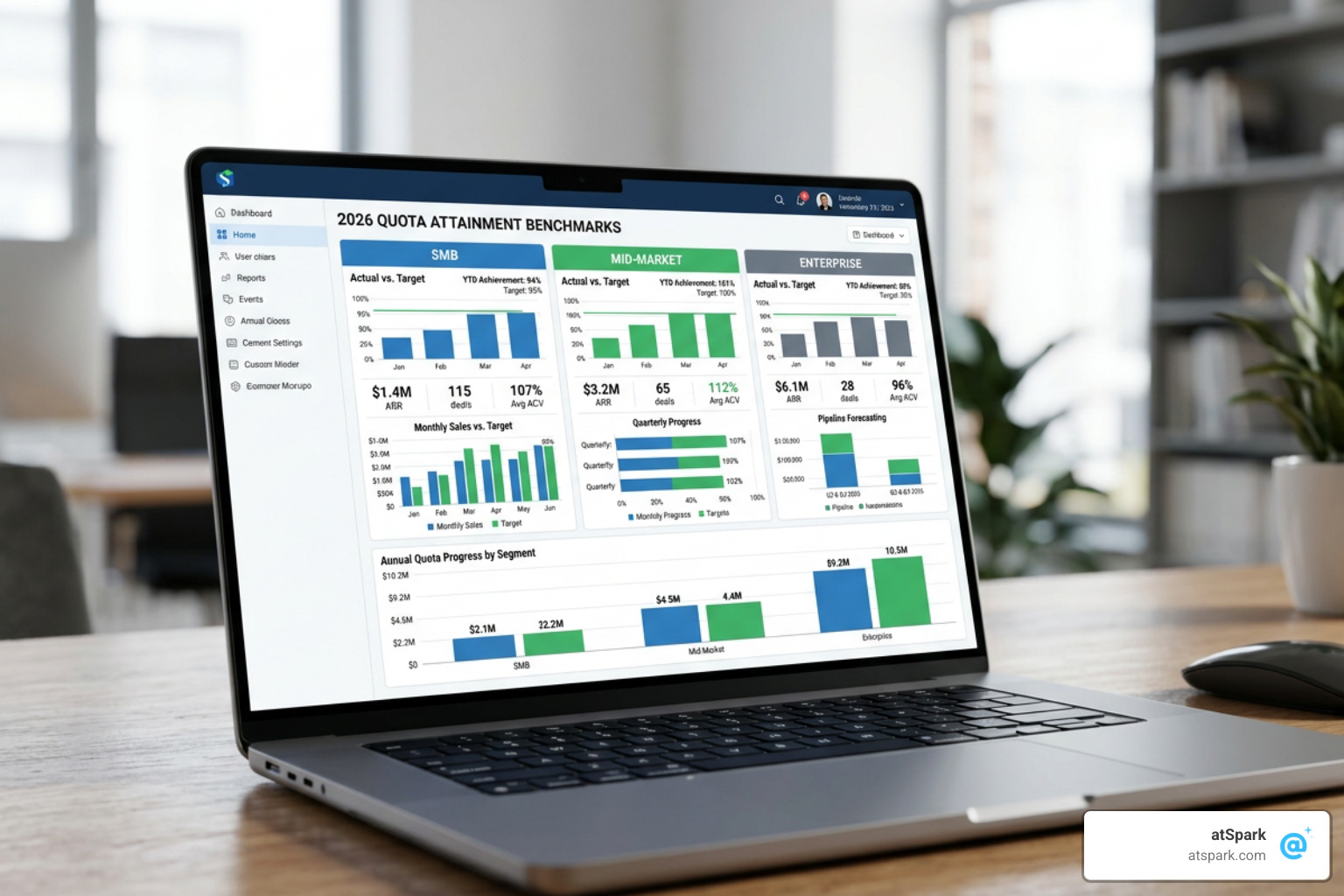
For a detailed breakdown of these metrics across various platforms, refer to the Sales Quota Attainment Rate: 2026 Benchmarks and How — Gangly Blog .
Benchmarks by Role, Segment, and Deal Size
Performance levels vary dramatically based on what you are selling, who you are selling to, and how long your sales cycle is:
- SDRs vs. AEs: SDRs typically see higher average attainment rates (58% to 68%) because their targets are activity-based and more directly controllable. AEs face longer, multi-stakeholder cycles, resulting in lower average attainment rates (43% to 55%).
- Company Stage: Early-stage SaaS companies (Seed to Series A) usually target a 60% to 70% attainment rate as they figure out product-market fit. Mature enterprise organizations aim for a tighter 70% to 80% band.
- Deal Size & ACV: Interestingly, reps selling larger deals (Annual Contract Value above $200K) see slightly higher average attainment rates (around 48%) than those in transactional SMB spaces (under $10K ACV), which hover around 41%. Larger deals receive more executive support, better pre-sales engineering, and more structured mutual action plans.
Why Reps Miss Quota: Diagnosing the Root Causes
When a rep misses quota, the default reaction from traditional management is often to demand more activity: make more calls, send more emails, run more demos. But in 2026, raw activity is rarely the bottleneck.
Let's look at the real structural culprits behind low attainment:
- Unadjusted Growth-Era Quotas: Many companies are still trying to hit aggressive revenue targets using headcount and quota models built during the zero-interest-rate policy (ZIRP) boom.
- The Exploding Buying Committee: The average B2B buying committee has grown from 6 stakeholders in 2019 to between 10 and 13 stakeholders today. Deals stall not because the champion doesn't want the software, but because they can't get legal, security, and finance to agree.
- Admin Overload: Sales reps spend an average of 60% of their week on non-selling administrative tasks—updating CRM fields, writing post-call summaries, and navigating disjointed tech stacks. This leaves them with only about two hours of active selling time per day.
- Territory Imbalance: When territories are designed by geographic convenience rather than actual revenue capacity, some reps get highly fertile patches while others are left with barren soil.

Setting Ambitious Yet Achievable Quotas: Top-Down vs. Bottom-Up
To fix these structural issues, we have to rethink how quotas are built.
Most organizations use a top-down approach: the board sets a revenue target, and leadership divides that target among the sales team. While this ensures alignment with investor expectations, it often completely ignores the reality on the ground.
A bottom-up approach builds quotas from the ground up using historical conversion rates, active pipeline, representative capacity, and realistic sales cycle lengths.

The best organizations use a hybrid approach:
- Start with the top-down target.
- Validate it against bottom-up capacity math (e.g., historical win rates, average deal sizes, and ramp times).
- Apply a reasonable "stretch factor" by setting quotas at 80% to 90% of your maximum calculated capacity. This keeps goals ambitious without making them feel mathematically impossible.
To learn more about validating these capacity models, see the analysis on Quota Attainment: What the Numbers Show .
Actionable Levers for Quota Attainment Improvement by Rep
Improving quota attainment improvement by rep requires pulling systemic levers rather than simply telling your team to "try harder." Here are the most effective ways to drive consistent, rep-level performance:
- Fix Pipeline Generation First: You cannot close what you do not have. Ensure your reps maintain a healthy pipeline coverage ratio (historically 3x, but increasingly 4x to 5x for enterprise segments with lower win rates).
- Implement Rigorous Deal Qualification: Train reps on frameworks like MEDDIC or BANT. If a deal doesn't have a clear economic buyer, a defined pain point, and a structured decision process, it shouldn't be clogging up your active pipeline.
- Rethink the Commission Structure: Design compensation plans with tiered accelerators that kick in at 80% and 100% of quota to keep reps motivated. Avoid capped commissions, which encourage reps to sandbag deals once they hit their targets.
For more strategic guidance on balancing these levers, read the insights in Quota Attainment: Benchmarks & How to Hit Target Consistently .
The Role of Sales Coaching in Quota Attainment Improvement by Rep
Coaching is your highest-leverage activity. According to data from Manchester Inc., structured coaching can increase sales productivity by up to 53%. Yet, there is a massive perception gap: 80% of sales managers claim they coach their reps, but only 48% of reps report actually receiving coaching.
Most managers confuse deal inspection ("Where is this deal at? When will it close?") with coaching ("How can we multi-thread this account to get legal buy-in? Let's roleplay the next call").
To build an effective coaching cadence:
- Focus on leading indicators: Coach reps on pre-call preparation, discovery techniques, and competitive positioning rather than post-mortem deal reviews.
- Keep it consistent: Dedicate at least 50% of your weekly 1-on-1 time to skills development and active deal strategy.
- Use peer learning: Have top performers share their winning playbooks, email templates, and objection-handling techniques with the rest of the team.
How Real-Time Commission Visibility Drives Consistent Performance
One of the most overlooked psychological levers in sales is real-time compensation visibility.
When reps have to wait until the end of the month or quarter to see how their closed deals translate into commission checks, they lose connection to the direct value of their work.
On the other hand, giving reps access to a live dashboard that shows exactly how much they will earn by closing a specific deal—and how close they are to hitting their next accelerator tier—changes their day-to-day behavior. It transforms quota from an abstract management target into a tangible, personal financial goal.
Diagnostic Metrics to Track Alongside Attainment
To diagnose why reps are missing quota before the quarter ends, you must track a balanced scorecard of leading and lagging indicators. Relying solely on quota attainment is like trying to drive a car by only looking in the rearview mirror.
To explore how these engineering principles can be applied to your broader go-to-market engine, check out Octave \| Your Agentic GTM Brain .
Tracking Key Metrics to Diagnose Quota Attainment Improvement by Rep
- Win Rate: The percentage of opportunities in your pipeline that convert to closed-won deals. A low win rate usually points to poor qualification or skill gaps in late-stage negotiations. Learn more in our Win Rate Glossary.
- Sales Velocity: The speed at which deals move through your pipeline and generate revenue. If your velocity stalls, your sales cycle is likely too long or your deals are getting stuck in specific stages. Learn more in our Sales Velocity Glossary.
- Sales Efficiency: How effectively your sales team converts resources (like marketing spend and sales tools) into revenue. High efficiency means you are scaling cleanly without burning capital. Learn more in our Sales Efficiency Glossary.
- Sales Activity: The foundational volume of calls, emails, and meetings your team is executing. While activity alone doesn't guarantee success, a sudden drop in activity is a reliable leading indicator of a shrinking pipeline. Learn more in our Sales Activity Glossary.
Frequently Asked Questions about Quota Attainment
What is a realistic percentage of reps that should hit quota in a healthy sales organization?
In a well-designed sales plan, 60% to 70% of fully ramped reps should hit or exceed their individual quotas. If more than 80% of your team is hitting quota, your targets may be too conservative. If fewer than 50% are hitting their numbers, your quota-setting process is likely misaligned with market realities.
How long should it take a newly hired sales rep to reach full quota productivity?
The average ramp time across B2B SaaS is 4.7 months, though this varies significantly by role and deal complexity:
- SDRs: 2 to 3 months.
- Mid-Market AEs: 4 to 6 months.
- Enterprise AEs: 6 to 9+ months (often matching your average sales cycle length).
To manage this transition smoothly, implement a progressive ramp schedule (e.g., 25% quota in month one, 50% in month two, 75% in month three, and 100% from month four onward).
Should sales quotas be adjusted mid-year due to changing market conditions?
Generally, you should avoid adjusting quotas mid-year because it can erode trust with your sales team. However, in extreme circumstances—such as major macroeconomic shifts, sudden regulatory changes, or massive product disruptions—adjustments may be necessary. If you must adjust quotas, do so transparently, apply the methodology uniformly across the team, and ensure the changes are clearly communicated.
Conclusion
Improving quota attainment improvement by rep isn't about micromanagement or demanding more cold outreach. It is about building a supportive sales system: setting realistic, data-backed quotas, removing administrative friction, providing structured coaching, and offering real-time visibility into performance and commissions.
But to make these systemic adjustments, you need clean, accessible data.
At atSpark, we help SaaS companies unify their billing, CRM, and subscription data into a single, reliable source of truth. Instead of spending hours writing complex SQL queries or building fragile spreadsheets, our AI-powered analytics platform lets you ask plain-English questions—like "Which of our enterprise AEs have the highest win rates this quarter?" or "What is our average sales velocity by industry segment?"—and get instant, beautiful charts and tables.
By bringing your data together, we give you the real-time insights you need to coach your reps, balance your territories, and hit your revenue targets with confidence.
Ready to see how conversational, governed analytics can transform your sales planning? Learn more about Quota Attainment Glossary and discover how atSpark can help your team win.